Mind Matters
Is It Safe to Talk to an AI About Your Mental Health?
For sorting out your own thoughts, usually yes. As a replacement for treatment, or in a crisis, no. In June 2026 the American Psychological Association surveyed more than 1,200 licensed psychologists in the US. More than three quarters said their patients were discussing AI in therapy. Among those whose patients had ongoing conversations with a chatbot, 68% said the patient felt supported or validated and 41% said chatbots were reinforcing healthy coping. The same survey found the other side: 36% reported patients developing a level of dependency on a chatbot, and 15% reported patients developing distorted thinking or delusions. The APA's own chief executive described these tools as supportive to a fault, and as lacking the alertness to warning signs that a human professional has. That phrase is the useful one. The risk is not usually that an AI says something monstrous. It is that it agrees with you.
We build an app with an AI companion in it, so you should weigh what follows accordingly. The survey numbers below are linked, and several of them are not flattering to the category we are in.
The short answer: fine for thinking out loud, not a substitute for treatment, and not for a crisis.
What psychologists are actually seeing
In June 2026 the American Psychological Association asked more than 1,200 licensed psychologists in the US what their patients were doing with AI.
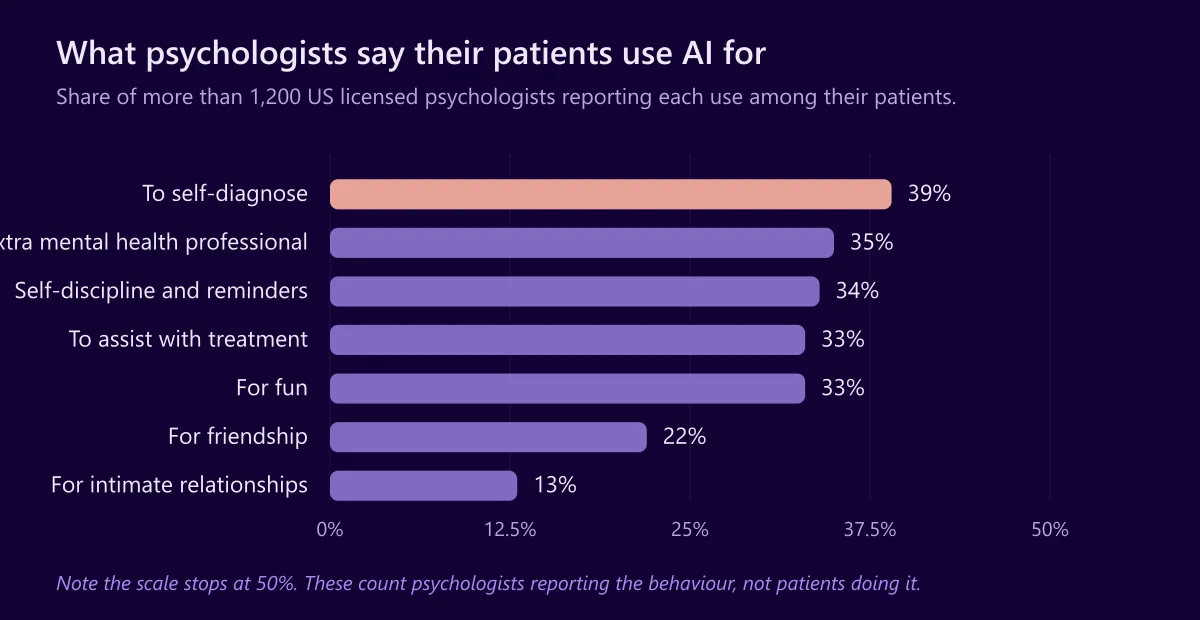
More than three quarters said patients were discussing AI in therapy at all. What they were using it for varied widely:
The same survey found clear benefits. Among psychologists whose patients had ongoing conversations with a chatbot, 68% said the patient felt supported or validated, and 41% said chatbots were reinforcing healthy coping skills.
And it found the other side. 36% reported patients developing a level of dependency on a chatbot. 15% reported patients developing distorted thinking or delusions.
Both halves are real. Anyone quoting only one of them is selling something.
The shape of the risk
The head of the association put it in a phrase worth keeping. These tools are supportive to a fault, there at any hour and easy to reach without insurance, but short on nuance and on the alertness to warning signs that a trained person has.
That describes the failure mode precisely. The danger is rarely that an AI says something outrageous. It is that it agrees with you.
A person who knows you would push back on the plan you have talked yourself into, notice what you are not saying, and remember what you said three months ago. A chatbot answers what you bring it, in the frame you bring it in. If what you bring is a belief that you are a burden, the reply tends to be kind to the person holding that belief rather than doubtful about the belief itself.
That is also how dependency forms. Something endlessly available and reliably warm is easy to return to, and each return makes the next one easier.
What it is reasonably good for
Low-stakes things, between the things that matter:
- Putting a vague feeling into words. Often the hardest step, and one a chatbot genuinely helps with.
- Rehearsing a hard conversation, including the one with a doctor. Our guide on talking to a doctor covers what is worth preparing.
- Three in the morning, when there is no one to text and you are not in danger, just awake. Our guide on waking at 3am covers the rest of that.
- Sorting a tangle into a list. Chatbots are good at structure.
Worth noting that apps including chatbot features did show larger effects for depression in the largest review of app trials — which our guide on whether mental health apps work sets out, along with how small those effects are overall.
What it is not for
Not a crisis. If you are in danger or thinking of harming yourself, use your local emergency number or a crisis line. The specific thing these tools lack is alertness to warning signs, and a crisis is when that gap matters most.
Not a diagnosis. 39% of these psychologists had seen patients use AI to diagnose themselves. A chatbot will give a plausible answer to “do I have X”, and plausible is not the same as right. The free anxiety and depression self-checks here at least use tested questionnaires, and even those only screen. They do not diagnose.
Not a stand-in for treatment. The association’s position is that ordinary chatbots are not recommended for treating a mental health condition. That is about what has been tested, not about whether the chat feels helpful.
Not a private diary. What you type is data held by whoever runs the service. Policies differ on storage, training and deletion. Our guide on free mental health apps covers why the star rating tells you nothing about this and the policy tells you most of it.
How to use one without the failure modes
- Notice if it only ever agrees. If you have never once felt challenged, that is information about the tool, not about you being right.
- Set an end to the conversation. “Until I have the list” is a finish. “Until I feel better” is not.
- Take conclusions to a person. Anything that ends in a decision about medication, a diagnosis or a relationship deserves a human.
- Watch for it replacing people. In the survey, 22% of psychologists reported patients using chatbots for friendship and 13% for intimate relationships. Those are not automatically harmful, and they are worth noticing honestly.
- Do not use it to seek reassurance repeatedly. Reassurance works for seconds and then needs renewing, which is the loop our guide on googling your symptoms describes.
Where Moodify stands
The companion in our app is an AI. Everything above applies to it.
It is not a therapist and we do not call it one. It cannot diagnose anything, it has no way of knowing what you have not told it, and it is not an emergency service. The app shows crisis resources rather than trying to handle a crisis in conversation. That is a deliberate limit, not a missing feature.
What it is for is the ordinary end of the list above: a place to put something into words at an hour when that is otherwise impossible, alongside a log that gives you a record rather than an impression. You can see what else is in it on our about page.
If you would rather not talk to an AI at all, that is an entirely reasonable position and most of this site works without one — the guides, the self-checks and a notebook will do.
The part worth writing down
Whatever you talk to, the conversation is not a record. It is a transcript of one evening, and nobody rereads those.
A number and a date, written near the time, is the thing you can actually look back at — and it is the thing memory will not give you, for reasons our guide on why you cannot remember how you felt explains.
Logging it takes a few seconds in Moodify, and the same few seconds in a notes app. The record is the part that compounds. The conversation, however good, mostly does not.
Common questions
- Is it safe to talk to an AI chatbot about mental health?
- For thinking out loud, naming what you feel, or getting ready for a talk with your doctor, it is reasonable. As a stand-in for treatment, or in an emergency, it is not. A 2026 survey of more than 1,200 US psychologists found patients both helped and harmed by chatbots, and their professional body does not recommend ordinary chatbots for treating a condition.
- What are the actual risks of using AI for mental health support?
- Three show up in the survey. Growing dependent on it, reported by 36% of psychologists about their patients. Distorted thinking or delusions, reported by 15%. And self-diagnosis, which 39% had seen. Under all three sits the same thing: a chatbot tends to agree with you, so it can harden a conclusion a person would have questioned.
- Can an AI chatbot replace a therapist?
- No, and the professional body says plainly that ordinary chatbots are not recommended for treating a condition. The gap is not knowledge but judgement: noticing what you avoid, remembering what you said three months ago, being alert to warning signs you have not raised. A chatbot answers what you bring it.
- Should I use an AI chatbot in a crisis?
- No. If you are in danger or thinking of harming yourself, call your local emergency number or a crisis line. The worry raised about these tools is exactly that they lack the alertness to warning signs a trained person has, and a crisis is when that gap matters most.
- Is what I tell an AI chatbot private?
- Treat it as recorded rather than private. What you type is data held by whoever runs the service, and the rules vary on whether it is stored, used for training, or shared. Before telling a chatbot something you would not want kept, check that service's policy on storage and training, and whether you can delete your history.
- What is AI actually good for in mental health?
- Small things, between the things that matter. Putting a vague feeling into words, rehearsing a hard conversation, writing down what you want to tell a doctor, or having something to talk to at three in the morning. In the survey, two thirds of psychologists said their patients felt supported, and two in five said chatbots backed up healthy coping. That is a real benefit at a modest size.
Sources
- American Psychological Association — Chatbots and Mental Health Survey (June 2026). More than 1,200 US licensed psychologists; over three quarters report patients discussing AI in therapy; 39% saw patients self-diagnosing with AI; among psychologists whose patients had ongoing chatbot conversations, 68% reported patients feeling supported or validated and 41% reinforcing healthy coping; 36% reported dependency and 15% distorted thinking or delusions
- Linardon et al. — Current evidence on the efficacy of mental health smartphone apps for symptoms of depression and anxiety: a meta-analysis of 176 randomized controlled trials (World Psychiatry, 2024;23(1):139-149). Apps incorporating chatbot technology showed larger effects for depression
- US National Institute of Mental Health — health topics
General information, not medical advice. See our editorial policy for how these guides are written and corrected.