Mind Matters
Why You Can't Remember How You Actually Felt

When people rate an experience afterwards, the rating is built almost entirely from two moments: the most intense point, and how it finished. In the original laboratory work, those two together accounted for about 94% of the variation in how people scored past episodes, while how long the episode lasted accounted for around 3%. That has a name — duration neglect — and it means a fortnight of quiet steadiness and a fortnight containing one terrible Tuesday can be remembered almost identically. The effect is best established for short, self-contained episodes; over months it is weaker and researchers argue about how much it explains, and the wording of the question changes the answer. But the direction is consistent enough to be worth planning around, because almost every decision about your own mental health rests on comparing now to a remembered then.
Almost every judgement you make about your own mental health is a comparison. Is this worse than last month. Did that help. Am I getting better.
Each one depends on remembering how you felt then. Which turns out to be the weak link.
What a memory of an experience is made of
In the original research, people went through episodes of varying length and unpleasantness, then rated the whole thing afterwards. The researchers checked which parts of the actual experience predicted the final rating.
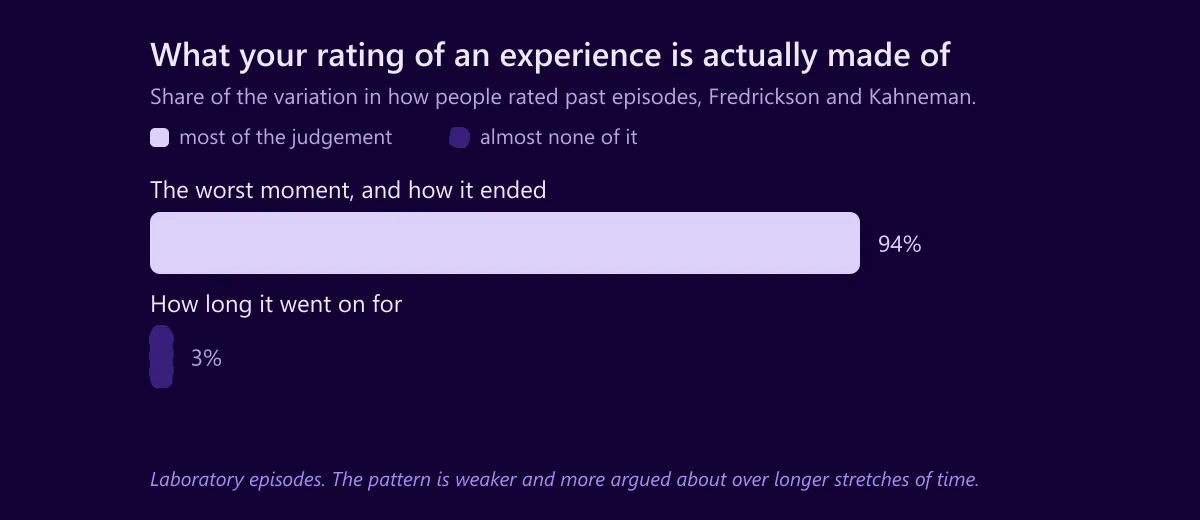
Two moments did nearly all the work: the most intense point, and how it ended. Together they accounted for about 94% of the variation in people’s overall ratings.
How long it went on for accounted for about 3%.
That second finding has a name — duration neglect — and it is the stranger of the two. A longer bad experience is not reliably remembered as worse than a short one. The clock barely registers.
What that does to a month
Follow it through and the implications are uncomfortable.
A quiet, unremarkable fortnight and a fortnight containing one awful Tuesday can be summarised almost identically. The Tuesday is a peak, and peaks carry the weight. Thirteen ordinary days contribute very little.
And whichever way the last few days went colours the whole stretch, because endings count twice over.
So “this month was bad” is not a lie, and it is not quite a measurement either. It is a summary built from two or three moments you happen to be able to reach.
Where the research is solid, and where it is not
Worth being precise, because this gets stated far more confidently than it should be.
Solid: the pattern is well established for short, self-contained episodes that people can still recall in detail. That is where it was found and where it replicates.
Less solid: over longer stretches it gets murkier. A recent study followed nearly 1,900 people and did find peaks and endings leaning on their later judgements. But the size of the effect depended on how the question was framed, and on how “peak” and “end” were defined. Other work suggests the pattern explains short gaps better than long ones: detail fades with time, and general impression fills the space.
Also true: not all of the gap between living something and remembering it is peak-end weighting. Some of it is ordinary forgetting, and some is just measurement noise.
So: a real and repeatedly observed effect, with edges that are still being argued about. Enough to plan around, not enough to treat as a law.
What this does not mean
It does not mean your feelings were not real, or that you are unreliable as a person. The research is about how episodes get summarised, not about whether they happened.
You are not misremembering that last winter was hard. What is unreliable is the comparison: whether it was harder than the winter before. That is the thing you would actually need in order to act.
What to do about it
The fix is not to try harder at remembering. It is to stop asking memory to do a job it is not built for.
- Record near the time, not at the end. A number out of ten on the day is a measurement. The same number recalled a fortnight later is a summary.
- Write down the ordinary days too. They are the ones that vanish, and they are most of your life.
- Decide what you are testing before you test it. “I’ll see if the lamp helps” invites a verdict assembled afterwards from the two most memorable days.
- Distrust the last few days especially. Endings are overweighted, so a rough weekend can repaint a decent month.
- Compare records, not impressions. The question is not whether November felt worse than October, but what the two columns of numbers say.
Where this bites hardest
Three places on this site run straight into it, which is why the point is worth making properly.
Seasonal patterns. The clinical criterion is a pattern over at least two years — and nobody can compare two winters from memory. Our guide on seasonal depression goes into what that threshold actually requires.
Whether a break helped. The most useful test for burnout is whether real time away shifts anything. That test is worthless if you judge it afterwards from how the first day back felt — a textbook ending effect.
Whether anything you tried worked. Light boxes, cutting caffeine, a new routine. Most have modest effects at best, which means they are precisely the size that gets lost in a remembered impression.
The practical version
You need a record because the alternative is not neutral. The alternative is a summary built from your worst moment and your most recent one, which is a systematically harsher account than the one you actually lived.
It does not take much. A number and the date. Our guide on using a mood tracker covers what to do with a few weeks of those once you have them.
Logging it in a few seconds, as you can in Moodify, is one way. Paper is another. The method matters far less than the timing — written near the moment, before it becomes a memory of a memory.
Common questions
- Why can't I remember how I felt last month?
- Partly because memory does not store a running average. When people rate a past experience, the score is dominated by the most intense moment and by how it ended, while the length of it contributes very little. So a month gets compressed into a handful of vivid points, and the ordinary days that made up most of it leave almost no trace.
- What is the peak-end rule?
- The finding that retrospective judgements of an experience are predicted mostly by its most intense moment and its final moments. In the original work those two together explained about 94% of the variation in people's overall ratings. It is well established for short episodes and more contested over longer stretches of time.
- What is duration neglect?
- The companion finding: how long something lasted barely affects how badly it is remembered. In the same research, duration added only around 3% of explanatory power. This is why a short, sharp bad patch can be remembered as worse than a long, grinding one.
- Does this mean my memory of being depressed is wrong?
- No, and that is worth being clear about. The research is about how episodes get summarised, not about whether the feelings were real. You are not misremembering that it was hard. What is unreliable is the comparison — whether this month is better or worse than the last one, which is exactly the judgement most decisions rest on.
- How long before you should stop trusting your memory of your mood?
- Sooner than feels reasonable. The peak-end pattern is strongest for episodes you can still recall in detail, and research on longer intervals suggests specific details become less accessible as time passes, with general impressions filling the gap. By a few weeks out you are mostly working from impression rather than recall.
- Why do bad days feel more representative than they were?
- Because they qualify as peaks, and peaks carry most of the weight. A fortnight with one awful day and thirteen ordinary ones can be remembered as a bad fortnight, since the awful day is doing most of the work in the summary. Nothing about that is a failure of character or attention; it is how summarising works.
Sources
- Fredrickson & Kahneman — Duration neglect in retrospective evaluations of affective episodes (Journal of Personality and Social Psychology, 1993)
- Scharbert et al. — Peaks, ends and retrospective well-being judgements across four experience-sampling samples (European Journal of Personality, 2025)
- Momentary versus retrospective reports of affect — accessibility and retrieval interval
- US National Institute of Mental Health — health topics
General information, not medical advice. See our editorial policy for how these guides are written and corrected.