Daily Rituals
What to Do When You Wake Up at 3am and Cannot Get Back to Sleep

Waking in the middle of the night is normal. More than a third of adults do it at least three nights a week, and brief wakes are built into the way sleep works — you surface a little between sleep cycles all night without remembering it. The second half of the night is lighter and more full of dreaming, so that is when a wake is most likely to be one you notice. What turns an ordinary wake into a bad hour is usually what happens next: lying there willing yourself back to sleep, checking the clock, and working out how little sleep is left. If you are still awake after about twenty minutes, the most useful thing is to get up, go somewhere dim, do something undemanding, and go back when you feel sleepy. It feels counterproductive and it is the approach sleep clinics actually use.
You are awake. The room is dark, the house is silent, and your brain has decided this is a good moment to review everything. The worst part is knowing the alarm is coming.
Here is the first thing worth knowing: this is ordinary. It does not mean your sleep is broken.
Is it normal to wake up in the night?
More than a third of adults wake at least three nights a week. In large surveys across the US and Europe, that is the consistent finding — night waking is one of the most common experiences there is.
And that only counts the wakes people notice. You surface briefly between sleep cycles all night long, several times, and almost never remember it. Those moments are part of how sleep is built, not a fault in it.
The reassuring part: when night waking happens on its own, without other sleep problems, it usually has no effect on the next day. The waking is not the problem. What happens next sometimes is.
Why does it always seem to be 3am?
The clock is a coincidence. What matters is which part of the night you are in.
A night of sleep runs in cycles of roughly an hour and a half, four to six times over. Those cycles are not all the same. Deep sleep is loaded into the early hours. Dreaming sleep gets longer as the night goes on.
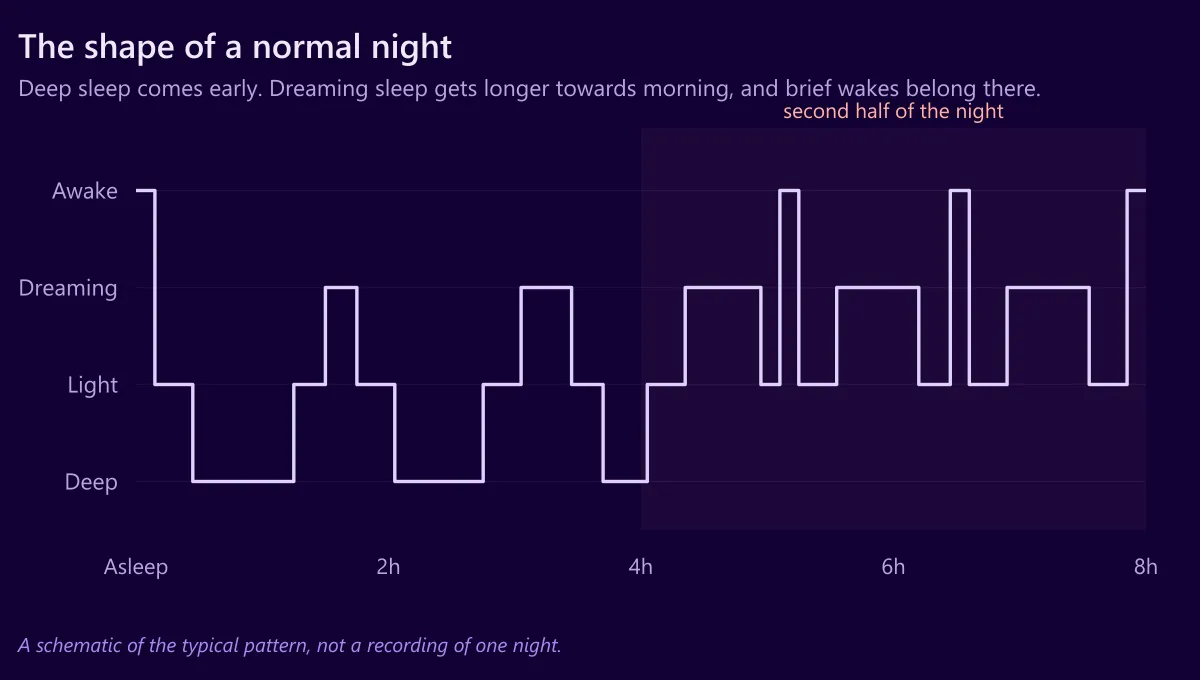
So by the small hours you are in the lightest, dream-heaviest part of the night. A wake there is far more likely to be one you actually notice — and far more likely to come with a vivid dream still hanging around.
If you go to bed at about the same time each night, that light stretch lands at about the same time each night too. Which is why it feels like your body has picked an hour.
Why does everything feel so much worse at 3am?
Three things stack up.
Nothing else is competing. In daylight a worry has to share your attention with work, people, traffic, messages. At 3am it has the entire room.
You are tired. Putting a thought down takes effort, and that is exactly the effort you have least of in the middle of the night.
Nothing can be done. You cannot send the email, have the conversation or check the thing at 3am. So the worry has nowhere to go and just loops.
This is why problems that feel enormous at 3am are often quite manageable at 8am. It is not that you were wrong then and right now. It is that the hour was doing something to the thought.
What to do when you are lying there awake
The single most useful move is the one that feels most wrong.
If you have been awake a while, get up.
Not immediately — if you drift off in ten minutes, lovely. But once you have been lying there long enough to feel frustrated, around twenty minutes or so, staying put stops helping. Get up, go to another room if you can, keep the lights low, and do something undemanding. Read something dull. Sit quietly. Then go back to bed when you feel sleepy, rather than when you think you should.
This is not folk advice. It is a standard part of the treatment sleep clinics use for insomnia. The reason it works is about association: the more hours you spend lying awake and annoyed in your bed, the more your body learns that bed is a place where that happens. Getting up protects the association.
A few other things that genuinely help:
- Do not look at the clock. Nothing good comes of it. Knowing it is 3:40 starts the arithmetic — how long until the alarm, how bad tomorrow will be — and that arithmetic is itself what keeps you awake. Turn the clock around.
- Stop trying to sleep. Trying is effort, and effort is the opposite of what you need. Aim for resting quietly instead, and let sleep happen on its own.
- Write it down. If the same worry keeps circling, put it on paper with a time tomorrow when you will deal with it. You are not solving it, you are giving yourself permission to stop holding it.
- Keep the light low. Bright light tells your body it is morning. If you do get up, keep it dim.
- Breathe out longer than you breathe in. A slow, long out-breath settles the body. It will not knock you out, but it stops the spiral building.
What makes it worse
| What you do | Why it backfires |
|---|---|
| Lie there determined to sleep | Trying harder is more effort, and effort keeps you alert |
| Check the clock | Turns a wake into a countdown you cannot win |
| Pick up your phone | Bright, absorbing, and full of things that start new thoughts |
| Do the sleep arithmetic | “Four hours left” is a prediction of a bad day, at the hour you can least argue with it |
| Lie in the next morning | Pushes the next night later, which makes the pattern more likely |
| Rely on sleep hygiene tips alone | Sensible, but guidelines specifically advise against them as a standalone fix |
That last one surprises people. Cool rooms and fewer screens are fine advice, but as a treatment on their own they are not enough, and sleep guidelines say so directly. The approach with the strongest evidence is a short course of talking therapy built for insomnia — which has the getting-out-of-bed rule in it.
When is it worth seeing someone?
Night waking by itself is usually nothing. It is worth talking to a doctor if:
- it happens most nights and has done for three months or more
- your days are affected — tired, irritable, struggling to concentrate
- you are dreading bedtime
- you wake gasping, or you have been told you stop breathing in your sleep
- the thing keeping you awake is worry you cannot get on top of in the daytime either
That last one matters. Night waking and anxiety feed each other in both directions, and sometimes the sleep is the symptom rather than the cause.
The treatment for long-term sleep problems is usually a few weeks of structured therapy, not medication, and it works well for most people. It is a much more fixable problem than it feels at 3am.
Working out whether it is a pattern
One bad night is a bad night. What is worth knowing is whether there is a shape to it — and that is genuinely hard to see from memory, because the nights you remember are the bad ones.
It only takes a note. Roughly when you woke, how long you were up, and what the next day was like. After two or three weeks you can usually see something: whether it follows late nights, or drinking, or particular days, or whether it clusters when something specific is going on.
Logging how you feel each day, the way you can in Moodify, makes the link between your nights and your days easier to see than trying to remember it. A notebook by the bed does the same job. The point is writing it near the time instead of reconstructing it later.
And if you do end up talking to a doctor, a few weeks of notes is far more useful than trying to describe it from memory in a ten-minute appointment.
Common questions
- Is it normal to wake up at 3am?
- Yes. More than a third of adults wake at least three nights a week, and everyone surfaces briefly between sleep cycles through the night without remembering it. Waking on its own, without other sleep problems, is usually not a sign of anything wrong. What matters more is whether you can get back to sleep and how you feel the next day.
- Why do I keep waking up at exactly 3am?
- The clock time is not really the point. The second half of the night is lighter and contains much more dreaming sleep, so a wake in those hours is far more likely to be one you notice and remember. If you go to bed at a similar time each night, that lighter stretch lands at a similar time too, which is why it can feel like the same hour every night.
- Should I get out of bed if I cannot sleep?
- Usually yes, if you have been awake a while — around twenty minutes is the common guide, judged by how it feels rather than by checking a clock. Go somewhere dim, do something undemanding, and go back to bed when you feel sleepy. This is a standard part of the therapy sleep clinics use for insomnia. The aim is to stop your bed becoming a place where you lie awake feeling frustrated.
- Why does everything feel worse in the middle of the night?
- Because nothing else is competing for your attention. In daylight a worry has to share space with work, people and noise. At 3am it has the whole room. You are also tired, which makes it harder to put a thought down, and there is nothing you can actually do about most worries at that hour, so they just circle.
- Does waking up at night mean I have insomnia?
- Not by itself. Insomnia is about the pattern and the effect: trouble sleeping most nights for three months or more, and feeling it during the day. Occasional night waking that you recover from is just sleep. If it happens most nights and your days are suffering, that is worth taking to a doctor.
- Does sleep hygiene advice actually help?
- Not much on its own. Advice about cool rooms and screens is sensible, but sleep guidelines specifically recommend against using it as a standalone treatment, because on its own it does not do enough. The treatment with the strongest evidence for long-term sleep problems is a short course of talking therapy designed for insomnia, which includes the getting-out-of-bed approach above.
Sources
- US National Heart, Lung, and Blood Institute (NIH) — Sleep phases and stages
- Ohayon — Difficulty in resuming sleep after nocturnal awakenings, US survey of 8,937 adults (Sleep Medicine)
- Nocturnal awakenings in the general population — five-country European survey of 22,740 adults
- Behavioral and psychological treatments for chronic insomnia disorder in adults — American Academy of Sleep Medicine clinical practice guideline (2021)
- US National Institute of Mental Health — health topics
General information, not medical advice. See our editorial policy for how these guides are written and corrected.