Mind Matters
Do Mental Health Apps Actually Work?
The honest answer is a small yes, with two large caveats. When 176 trials were brought together in 2024, mental health apps beat their comparison groups on both depression and anxiety, but the effects were small: around twelve people would need to use one for a single extra person to improve beyond what the comparison group managed. The first caveat is what they were compared against. In the handful of trials that tested apps against a real treatment, face-to-face or online, there was no measurable advantage either way. The second is that almost nobody keeps using them. Across 93 popular apps, the typical one still had about three in a hundred users active after thirty days. So the useful question is not whether apps work. It is which parts work, and whether you will still be opening it in a month. We make one of these apps, which is a reason to read this sceptically, and a reason we have put the numbers where you can check them.
We make one of these apps. You should read this with that in mind, which is why every number below is linked to the paper it came from.
The short version: a small real benefit, almost no evidence they match an actual treatment, and a retention problem the industry would rather not discuss.
What the evidence actually says
In 2024 researchers brought together 176 trials of mental health apps, covering tens of thousands of people — the largest look at the question so far.
Apps beat their comparison groups on both depression and generalised anxiety. The effects were small, in the specific sense that the researchers put a number on: roughly twelve people would need to use an app for one extra person to improve beyond what the comparison group managed on its own.
That is worth sitting with in both directions. It is not nothing — twelve is not a bad number for something free that you carry anyway. It is also not what the app stores imply.
The comparison that matters
Most of those 176 trials compared an app against a waiting list, or against nothing at all. That tells you an app beats doing nothing, which is a low bar.
Only a handful compared an app against a real treatment — face-to-face therapy, or an established online programme. Across those few comparisons, the difference was too small and too uncertain to call in either direction, for depression and for anxiety alike.
The honest reading is not “apps are as good as therapy”. It is “this has barely been tested”. Six to eight comparisons is not an evidence base. Anyone telling you an app replaces treatment has gone past what anybody has shown.
Which parts seem to do the work
This is the most useful finding in the review, because it is actionable.
| Feature | What the trials showed |
|---|---|
| Cognitive behavioural therapy techniques | Larger effects, for both depression and anxiety |
| A chatbot | Larger effects for depression |
| Mood monitoring | Larger effects for anxiety |
| Everything else | No clear signal either way |
One caution. These are patterns across trials, not proof that any one feature does the work. Apps with these features may simply be the better-built apps. Still, if you are choosing with nothing else to go on, it is the clearest signal there is.
Our own guide on whether mental health chatbots help goes further into the chatbot evidence specifically, including where it is weaker than this table suggests.
Where they help, and where they do not
The same review looked past depression and anxiety:
- Social anxiety — moderate effect
- Obsessive-compulsive symptoms — moderate effect
- Depression and generalised anxiety — small effect
- Post-traumatic stress — very small effect
- Panic symptoms — no benefit; the measured effect pointed slightly the wrong way
Everything after the first two rests on a few trials, most of them weak. Treat them as early signals. The panic result is based on two comparisons and should not be read as evidence that apps make panic worse. It is evidence that nobody has shown they help. Our guide on what to do during a panic attack covers what the clinical guidance says instead.
The number the industry does not advertise
Here is the finding that should change how you choose.
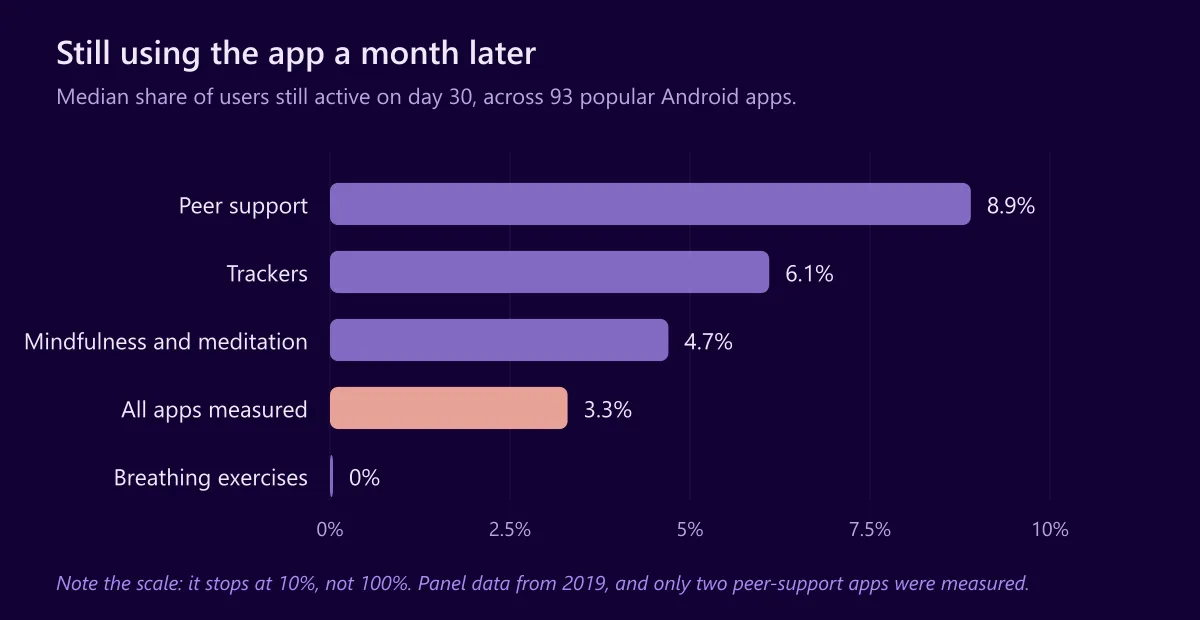
Researchers took 93 popular Android apps for anxiety, depression and wellbeing, and looked at independently collected usage data rather than figures supplied by the developers.
The typical app had about four in a hundred users still active after fifteen days, and three in a hundred after thirty.
Not three in ten. Three in a hundred.
Breathing-exercise apps were the worst, at effectively zero. Trackers and meditation apps did better than the average, and peer-support apps did best — though only two of those were measured, so that last point is thin.
Even inside clinical trials, where people have been recruited, paid attention to and often paid, about a quarter dropped out before the final assessment. Remove the smallest studies and it rises to nearly a third.
What that means when you are choosing one
Put the two findings together and the practical advice is almost the opposite of what app marketing suggests.
The effects are small, and they only exist for people who keep using the thing. So the question is not “which app has the most features”. It is “which one will I still be opening in a month”.
In practice that argues for:
- The smallest daily action that still produces a record. Something you can do in ten seconds survives a bad week; a guided twenty-minute session does not.
- Techniques with evidence behind them — the table above — rather than whatever is novel.
- Nothing that punishes you for stopping. Streaks and guilt mechanics are retention tools built for the company, and a bad week is exactly when you need the thing to be forgiving.
- Being honest about what you want it for. Tracking a pattern, having something to show a doctor, and treating a condition are three different jobs, and apps are strongest at the first two.
Where this leaves Moodify
Fairness requires saying this plainly.
Moodify is one of the apps in that category with small effects. It has not been tested in a trial, and nothing on this site should be read as a claim that it has. What it has is the features linked to larger effects — mood monitoring, a chat companion, CBT-based tools — and a daily action kept deliberately small, because the drop-off above is the problem we think matters most.
That is a design argument, not a result. We would rather say so than imply otherwise.
The free anxiety and depression self-checks on this site need no app, no account and no email address, and the guides are free to read. If an app is not the thing you need, those still are.
The one use nobody disputes
There is a job apps are plainly good at, and it is the dull one: keeping a record.
Not because recording is a treatment, but because the alternative is memory, and memory is unreliable about mood in a known direction — you recall the worst day and the most recent one, and those stand in for the month. Our guide on why you cannot remember how you felt explains the mechanism.
A record is also the single most useful thing to bring to a short appointment, as our guide on talking to your doctor goes into.
If you want to try that, Moodify takes a few seconds a day and is free. So does a note on your phone, and so does paper. The evidence above is about the category, not about us, and it would be strange to quote it and then pretend otherwise.
Common questions
- Do mental health apps actually work?
- They help a little. A 2024 review combining 176 trials found that apps improved symptoms of depression and generalised anxiety compared with control groups, but the effects were small. In practical terms, roughly twelve people would need to use one for one extra person to show improvement beyond the comparison group. That is a real effect and a modest one, and it is the most reliable figure available.
- Are mental health apps as good as therapy?
- There is no evidence that they are better, and very little evidence either way. Only a handful of trials have compared an app directly against a real treatment such as face-to-face therapy, and across those comparisons the difference was too small and too uncertain to call in either direction. With so few trials, the honest position is that this has barely been tested rather than that the two are equivalent.
- Which features of an app make a difference?
- In the 2024 review, apps built on cognitive behavioural therapy techniques produced larger effects, as did apps that included a chatbot, and for anxiety specifically, apps that included mood monitoring. These are associations found across trials rather than proof that any single feature causes the improvement, but they are the clearest signal there is about what to look for.
- Why do people stop using mental health apps?
- Most people simply do, and quickly. Across 93 popular apps, the typical one retained about four in a hundred users at fifteen days and three in a hundred at thirty days. Even inside clinical trials, where people are being paid attention to, around a quarter dropped out before the final assessment. Any app you choose has to survive that, which makes how little effort it asks of you a serious consideration rather than a minor one.
- What conditions do apps help with most?
- The 2024 review found moderate effects for social anxiety and for obsessive-compulsive symptoms, small effects for depression and generalised anxiety, a very small effect for post-traumatic stress, and no benefit at all for panic symptoms. The results outside depression and anxiety rest on small numbers of trials, so they should be treated as early signals rather than settled findings.
- Is a free mental health app worth using?
- Price is not what the evidence distinguishes. What the trials point at is the techniques an app uses and whether you keep using it, neither of which is a matter of what it costs. A free app you open daily is worth more than a paid one you abandon in a fortnight, and the reverse is also true.
Sources
- Linardon, Torous, Firth, Cuijpers, Messer & Fuller-Tyszkiewicz — Current evidence on the efficacy of mental health smartphone apps for symptoms of depression and anxiety: a meta-analysis of 176 randomized controlled trials (World Psychiatry, 2024;23(1):139-149). Depression g = 0.28, NNT 11.5; generalised anxiety g = 0.26, NNT 12.4; apps vs active interventions g = -0.08 (depression) and g = 0.11 (anxiety), both non-significant; weighted dropout 23.6%
- Baumel, Muench, Edan & Kane — Objective user engagement with mental health apps: systematic search and panel-based usage analysis (Journal of Medical Internet Research, 2019;21(9):e14567). 93 apps; median daily open rate 4.0%; median 15-day retention 3.9%, 30-day retention 3.3%
- US National Institute of Mental Health — health topics
General information, not medical advice. See our editorial policy for how these guides are written and corrected.