Mind Matters
Are Free Mental Health Apps Any Good?
Yes, often, and the people best placed to judge say so. A team rated 578 mental health apps against the American Psychiatric Association's evaluation framework and concluded that free apps offered similar privacy protections and similar levels of evidence to paid ones, so trying free apps first may be recommended. The same study found the marketplace is far less free than it appears: 88% were free to download, but only 39% were completely free, with 44% carrying in-app purchases and 34% requiring a subscription to unlock the whole app. It also found something more useful than any price comparison. Star ratings had no meaningful relationship with how well an app protected your data, so the most visible signal in the store tells you nothing about the thing hardest to check. Paying can buy you more features. There is no good evidence it buys you a better outcome.
Short answer: often yes, and the researchers who looked hardest at this say so in plain terms.
We make a free one, so read the next part with that in mind. Every figure is linked to the study it came from.
What the people who rate these apps concluded
A team took 578 mental health apps and rated each against 105 questions drawn from the American Psychiatric Association’s evaluation framework — privacy, clinical grounding, features, what the app does with your data.
Their conclusion about cost was direct: free apps offered similar privacy protections and similar levels of evidence as paid ones, so trying free apps first may be recommended.
That is not an argument that free apps are good. It is an argument that price is not the thing that separates them, which is more useful, because price is the first thing most people sort by.
The marketplace is much less free than it looks
The same study produced the number that explains most people’s frustration.
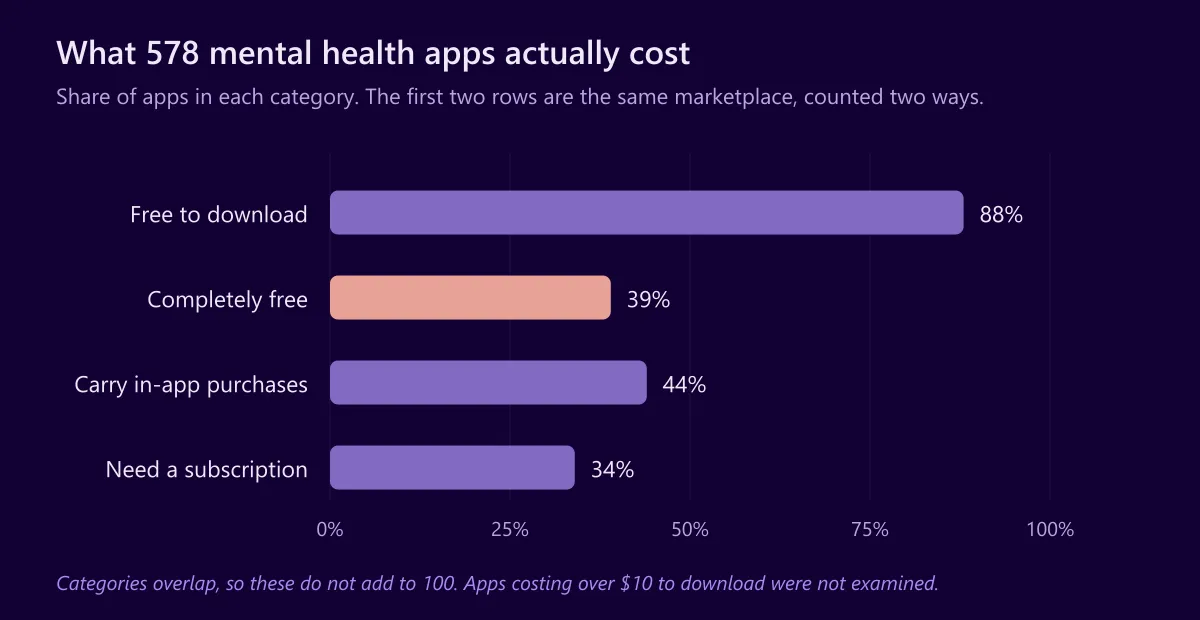
88% were free to download. Only 39% were completely free.
In between sit the 44% with in-app purchases and the 34% needing a subscription to unlock the whole thing. “Free” in an app store is mostly a pricing model, not a description.
This matters more than it sounds, because the usual experience — install something, use it for a week, hit a wall — is not bad luck. It is what six out of ten of these apps are designed to do.
What paying usually buys
More features. That is the honest summary.
What it does not reliably buy is a better outcome, because the things associated with better outcomes in the trial evidence are not premium features. Across 176 trials of mental health apps, the larger effects went with cognitive behavioural techniques, mood monitoring and chat companions — none of which is expensive to build, and all of which appear in free apps.
Our guide on whether mental health apps work at all goes through those results, including the part the industry skips: the effects are small, and against a real treatment nobody has shown an advantage either way.
One caveat the app-rating study states about itself: it did not assess the quality of the features or the science behind them, and it only looked at apps costing $10 or less to download. So “similar levels of evidence” means the paid ones are not better supported, not that either group is well supported.
The finding that should change how you browse
Here is the part worth remembering even if you forget everything else.
Across those 578 apps, star ratings had no meaningful relationship with how well an app protected your data. Downloads were only weakly related. The authors put it plainly: popularity metrics provided little help in identifying apps with better privacy.
So the two signals the store puts in front of you — rating and download count — are close to useless for the thing you would most want to know and can least easily check.
About a quarter of the apps had no privacy policy at all. And a separate study that installed 36 depression and smoking apps and watched what left the phone found that 33 of them sent data to someone else: nine had no privacy policy, five did not mention it, and three said it would not happen.
That is not a free-versus-paid problem. It cuts across both, which is exactly why cost is the wrong axis to shop on.
A fair test of a free tier
Not all paywalls are the same, and some freemium models are entirely reasonable. One question separates them:
Is the thing you intend to do every day free?
| Reasonable | A warning sign |
|---|---|
| Extra depth, long programmes or specialist content is paid | The daily log or entry is paid |
| The free tier works indefinitely, just with less in it | The free tier is a seven-day trial in disguise |
| The price and what it unlocks are stated before you install | You find out at the wall |
| Your data exports or deletes on the free tier | Export is a premium feature |
That last row deserves emphasis. Data you cannot take with you is a reason to leave early rather than late, and a record you cannot export is one you will lose the day you stop paying.
What to check, in two minutes, before you commit
- Read the privacy policy’s sharing section. Not all of it. The part naming who gets your data.
- Find the delete-everything option. If it takes more than a minute to find, assume it is not really there.
- Check whether an account is required, and whether the app says why.
- Log one entry and look for the wall. Better to meet it in minute two than in week three.
- Ignore the star rating for this purpose. It is measuring whether people liked the app, which is a different question from whether it is careful with your data.
Our guide on what to look for in a mood tracking app goes through the rest of the checks, including the ones about whether you will still be using it in a month.
Where Moodify sits
Moodify is free on Google Play, and every feature is currently free — the AI companion, the soundscapes, the journal and the trackers. The audio library and meditations are not behind a paywall and are not planned to be.
It is Android only, and it has not been tested in a trial. We would rather state both than let a page about honest pricing be quietly dishonest about itself.
The anxiety and depression self-checks on this site need no app, no account and no email address. If what you need today is a score to take to a doctor, that is two minutes and no download.
The part that is free whatever you choose
The evidence above is about apps. The thing that actually helps is more boring than any of it: writing down how you felt, near the time.
An app makes that quick. Paper makes it free. What neither can fix is doing it from memory a fortnight later, which is unreliable in a known direction — our guide on why you cannot remember how you felt explains the mechanism.
If a free app is the version of that you will actually keep up, Moodify takes a few seconds a day. If a notebook is, use the notebook. Nobody has shown the app does it better.
Common questions
- Are free mental health apps any good?
- Often, yes. In a study rating 578 mental health apps, the researchers concluded that free apps offered similar privacy protections and similar levels of evidence to paid ones, and that turning to free apps first may be recommended. Price is simply not the thing that separates a useful app from a useless one. What the techniques are, and whether you keep using it, matter far more.
- What is the catch with free mental health apps?
- Usually that they are not free. Of 578 apps examined, 88% were free to download but only 39% were completely free: 44% had in-app purchases and 34% needed a subscription to unlock everything. So the common catch is not hidden costs but a hidden paywall, where the free version is a demonstration rather than a usable tool.
- Do paid mental health apps work better?
- There is no good evidence that they do. No study has shown price predicting benefit. Paying often buys more features, which is not the same thing, since the features associated with better results in the trial evidence — cognitive behavioural techniques, mood monitoring, a chat companion — appear in free apps too.
- How can I tell if a mental health app is trustworthy?
- Not from the star rating, which is the main finding worth taking away from this research. Across 578 apps, star ratings had no meaningful relationship with how well an app protected your data. Reading the privacy policy yourself, checking whether you can delete your data, and seeing whether an account is required will tell you more in two minutes than any amount of browsing reviews.
- Is my data the price of a free app?
- Sometimes, and it is worth checking rather than assuming. About a quarter of the apps in that review had no privacy policy at all. A separate study that watched what actually left the phone found most apps transmitting data to third parties, with several either not disclosing it or stating it would not happen. That applies to paid apps as well as free ones, which is rather the point.
- What should a free app give you before you pay for anything?
- Whatever you intend to do every day. If the daily action — logging a mood, writing an entry, reading something — sits behind the paywall, the app is built around billing rather than around the habit. Extra depth being paid is reasonable. The thing you came for being paid is a different proposition.
Sources
- Camacho, Cohen & Torous — Assessment of mental health services available through smartphone apps (JAMA Network Open, 2022;5(12):e2248784). 578 apps rated on 105 dimensions; 507 (88%) free to download, 227 (39%) completely free, 254 (44%) with in-app purchases, 194 (34%) with subscriptions; 443 (77%) had a privacy policy; no significant correlation between privacy scores and store star ratings
- Huckvale, Torous & Larsen — Assessment of the data sharing and privacy practices of smartphone apps for depression and smoking cessation (JAMA Network Open, 2019;2(4):e192542). Data transmission detected in 33 of 36 apps
- Linardon et al. — Current evidence on the efficacy of mental health smartphone apps for symptoms of depression and anxiety: a meta-analysis of 176 randomized controlled trials (World Psychiatry, 2024;23(1):139-149)
- US National Institute of Mental Health — health topics
General information, not medical advice. See our editorial policy for how these guides are written and corrected.