Guides and Tools
How to Talk to Your Doctor About Anxiety or Depression

Take something written down. That is the single most useful thing, and it is not about being organised — it is about the shape of the appointment. In many countries the average visit to a family doctor lasts five minutes or less, and research pooling 41 studies found doctors correctly spotted depression in roughly half the people who had it. The same research found that accuracy improved a lot when there was information gathered over months rather than a single conversation. So a page of dates and notes is not fussiness; it is the thing that makes the short appointment work. Say the hardest sentence first, while you still have time. Describe what has changed rather than how you feel. And if you leave feeling dismissed, that is a reason to go back, not a verdict.
Most advice about this tells you to be honest and write things down. True, and not much use at 9am in a waiting room.
Here is the more specific version, and the reason behind it: the appointment is short, and almost everything that determines how it goes happens before you walk in.
Why this is harder than it should be
Two things are worth knowing, not to put you off, but because they change what you should prepare.
The appointment is shorter than you think. A review covering nearly thirty million consultations across sixty-seven countries found the average visit to a family doctor runs from under a minute in some countries to about twenty-two minutes in others. In eighteen countries — between them about half the world’s population — the average is five minutes or less.
And this is hard to spot in five minutes. Research pooling forty-one studies and more than fifty thousand patients found doctors correctly identified depression in about half of the people who had it.
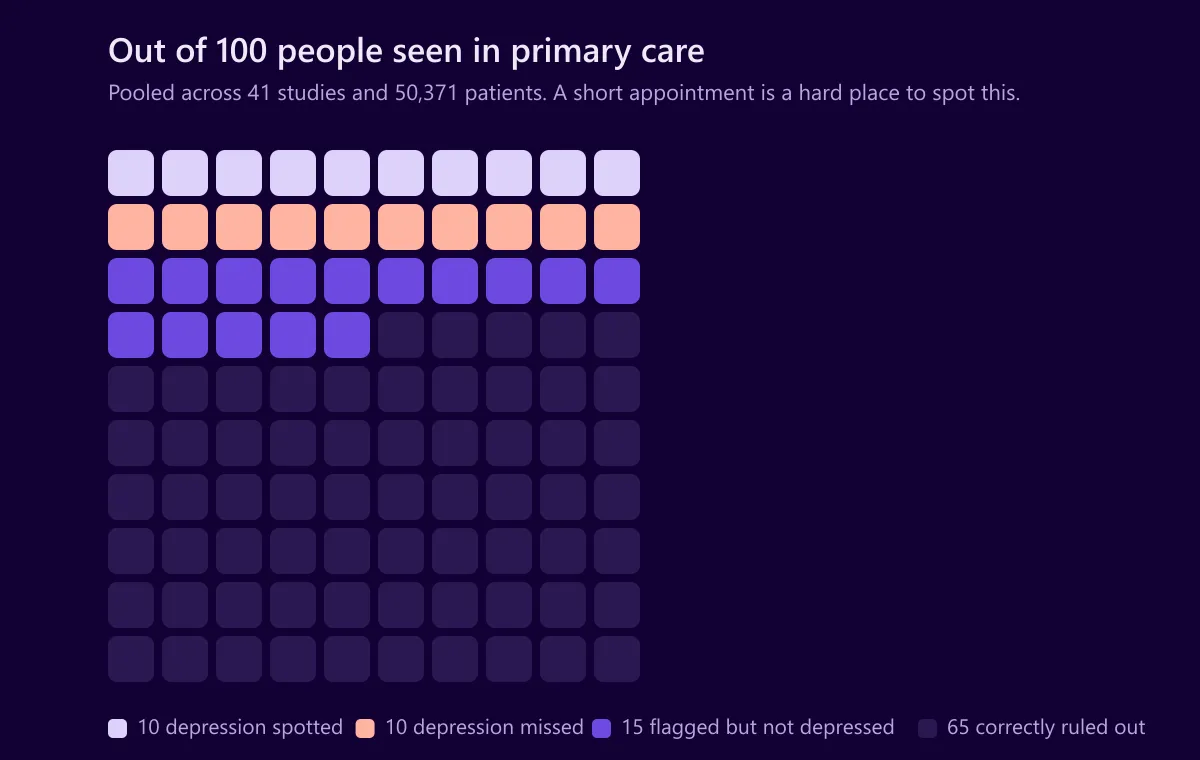
The researchers were careful about how they framed that, and so should we: it is not a criticism of doctors. It is a measure of how hard the task is when someone has a few minutes, no history with you, and a person in front of them who is probably understating it.
The part that matters most: the same research found accuracy improved markedly when the assessment drew on information gathered over months rather than a single conversation.
That one finding is the whole argument for taking something written down. Not because you need to prove anything. Because it converts a five-minute snapshot into something closer to the months of evidence that actually works.
What to take
Keep it to one page. A doctor who is handed six pages will read none of them.
- Roughly when it is worst. Mornings, evenings, certain days, after bad nights. Time-of-day patterns are genuinely informative and almost nobody mentions them.
- How you are sleeping. When you fall asleep, when you wake, whether you get back.
- What you have stopped doing. This matters more than any adjective. “I have not cooked a proper meal in three weeks” lands harder than “I feel low”.
- How long it has been going on. Many thresholds are about duration, so a start date does real work.
- A score and a date. If you have taken a depression self-check or an anxiety self-check, write the number and the day you took it.
- Any medication you take, including anything you buy without a prescription.
The score is worth a word of explanation. The PHQ-9 and GAD-7 are the questionnaires most commonly used in primary care, so walking in with a recent one means starting the conversation in the language the appointment already uses. It is a screening score and not a diagnosis. It just saves minutes you do not have.
Say the hardest sentence first
The most common way these appointments go wrong is that the real reason arrives with ninety seconds left.
So lead with it:
“I think I might be depressed, and I would like help with it.”
“I have been very anxious for a few months and it is affecting my work.”
“I am not sleeping, and I do not think it is only the sleep.”
You do not need the right terms. You do not need to be sure. Naming it in the first sentence is enough, and it tells the doctor how to spend the rest of the time.
If saying it out loud is the barrier, write it down and hand the paper across. Doctors have seen this before. It is not strange and it works.
Describe what changed, not how you feel
Feelings are hard to convey and easy to minimise. Changes are concrete.
| Instead of | Try |
|---|---|
| “I’ve been feeling low” | “I’ve stopped answering messages for about two months” |
| “I’m stressed” | “I’m waking at 4am most nights and can’t get back” |
| “I’m fine, just tired” | “I’m sleeping nine hours and still can’t get through the day” |
| “It’s not that bad” | “I’ve called in sick three times this month because of it” |
This is not about dramatising it. It is that the second column is checkable, and checkable things get acted on.
One more thing, if it applies to you: functioning well does not disqualify you. People who hold everything together on the outside often get taken less seriously, including by themselves. If that sounds familiar, our guide on high-functioning anxiety covers why the outside appearance is not the measure.
What will probably happen
Useful to know, so none of it surprises you:
- Questions about physical things — thyroid, sleep, alcohol, medication. Not dismissal. Several physical conditions produce the same symptoms and ruling them out is the right order.
- A questionnaire, often the PHQ-9 or GAD-7.
- Questions about self-harm or suicide. Direct, and asked of nearly everyone. Answering honestly does not trigger anything dramatic; it helps them judge urgency.
- A plan that is not medication. For milder presentations, guidelines in many countries recommend talking therapy or guided self-help first.
- A follow-up. Often a few weeks out, partly because the direction of travel tells them more than one appointment can.
If you feel brushed off
It happens, and it is not a verdict on whether you need help.
- Ask what would need to be different for this to be treated. It turns a vague ending into a specific one.
- Ask for it to be written in your notes. Reasonable, and it makes the next appointment start further along.
- Ask about a referral directly, rather than waiting to be offered one.
- Book a follow-up before you leave, even if nothing was decided.
- Ask to see a different doctor at the same practice if it happens twice. This is an ordinary request.
And go back with more than you took the first time. A second visit with four weeks of notes is a different conversation from a second visit with the same description.
Keeping the record is the hard part
None of this works without something written down, and the honest problem is that remembering to write it down is difficult precisely when you most need to.
Keep it small enough to survive a bad week. A date, a number out of ten, a few words. Months of that beats a detailed diary you abandon after four days.
Logging a mood in a few seconds, the way you can in Moodify, makes the record easier to keep and easier to show someone, because the pattern is already drawn. A note on your phone works too.
What matters is that when you are sitting in front of someone with five minutes on the clock, you are reading from something rather than reaching for it.
Common questions
- How do I tell my doctor I think I have anxiety or depression?
- Say it in the first sentence, before anything else. Something like "I think I might be depressed and I want help with it" works better than building up to it, because appointments are short and the important thing should not arrive in the last minute. You do not need the right words or a diagnosis. Naming it plainly is enough to start.
- What should I take to a doctor's appointment about my mental health?
- A few weeks of notes, if you have them: roughly when things are worst, how you are sleeping, and what you have stopped doing. A completed PHQ-9 or GAD-7 score with the date. A list of any medication you take. And one sentence on what has changed in your daily life, because that is what makes a doctor act rather than wait.
- Why do doctors miss depression?
- Mostly because it is genuinely hard to spot in a short appointment. Research pooling 41 studies and over 50,000 patients found doctors correctly identified depression in about half of the people who had it, and the authors were explicit that this reflects how difficult the task is rather than any carelessness. The same research found accuracy improved when assessment ran over months instead of one visit, which is exactly what a record gives them.
- What if my doctor does not take me seriously?
- Go back, and take more detail with you. Being brushed off once is common and it is not a verdict on whether you need help. Ask directly what would need to be true for this to be treated, ask for the reasoning to be written in your notes, and ask about a referral. If it keeps happening, ask to see a different doctor at the same practice — that is a normal request, not a complaint.
- Should I take a depression or anxiety test before my appointment?
- It usually helps. The PHQ-9 and GAD-7 are the questionnaires most commonly used in primary care, so arriving with a recent score gives the conversation a starting point in the language the appointment already uses. It is a screening score, not a diagnosis, and it does not replace anything your doctor does. It just saves several minutes of a very short appointment.
- What if I cannot say it out loud?
- Write it on a piece of paper and hand it over. Doctors are used to this, it is not strange, and it works. You can also book a double appointment when you call, say when booking that it is about your mental health, or bring someone with you who can say the first sentence if you cannot.
Sources
- Irving et al. — International variations in primary care physician consultation time: a systematic review of 67 countries (BMJ Open, 2017)
- Mitchell, Vaze & Rao — Clinical diagnosis of depression in primary care: a meta-analysis (The Lancet, 2009)
- Mitchell, Rao & Vaze — International comparison of clinicians' ability to identify depression in primary care (British Journal of General Practice, 2011)
- PHQ and GAD screeners — the questionnaires used in primary care
- US National Institute of Mental Health — health topics
General information, not medical advice. See our editorial policy for how these guides are written and corrected.