Mind Matters
Why You Keep Googling Your Symptoms, and How to Stop
Looking your symptoms up is not automatically a bad idea. In a survey of 720 people who do it, those without much health anxiety mostly came away feeling slightly better — they looked something up, got an answer, and moved on. Among people who were already anxious about their health, about two thirds felt worse afterwards, and they searched more often and for far longer. So the useful question is not whether to look things up, but which of those two patterns yours looks like. If a search reliably ends with you more frightened than when you started, and then you search again, the searching has stopped being research and become checking — and checking is the part that keeps the worry alive. The way out is not willpower but changing what you do with the urge, and if that is not enough there is a treatment with real, if modest, evidence behind it.
You almost certainly arrived here from a search. That is not a problem, and this is not going to tell you off for it.
What is worth knowing is that looking up symptoms does something quite different to different people — and the research is clearer about that than about anything else in this area.
Is looking up your symptoms actually bad for you?
A survey asked 720 people who look their symptoms up online how it goes. The answer depended almost entirely on how anxious about their health they already were.
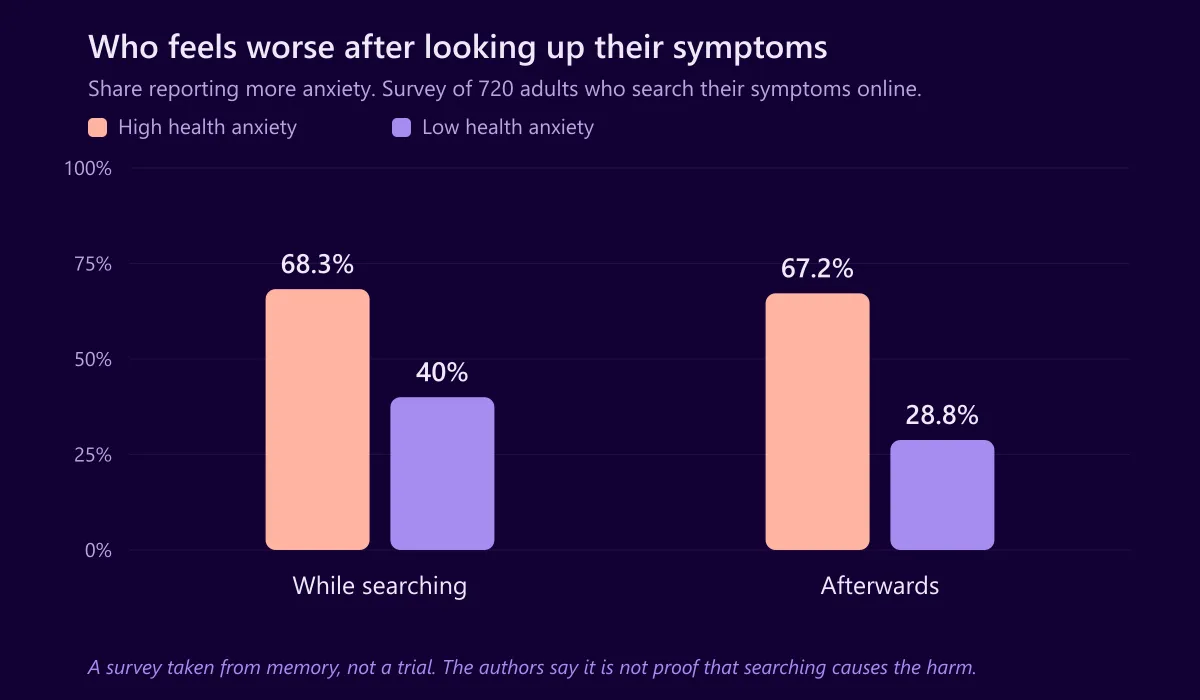
People who were not especially health-anxious mostly came away slightly better. They had a question, they found something, they stopped. For them, looking it up did what looking things up is supposed to do.
Among people who were already anxious about their health, about two thirds felt worse afterwards. They also searched far more: one to three hours on their worst day of the month, two to four times a day, against under an hour and about once a day for everyone else. And the longer the searching went on, the worse the reported anxiety.
So “don’t google your symptoms” is advice aimed at the wrong thing. The behaviour is identical in both groups. The difference is what it does to you.
One honest caveat, because it matters: this was a survey, answered from memory, by people who volunteered — many of them recruited through a website about illness anxiety. The authors said plainly that it is not proof that searching causes the harm. It may well run the other way, with anxiety driving the searching. Most likely both, feeding each other.
Why the relief never lasts
Here is the mechanism, and it is the same one behind most checking habits.
You search. You find something reassuring. You feel better — genuinely, for a few minutes or a few hours.
Then the doubt comes back, usually wearing a reasonable disguise. That site wasn’t very reliable. I didn’t describe it properly. My case is a bit different. It said it’s usually nothing — but usually isn’t always.
And the only thing that has ever made this feeling go away, even briefly, is searching. So you search again.
That is the loop. Each round teaches you a little more firmly that searching is what brings relief, which makes the next urge harder to sit with. The relief is real; it is just short, and it is paid for with a stronger urge next time.
If this sounds like the pattern in our guide on intrusive thoughts at night, it is the same shape — a thing you do to make a thought go away, which works briefly and makes the thought more insistent over time.
What makes it worse
| What you do | Why it feeds the loop |
|---|---|
| Search again with different wording | Hunting until you find the frightening answer, which always exists somewhere |
| Read forums and personal stories | Written mostly by the unlucky, so the picture is skewed and vivid |
| Check your body to compare | Looking for a symptom reliably finds something; bodies are noisy |
| Ask several people the same question | Reassurance from others works like searching, with the same short half-life |
| Search late at night | Tiredness makes it harder to put a thought down, and nothing can be acted on |
How to actually break the loop
Trying never to search again tends not to survive a bad evening. These work on the urge instead.
- Delay rather than ban. Tell yourself you can search in an hour. Often the urge drops before the hour does, and when it doesn’t you have lost nothing.
- Decide the threshold in advance, when you are calm. Write down what would genuinely warrant a doctor — this lasting past a certain date, getting worse, a specific new sign. Then a frightening evening is measured against something you already decided instead of against how scared you feel now.
- Write it down instead of searching. The symptom and the date, nothing else. It serves the same urge to do something, and after a few weeks you have a record that is far more useful to a doctor than a search history.
- Cut the checking, not just the searching. The re-reads, the second opinions, the body checks. Those are the same behaviour in different clothes.
- Set a stopping rule if you do search. One reputable source, once. Not the fifth page of results.
- Notice the time of day. If almost all of it happens after 11pm, that is partly a sleep problem wearing a health costume.
When you should actually get it checked
This section matters more than the rest, so it is deliberately blunt.
Nothing above is a reason to avoid medical care. Being prone to health anxiety does not protect anyone from also being ill, and the aim here is not to replace endless searching with ignoring things. It is to replace it with one proper assessment.
See a doctor if a symptom is new and persistent, getting worse, waking you, or frightening you enough that you are reading this at midnight. Go sooner, not later, for anything involving chest pain, breathlessness, sudden weakness or numbness, or bleeding you cannot explain.
And when you go, take the written record rather than the search history. Our guide on talking to a doctor covers what actually helps in a short appointment — the same approach works whether the worry is about your mind or your body.
Does treatment help?
Yes, and it is worth being honest about the size of it.
In a trial of 444 people with significant health anxiety, attending ordinary hospital clinics, five to ten sessions of CBT adapted for health anxiety were compared with usual care. After a year, the proportion who had come down into a normal range was roughly double that of usual care. The gains were still there at two years, and it cost no more overall.
Roughly double a small number is still a small number. Most people in that trial did not end up in the normal range. But it is a real effect, from a proper trial, delivered by staff who were not specialists — which means it is the kind of help that can exist outside a specialist clinic.
If the searching is taking hours of your week, that is a reasonable thing to raise with a doctor in its own right, separately from whatever symptom started it.
Keeping a record instead
The thing that makes the delay tactic work is having somewhere for the urge to go. Writing the symptom and the date takes ten seconds and does three useful things: it satisfies the need to act, it gives you something checkable later, and it quietly shows you how often the frightening thing turned out to be nothing.
That last part is the one people are most surprised by. The searches you remember are the frightening ones. A written record includes all the times it passed.
Logging how you are each day, the way you can in Moodify, makes that record easier to keep than a notebook you have to remember to open. A notes app works too. What matters is that the next time the worry arrives, you have something to read that is not search results.
Common questions
- Is it bad to google your symptoms?
- Not for everyone. In a survey of 720 people who search their symptoms online, those with low health anxiety mostly reported feeling slightly less anxious afterwards — they found an answer and moved on. Among those with high health anxiety, about two thirds felt worse afterwards. The behaviour is the same; the effect is almost opposite. What matters is which pattern yours fits.
- Why does searching my symptoms make me feel worse?
- Because the relief does not last. A reassuring page settles the worry for a short while, then doubt returns — you were not specific enough, the site was not reliable, your case is different — and the only thing that has ever settled it before is another search. Each search teaches you that searching is what brings relief, which makes the next urge stronger.
- How long do people spend googling symptoms?
- More than they think. In that survey, people with high health anxiety spent one to three hours on their worst day in the past month and searched two to four times a day, against under an hour and about once a day for people with low health anxiety. Those who searched longest also reported the most anxiety afterwards.
- How do I stop googling my symptoms?
- Not by trying to never do it again, which rarely survives a bad evening. Delay the search rather than ban it, decide in advance what would genuinely warrant a doctor, write the symptom down with a date instead of searching, and cut the checking that follows — the re-reads, the second opinions, the forums. If the urge is strong enough that this feels impossible, that is worth taking to a professional rather than white-knuckling.
- When should I actually see a doctor about a symptom?
- Whenever something is new and persistent, getting worse, or frightening you. Nothing here is a reason to avoid care, and health anxiety does not protect anyone from also being ill. The aim is to replace an endless search with one proper assessment — not to replace it with nothing.
- Can health anxiety be treated?
- Yes, though expect improvement rather than a cure. In a trial of 444 people with excessive health anxiety, five to ten sessions of CBT adapted for health anxiety roughly doubled the proportion who reached a normal range after a year, against usual care — and the gains held at two years. Roughly doubling a small number still leaves many people short of "better", so it is worth starting with realistic expectations.
Sources
- Doherty-Torstrick, Walton & Fallon — Cyberchondria: parsing health anxiety from online behavior (Psychosomatics, 2016)
- Tyrer et al. — Clinical and cost-effectiveness of cognitive behaviour therapy for health anxiety in medical patients (the CHAMP trial, The Lancet)
- Imperial College London — summary of the CHAMP trial findings
- US National Institute of Mental Health — health topics
General information, not medical advice. See our editorial policy for how these guides are written and corrected.