Daily Rituals
Why You Sleep Worst Before Something Important

It is close to universal and it has two separate causes. The first is anticipation. In a survey of 283 elite athletes, 64% reported sleeping worse before an important competition, the main problem was falling asleep, and the main reason given was thoughts about the event itself. The second cause only applies if you are somewhere new, and it is automatic rather than psychological: on a first night in an unfamiliar place, part of one brain hemisphere stays measurably more awake during deep sleep, responds more strongly to unexpected sounds, and wakes you more easily. That asymmetry is gone by the second night. Two things are worth knowing on top of that. The athletes' poor sleep was situational rather than a sign of a sleep problem. And when researchers measure sleep around competitions with devices rather than questionnaires, they often find no difference at all, which suggests a good deal of the damage is in how the night is experienced and remembered.
The interview is at nine. You went to bed early, specifically so you would be rested, and that was the moment the night stopped cooperating.
Two separate things cause this, and telling them apart changes what helps.
It is close to universal
Among 283 elite athletes asked about the previous year, 64% reported sleeping worse before an important competition. A separate survey of 632 athletes in Germany found much the same, around 66%.
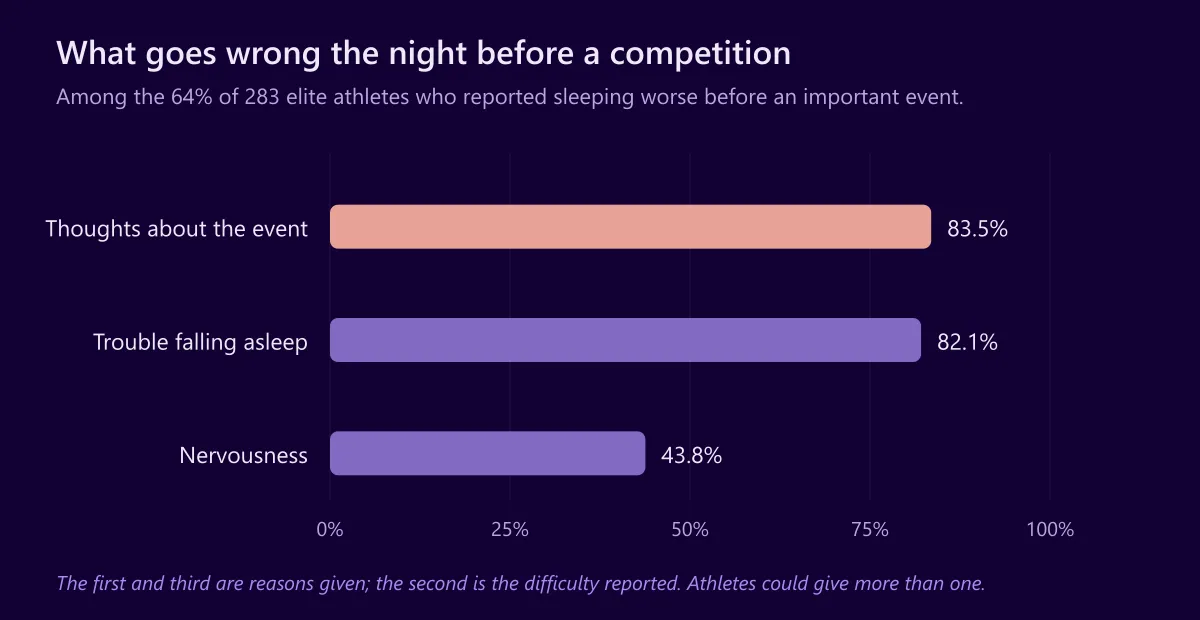
Among those affected, the specifics are consistent:
- 82% could not fall asleep. Not waking at three, not waking early. Getting to sleep at all.
- 84% blamed thoughts about the event, and 44% nervousness.
These are people whose sleep is professionally managed, before events they have trained years for. If it happens to them it is not a personal failing.
One more number from that study, which says something about the problem: among team-sport athletes, 59% had no strategy at all for it.
The part that is not worry
Here is what most advice misses. If you are sleeping somewhere unfamiliar — a hotel, a spare room, a friend’s sofa — a second mechanism is running, and it has nothing to do with your state of mind.
Researchers recorded people’s brains across a first and second night in a sleep laboratory. On the first night only, during deep sleep, a particular network in the left hemisphere stayed more active than the same network on the right. The side that slept less deeply responded more strongly to unusual sounds, produced more wakings, and reacted faster.
The researchers describe it as a night watch: part of the brain keeping an eye on an unproven environment.
By the second night in the same place, the asymmetry was gone.
| What is happening | What it responds to |
|---|---|
| Anticipation | Thoughts about the event. Worst at the falling-asleep stage |
| Unfamiliar place | Nothing you can talk yourself out of. Fades by night two |
If your important day involves travelling somewhere, you are getting both at once, which is why the night before a wedding in a hotel is worse than the night before a presentation at home.
The genuinely reassuring part
Two findings worth holding onto.
It is situational. The researchers were explicit that the athletes’ poor sleep before competitions was situational rather than a general sleep problem. A bad night before something that matters is not the start of insomnia, and treating it as a symptom is how a one-night problem becomes a standing one. Our guide on waking at 3am covers the difference.
Measured sleep and remembered sleep often disagree. When researchers put devices on athletes around competitions, they frequently find no difference from an ordinary night — even when the athletes report sleeping badly. That does not mean the experience is imagined. It does suggest a good deal of what makes the night feel ruinous is how it is experienced and recalled, which is exactly the part that then feeds the dread the following year.
What to do the night before
The aim is not to sleep well. It is to stop spending the night on the problem of not sleeping well.
- Decide in advance that a short night is survivable. Most of the harm is the second-order worry — lying there calculating what tomorrow will cost. The calculation is worse than the deficit.
- Do not check the clock. It converts a bad night into arithmetic.
- Keep your usual wake time. Sleeping in to make up for it is how one disrupted night becomes three. Our guide on staying up late when you are tired covers how quickly that drift sets in.
- If you are going somewhere new and it really matters, arrive two nights before. You cannot talk your way out of the first-night effect, but you can spend it on a night that does not count.
- Deal with the thinking earlier in the evening, not in bed. Setting aside a time earlier to go through what is on your mind has modest evidence behind it, which our guide on whether a worry time works sets out honestly, including where it does not help.
- Get up if you have been awake a long while. Lying in bed losing an argument with yourself trains the bed as the place where that happens.
What not to do
Do not try a sleep aid for the first time. Whatever makes you sleep can leave you slow in the morning, and the night before something important is the worst occasion to find out how it affects you.
Do not nap long that afternoon. A short early one is fine; a long late one spends the sleep pressure you want at bedtime. Our guide on whether naps help covers the timing.
Do not go to bed much earlier than usual. Extra time in bed before you are sleepy is extra time to lie there, and lying awake is the thing you are trying to avoid.
Afterwards, write down what actually happened
This sounds beside the point and it is the thing that changes next year.
The dread before the next event is built from memory of this one, and memory of a bad night is unusually distorted — you remember the worst stretch and the last thing you felt, not the hours you were actually asleep. Our guide on why you cannot remember how you felt explains the mechanism.
So the morning after, note two things: roughly how you slept, and how the day actually went. Most people discover the day went considerably better than the night predicted. That is the record worth having before the next one, and it is not recoverable later.
Logging it in a few seconds, as you can in Moodify, is one way. A line in a notebook is another. What matters is that it exists before the next important morning, when you will otherwise be working from a feeling rather than a fact.
Common questions
- Why can't I sleep the night before something important?
- Usually for two reasons at once. One is anticipation: in a survey of elite athletes, the most common difficulty before a competition was falling asleep, and the most cited cause was thoughts about the event. The other applies only if you are sleeping somewhere unfamiliar, where part of your brain stays more alert through the night automatically, regardless of how calm you feel.
- What is the first-night effect?
- The well-documented finding that people sleep worse on their first night in an unfamiliar place. Research using brain recordings found that during deep sleep on that first night, a network in the left hemisphere stayed more active than the same network on the right, responded more strongly to unusual sounds and woke people more readily. The difference was absent on later nights in the same place.
- How common is sleeping badly before a big event?
- Very. Among 283 elite Australian athletes, 64% reported worse sleep on at least one occasion before an important competition in the previous year. Among those affected, 82% had trouble falling asleep. A separate German survey of 632 athletes found a similar figure of about 66%.
- Does one bad night before an event actually matter?
- Less than the worry about it suggests, though it is not nothing. Worth knowing that the athletes' pre-competition sleep problems were described as situational rather than a general sleep disorder, and that studies measuring sleep with devices around competitions often find no difference from normal nights, even when people report sleeping badly.
- What should I do the night before something important?
- Protect the morning rather than chase the night. Keep your usual wake time, decide in advance that a short night is survivable, and avoid checking the clock, which converts lost sleep into arithmetic about lost sleep. If you are staying somewhere new and it matters a great deal, arriving a night earlier means the unfamiliar-place effect has already passed.
- Should I take something to sleep before an important day?
- Not for the first time the night before something that matters. Anything that makes you sleep can also leave you slowed the next morning, and the night before an event is the worst possible occasion to discover how a substance affects you. If sleep before events is a recurring problem, that is a conversation for a doctor on an ordinary week.
Sources
- Juliff, Halson & Peiffer — Understanding sleep disturbance in athletes prior to important competitions (Journal of Science and Medicine in Sport, 2015;18(1):13-18). 283 elite athletes; 64.0% reported worse sleep before an important competition; problems falling asleep 82.1%; thoughts about competition 83.5%; nervousness 43.8%
- Tamaki, Bang, Watanabe & Sasaki — Night watch in one brain hemisphere during sleep associated with the first-night effect in humans (Current Biology, 2016;26(9):1190-1194)
- US National Institute of Mental Health — health topics
General information, not medical advice. See our editorial policy for how these guides are written and corrected.