Daily Rituals
Why You Stay Up Late When You're Already Tired

Going to bed later than you meant to, with nothing actually stopping you, is called bedtime procrastination, and it is well documented — a review pulling together 43 studies found it goes with worse sleep and shorter sleep. What is genuinely unsettled is why. One account says it is a self-control problem: the hour before bed is when your capacity to make yourself do the dull thing is at its lowest. Another says that for night owls it is partly a body-clock problem, because being told to sleep at 10.30pm when your body expects to sleep at 1am is not really procrastination. Researchers have argued this out in print and neither side won. It matters because the two explanations point at different fixes: one calls for friction, the other for a schedule you can actually keep. For most people it is some of both, and the only way to know the mix is to watch your own week.
It is half past eleven. You have been tired since nine. You are not doing anything you would describe as enjoyable — a video you are not really watching, a feed you have already seen.
Nothing is stopping you going to bed. You just are not going.
This has a name, and a research base
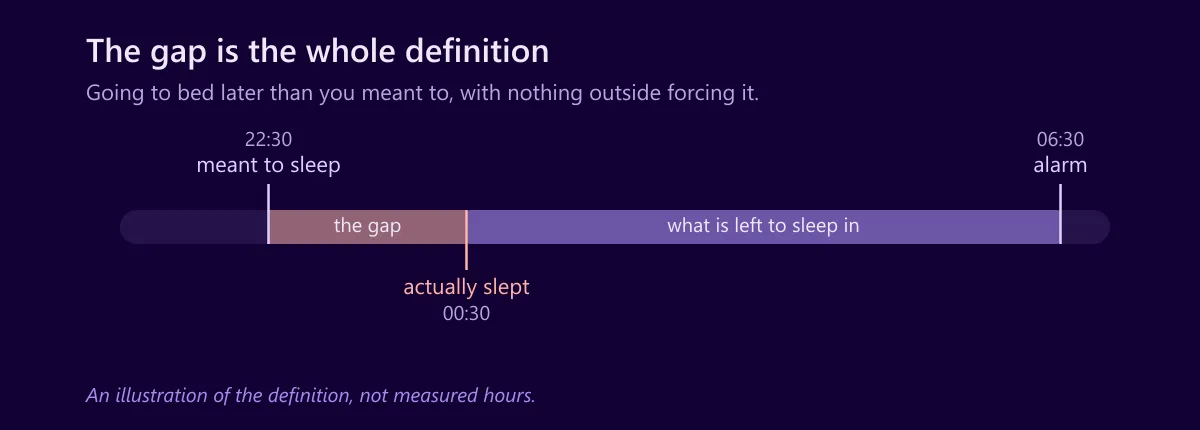
Researchers call it bedtime procrastination, and they define it narrowly: going to bed later than you intended, when nothing outside is forcing you to.
That last part is what makes it a real category. A night shift is not procrastination. A crying baby is not procrastination. This is the version where the only thing between you and bed is you.
A review pulling together 43 studies found it goes with poorer sleep quality and shorter sleep, at a moderate strength. So the thing is real, measurable, and does what you would expect.
About “revenge” bedtime procrastination, since that is the phrase most people arrive with: the underlying behaviour is well studied, but the revenge part — reclaiming time your day took from you — is a popular framing rather than an established finding. The research behind it specifically is a small student sample and some surveys commissioned by companies selling mattresses. It may well be true. It is just not the part with evidence under it.
Is it a willpower problem?
The original research pointed that way. People who scored lower on self-regulation reported more bedtime procrastination, and the later review found a moderate relationship with self-control across dozens of studies.
That fits something you can probably feel. Going to bed is a dull, effortful task with a delayed payoff — exactly the kind of thing self-control is for, and exactly the kind of thing you have least of late at night, after a whole day of making yourself do things.
Which is why the advice “just go to bed earlier” lands so badly. It asks for the one resource that is reliably empty at the hour you need it.
Or is it your body clock?
Here is where it gets genuinely interesting, because researchers disagreed in print about this.
The counter-argument runs: if you are naturally a night person, and your body does not expect to sleep until 1am, then setting a 10.30pm bedtime and failing to meet it is not really procrastination. It is a mismatch between your biology and your schedule. Calling it a character flaw adds guilt to a timing problem.
The original researchers pushed back, arguing that reducing it to biology does not do justice to the complexity — plenty of people miss bedtimes their body would happily have kept.
Neither side won, and that is worth knowing rather than glossing over. The honest position is that both are real, and the mix differs between people.
Why it matters which one you are
Because they point at completely different fixes.
| If it is mostly | What helps | What will not |
|---|---|---|
| Self-control | Making the first step smaller and the friction earlier | Deciding tonight will be different |
| Body clock | Shifting timing gradually, steady wake time, morning light | Setting a bedtime you have never once hit |
| Not having had any time to yourself | Finding that time earlier in the day, deliberately | Treating it as a discipline problem |
Most people are some of each. The useful question is not “which type am I” but “which of these, this week, is doing the most damage”.
What actually helps
- Decide the first step, not the bedtime. “Go to bed” is too large an instruction for a tired evening. “Put the phone on the charger” is not.
- Move the friction earlier. Put the phone to charge in another room before you sit down, while you still have the will to do it. Late-evening you is not the one to negotiate with.
- Set an alarm for starting, not finishing. A nudge at the time you meant to begin winding down is more useful than one at the time you meant to be asleep.
- Shift in fifteen-minute steps. If your realistic bedtime is 1am and your goal is 11pm, go for 12:45 this week. Two hours in one night does not hold.
- Keep the wake time steadier than the bedtime. It is the more powerful of the two for pulling your clock earlier, and it is the one you can actually enforce with an alarm.
- Watch the caffeine. If the evening tiredness never quite arrives, our guide on when to stop drinking coffee explains why the cut-off is probably earlier than you think.
When it is not procrastination
This matters, because the advice above is useless or worse if the problem is something else.
If you want to sleep and cannot, that is not putting it off. Lying awake trying is a different problem with a different fix — our guide on waking at 3am covers the approach sleep clinics actually use, and it applies at the start of the night too.
If your head gets loud the moment it is quiet, the delay may be avoidance rather than procrastination. Intrusive thoughts at night goes into that.
If staying up is the only time that belongs to you, no amount of phone friction will fix it, because the late hour is not the problem — it is the solution you found to a different one.
Finding out which it is
All of this turns on something only you can establish: whether your late nights follow a pattern, and what the pattern follows.
It takes very little. The time you actually went to bed, and one word about the day. After two or three weeks you can usually see it — whether the worst nights follow the busiest days, whether they cluster on particular weekdays, whether your “late” is consistent enough to be a body clock rather than a lapse.
That last one is the most useful thing you can learn here. If your natural bedtime is the same late hour every night, that is information about your timing, not evidence about your character.
Logging the day in a few seconds, the way you can in Moodify, makes that pattern visible without having to remember it. A note by the bed does the same. The point is having something to look at other than the feeling that you should be better at this.
Common questions
- What is revenge bedtime procrastination?
- The researched part is "bedtime procrastination", defined as going to bed later than you intended when nothing outside is forcing you to. The "revenge" layer — the idea that you are reclaiming time your day took from you — is a popular addition rather than an established finding. It rings true to a lot of people, and the evidence for it specifically is thin: mostly small student samples and surveys commissioned by companies selling sleep products.
- Why do I stay up late even when I am exhausted?
- Two explanations compete, and both are plausible. One is self-control: the late evening is when your capacity to make yourself do something dull is lowest, and going to bed is dull. The other is your body clock: if you are naturally a night person, the bedtime you have set may be earlier than your body is ready for, in which case lying there is not an option anyway.
- Is bedtime procrastination actually bad for you?
- It is reliably linked to worse outcomes. A review of 43 studies found it has a moderate relationship with poorer sleep quality and shorter sleep. Worth noting that this is a correlation — the research cannot yet say whether putting off bedtime causes the bad sleep, or whether both come from something else. The authors said plainly that the causal work has not been done.
- How do I stop putting off going to bed?
- Decide the first step rather than the bedtime, because "go to bed" is too big an instruction for a tired evening. Move the friction earlier: put the phone to charge in another room before you sit down, not when you are already on the sofa. And if you are a night person on an early schedule, shifting your bedtime by fifteen minutes a week works better than deciding tonight is different.
- Does my chronotype mean I cannot fix this?
- No, but it changes what is realistic. A night person can usually shift their timing somewhat, especially with morning light and a steady wake time, but not into a different person. If your bedtime goal is two hours earlier than your body has ever managed, the problem may be the goal rather than your willpower.
- When is it not procrastination?
- When you want to sleep and cannot. Lying awake trying is insomnia, not putting it off, and it needs a different approach. The same is true if shift work sets your hours, if you are kept up by a child or by caring for someone, or if staying up is the only private time you get — those are circumstances, not habits, and advice about willpower will not touch them.
Sources
- Kroese, De Ridder, Evers & Adriaanse — Bedtime procrastination: introducing a new area of procrastination (Frontiers in Psychology, 2014)
- Hill et al. — Go to bed! A systematic review and meta-analysis of bedtime procrastination correlates and sleep outcomes (Sleep Medicine Reviews, 2022)
- Kroese et al. — response to the chronotype critique of bedtime procrastination (Frontiers in Psychology, 2018)
- US National Institute of Mental Health — health topics
General information, not medical advice. See our editorial policy for how these guides are written and corrected.