Daily Rituals
Do Naps Help, or Make You More Tired?
A nap helps, mostly with alertness, and the improvement is modest. The catch is the order things happen in. When researchers combined eleven laboratory trials of afternoon naps, the benefit showed up clearly between about thirty minutes and two hours after waking, while results in the first half hour were mixed. That early patch is sleep inertia, the grogginess of coming out of sleep, and how heavy it is depends on how deeply you slept, which is why longer naps tend to produce more of it. Two fears can be set aside. Napping is not linked to memory problems later in life: a review of twenty-five studies covering more than 95,000 older adults found no association at all. And while people with insomnia are usually told never to nap, the one study that tested a short early-afternoon nap alongside insomnia treatment found it did not undermine the treatment. The clear advice is narrower than the usual advice: keep it short, keep it early, and judge it after the first half hour rather than during it.
Most arguments about naps are really two different questions stuck together. Does a nap leave you better off? And why does it so often feel like it has not?
Both have answers, and the second one explains the first.
What a nap reliably does
Researchers combined eleven laboratory trials of afternoon napping, covering 381 working-age adults. Each compared people who napped against people who did not, then tested them.
The people who napped did better. The improvement was small, and it was strongest for alertness — staying awake and reacting — rather than for memory or harder thinking.
Two honest limits on that. Nearly all of it was done in sleep laboratories, so it describes a quiet room and a planned nap rather than twenty minutes on a sofa with the television on. And the average nap in these trials was about fifty-five minutes, which is longer than the nap most people are advised to take.
The first half hour is the catch
This is the part that explains why naps have a bad reputation, and it is a matter of timing rather than of whether they work.
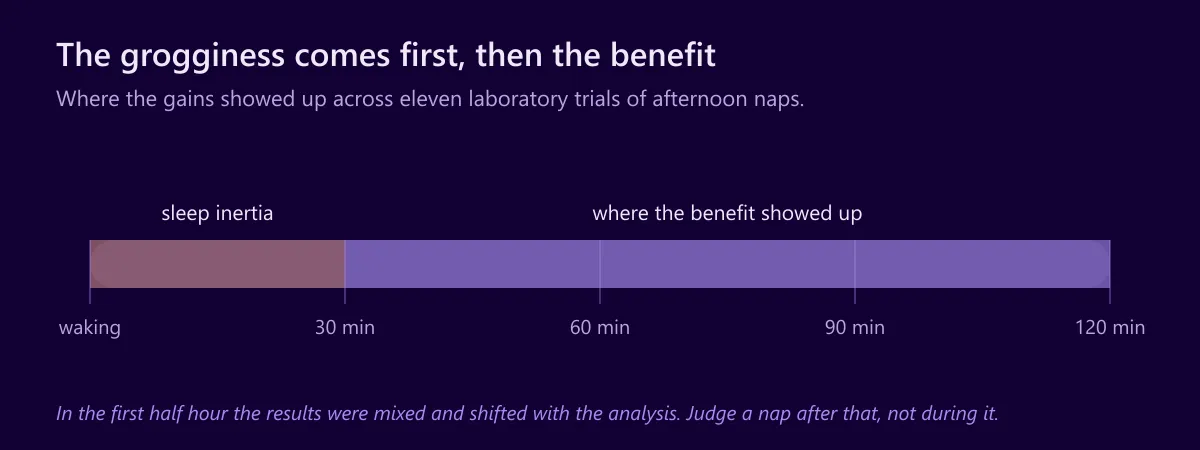
In the combined data, the benefit showed up mainly between thirty minutes and two hours after waking. In the first thirty minutes the results were mixed and shifted depending on how the numbers were analysed.
That early patch has a name: sleep inertia. It is the state of coming out of sleep — slow, foggy, worse at things than you were before you lay down. It is not a sign the nap failed. It is the first stage of it.
Which leads to the practical point most nap advice skips. If you judge a nap in the first twenty minutes after waking, you will judge it wrong every time. The grogginess arrives before the benefit does.
How long, then
Here the honest answer is less tidy than the usual one.
The common advice — twenty to thirty minutes — rests on a real mechanism. The heaviness of sleep inertia depends on how much deep sleep the nap contained, and a longer nap contains more of it. Short naps mostly stay above that, so you wake up with less to shake off.
But the trials themselves did not show nap length changing the size of the benefit. Nor did the gap between the nap and the test.
So:
| Twenty to thirty minutes | Sound reasoning about deep sleep, not a measured result |
| Around an hour | What the trials mostly used, and they still showed a benefit |
| The first 30 minutes after waking | Expect to feel worse, whatever the length |
| 30 minutes to 2 hours after | Where the benefit showed up |
The short-nap rule is still the one to follow if you have to be useful soon after waking. Just know that it comes from reasoning about how sleep is built rather than from a trial that measured it.
Early afternoon, not late
Your body runs a dip in alertness roughly twelve hours after the middle of the night — in practice somewhere between one and five in the afternoon. That slump is not caused by lunch, which is the usual explanation and the wrong one. It is the clock.
A nap in that window is the one that fits the body’s own rhythm. In the combined data, naps taken before one in the afternoon came out better, although that particular comparison was not statistically solid, so treat it as a lean rather than a finding.
The firmer reason to keep naps early is the other end of the day. The later you sleep in the afternoon, the more of your drive to sleep you spend before bedtime. Our guide on why you stay up late when you are tired covers what that drive does to the evening.
The dementia headline
Every so often a study links daytime napping to dementia and the headline goes round. It is worth knowing what the fuller picture looks like.
A review brought together twenty-five studies covering more than 95,000 people over the age of sixty, some measured at a single point in time and some followed over years. It found no association between napping and general thinking ability, and none with memory. Nothing about the people — their age, how much they slept at night, whether they were men or women — changed that.
The reason single studies sometimes find a link is almost certainly the direction of it. Sleeping much more in the daytime can be an early sign of something already happening, rather than a cause of it. A new and growing need to nap is worth mentioning to a doctor. Napping itself is not the thing to worry about.
If you already sleep badly at night
This is the one place to be careful, and the advice usually given here is absolute: if you have insomnia, do not nap. The reasoning is that daytime sleep spends the pressure to sleep that you need by bedtime.
One study has actually tested it. Among 108 people being treated for insomnia, some were allowed a short nap in the early afternoon. It improved their afternoon alertness, and it did not reduce the gains from treatment — not in their insomnia scores, not in how long they took to fall asleep, not in how much of the night they spent awake.
That is a single small study and it does not overturn the standard advice. But it does soften it into something more usable:
- If you sleep badly at night, short and early is the version to try, not none at all.
- A long afternoon sleep, or one after about three, is the kind that competes with your night.
- If you are deliberately restricting your time in bed to fix your sleep, follow what you were told rather than this.
How to nap so it helps
- Set an alarm for twenty-five minutes. Not because longer is harmful, but because it keeps the grogginess manageable.
- Keep it in the early afternoon. One o’clock is better than four.
- Do not plan anything demanding for the half hour after. That is the grogginess window and it is predictable.
- Dark and quiet beats comfortable. The laboratory trials got their results in conditions most sofas do not match.
- If you cannot fall asleep, lying still for twenty minutes is still rest. It is not the same as a nap, and it is not a failure either.
- A nap is not a substitute for a night. It relieves the symptom. Our guide on soundscapes for sleep deals with the night itself.
When needing naps is the signal
An afternoon nap is ordinary. Needing one every day, for weeks, is information.
Sleeping much more than usual and still feeling unrested is one of the recognised features of depression, and of winter-pattern depression in particular. So is sleeping a great deal more as the months get darker, which our guide on wanting to sleep more in winter covers.
What is useful here is the pattern rather than any single day: which days you needed a nap, how you slept the night before, and whether the need is spreading. That is not something anybody can reconstruct afterwards — memory flattens a month of tiredness into one grey block, for reasons our guide on why you cannot remember how you felt explains.
A number out of ten and the time you woke is enough. Logging it in a few seconds, as you can in Moodify, makes a few weeks of it realistic. A paper calendar does the same job. The point is having something to read in a month other than a feeling that you have been tired for a while.
Common questions
- Do naps actually help?
- Yes, modestly, and mostly for alertness. When eleven laboratory trials of afternoon napping were combined, people performed better after a nap than people who had not napped, with the clearest gains in staying alert rather than in memory or decision-making. The size of the benefit was small, and almost all of this research was done in sleep laboratories rather than in real working days.
- Why do I feel worse after a nap?
- Because of sleep inertia, the groggy, slowed-down state of coming out of sleep. In the combined trial data, results in the first thirty minutes after waking were mixed, and the clear benefit only appeared from about thirty minutes to two hours afterwards. How heavy that grogginess is depends on how deeply you slept, which is why it tends to be worse after a long nap than a short one.
- How long should a nap be?
- The common advice is twenty to thirty minutes, and the reasoning behind it is sound: longer naps contain more deep sleep, and deep sleep is what produces the grogginess afterwards. Worth knowing that the trial data itself did not show nap length changing the benefit, so the short-nap rule is reasoning about how sleep works rather than something measured directly.
- What is the best time of day to nap?
- Early afternoon. Your body clock has a natural dip in alertness roughly twelve hours after the middle of the night, usually somewhere between one and five in the afternoon, and a nap taken in that window is the one that fits. In the combined data, naps before one in the afternoon did better, though that particular comparison was not statistically solid.
- Is napping bad for your memory as you get older?
- The evidence says no. A review of twenty-five studies covering more than 95,000 people over the age of sixty found no association between napping and either general thinking ability or memory, whether measured at one point in time or followed over years. Headlines linking naps to dementia usually come from single studies where heavy daytime sleepiness was an early sign of a problem, not its cause.
- Should you nap if you have trouble sleeping at night?
- This is the one case where caution is genuinely warranted, because the usual advice to avoid naps exists to keep your drive to sleep high by bedtime. That said, the one study to test it found that allowing a short early-afternoon nap during insomnia treatment did not undermine the treatment, and improved afternoon alertness. It was a small study, so the safest version is: if you cannot sleep at night, do not nap long and do not nap late.
Sources
- Dutheil et al. — Effects of a short daytime nap on cognitive performance: a systematic review and meta-analysis (International Journal of Environmental Research and Public Health, 2021;18:10212). 11 studies, 381 participants; post-nap effect 0.18 (95% CI 0.09-0.27), alertness 0.29 (0.10-0.48); mean nap 55.4 minutes
- Alvarez-Bueno et al. — Napping and cognitive decline: a systematic review and meta-analysis of observational studies (BMC Geriatrics, 2022;22:756). 25 studies, 95,719 participants aged over 60; pooled odds ratios 1.00-1.08, all confidence intervals spanning 1
- Faraut et al. — Napping during cognitive behavioural therapy for insomnia: friends or foes? (Journal of Sleep Research, 2024). Pilot study, 108 patients
- US National Institute of Mental Health — health topics
General information, not medical advice. See our editorial policy for how these guides are written and corrected.