Mind Matters
Does Setting Aside a "Worry Time" Actually Work?

The technique is simple. When you catch yourself worrying during the day, you stop, and you save it for one set period in the evening, twenty to thirty minutes long. Seven trials, with 999 people between them, have tested this against simply writing worries down. The benefit was real but small: people spent less time worrying, and worried slightly less often. Two things are worth knowing before trying it. Every one of those trials ended when the practice ended, so nobody knows whether the benefit lasts. And in the largest recent trial, the technique only beat its own plain version when people decided in advance exactly when their worry slot would start, tied to something they already did each evening. Without that step it did not help, and those people recorded slightly more worry episodes rather than fewer. It also did nothing at all for sleep.
The instruction is almost too simple to believe. Catch yourself worrying, stop, and save it for later — one slot, same time every evening.
It has been studied since 1983, which is long enough for an honest answer.
What the technique actually is
Two versions exist, and the difference between them matters.
The original asked people to put their worries off to a half-hour period held at the same time and the same place each day. During that period they were meant to work through the worries and try to solve them. Anything that came up outside the slot was to be replaced with whatever was actually happening around them.
The later version, which most recent trials use, kept the slot and dropped the problem-solving. Twenty to thirty minutes in the early evening, about four to five hours before sleep. You worry for that time if you want to. You are not required to get anywhere with it.
The timing is the part people get wrong. Early enough in the evening that the day is over but bedtime is not close. Put the slot at ten at night and you have built a routine for taking your worries to bed.
What the evidence shows
A review published in 2024 brought together seven trials of the technique — 999 people between them, from primary school children to working adults.
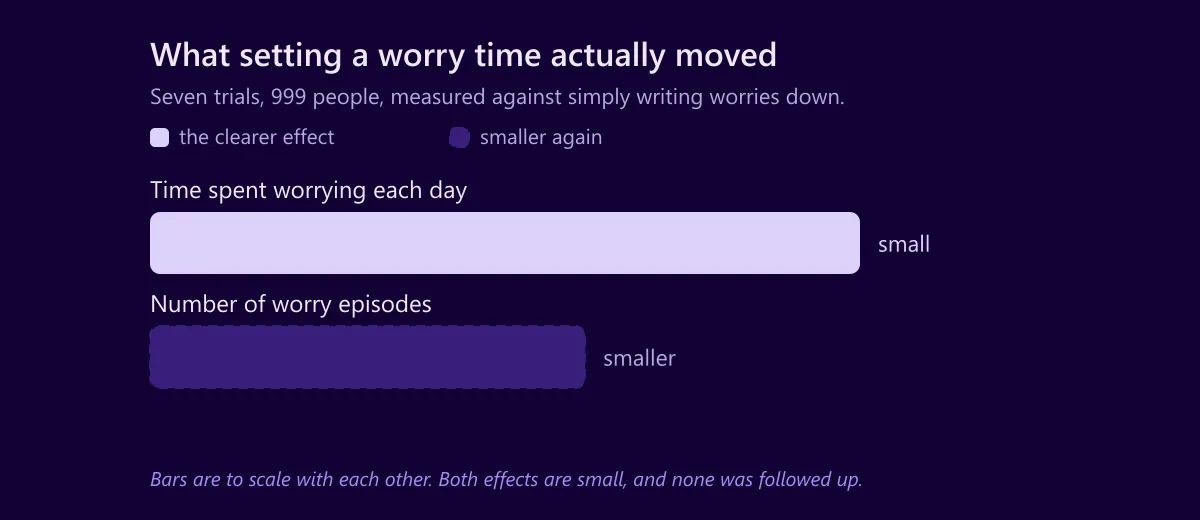
Both results pointed the same way and both were small. Time spent worrying fell more than the number of worry episodes did. Which fits the technique: you are not meant to have fewer worries, you are meant to spend less of the day inside them.
Three things cut against taking that at face value.
The comparison probably flatters the control group. Everyone in these trials, including the people not using the technique, had to write their worries down daily so there was something to measure. Writing down how long you worried appears to reduce it on its own. The review’s authors say directly that worry fell in the control groups too, which would make the technique look weaker than it is.
Nobody knows if it lasts. Not one of the seven trials included a check after the practice stopped. The practice periods ran from a week to a month, and the measurement ended when they did.
Most of the trials have some weakness in them. Mostly because worry can only be measured by asking people about it, which is not a precise instrument. There are also very few men in this body of work, and the effects were larger in the trials with more women in them — which might mean the technique suits women better, or might just mean the men in these trials were not worrying much to begin with.
The finding that changes how you should do it
In 2025 a trial ran the technique for fourteen days — longer than it had ever been tested — with 186 people and four groups. One group did the standard version. One did the same thing but first wrote a plan naming exactly when the slot would start. The other two were comparison groups.
The plans were specific and attached to things people already did:
If I find myself worrying, then I will save it for my worry window after folding up my laundry.
If I worry or feel anxious, then I will not think about it until after the 6pm news.
The result is the most useful thing in this whole body of work:
| Planned group against the plain version | About 14 minutes less worry a day |
| Plain version against the planned group | Slightly more worry episodes — around half an extra one a day |
| Either group against the comparison groups | No clear difference |
| Sleep quality, time to fall asleep, night wakings | No improvement anywhere |
Read that top to bottom and the conclusion is uncomfortable but clear. Deciding in advance when the slot starts is not a refinement. It is most of what was working.
And the technique without the plan was not neutral. Those people reported slightly more worry episodes than the planned group. The researchers’ own explanation is about sticking with it: without a cue to trigger the slot, you end up noticing your worries all day and never actually holding the period.
Also worth facing honestly: neither group beat the comparison groups. The only clear win was planned against unplanned.
It did not help sleep
This deserves its own heading, because helping sleep is the usual reason the technique gets recommended.
The trial measured sleep every morning for a fortnight: quality, how long falling asleep took, how many times people woke. Nothing improved in any group using the technique.
That is one trial, and sleep people report themselves is a noisy measure. But if you are trying this because you cannot sleep for worrying, the plain version of the evidence is that it has not been shown to help with that. The guides on intrusive thoughts at night and waking at 3am deal with the night-time problem more directly.
Where it clearly did work
One trial took the technique into a clinic, taught it in two sessions, and tested it on two groups: people with generalised anxiety, and people whose main difficulty was worry about their health.
The anxiety group improved on worry, and on their beliefs about whether worry can be controlled at all. About four in ten of them no longer scored as worriers afterwards, and the gains were still there a month later. The health-worry group showed no clear benefit.
Two things to note about that trial. There was no active comparison — the other half simply waited — so some of the improvement is the ordinary effect of being treated by someone. And the groups were small.
How to actually run one
Drawn from what the trials did, not from what sounds sensible.
- Decide the trigger before the first day. Write it down in the form “if I notice I am worrying, then I will save it until after I have done X.” Pick an X you genuinely do every evening.
- Twenty to thirty minutes, four to five hours before bed. Not later.
- Same time daily, and the original added the same place. A chair that is not where you work or sleep.
- When a worry arrives, stop it and go back to what you were doing. Not arguing with it. Deferring it.
- Expect to defer the same worry many times. That is the practice, not a sign it is failing.
- Use the slot even on a day with nothing much to worry about. The point is a reliable container, and one you open only in emergencies is not reliable.
- Give it two weeks. That is the longest it has ever been tested for, so claiming more would be inventing it.
If the worry is less a stream of thoughts and more a loop you cannot get out of, the guide on how to stop overthinking covers different techniques for a different problem.
How to tell whether it worked for you
The effects here are small — that is the honest summary of the whole evidence base. Small effects are exactly the ones you cannot detect by thinking back over a fortnight.
Two numbers at the end of each day are enough: roughly how many minutes you spent worrying, and how many times it started. Those are the two things the trials themselves measured, and they move in different ways.
This matters more than it sounds. Memory is unreliable about this in a known direction — you will remember the worst evening and the most recent one, and those two will stand in for the fortnight. Our guide on why you cannot remember how you felt goes into why that happens.
A note on your phone works. So does Moodify, where a few seconds at the end of the day leaves you a fortnight you can actually look at. What matters is writing it near the time rather than deciding at the end of two weeks how it went.
If the worry is constant rather than occasional, and has been for months, the free anxiety self-check takes two minutes and gives you a score worth bringing to a doctor. A technique with small effects is not the right tool for something that size, and our guide on talking to a doctor covers how to raise it.
Common questions
- Does setting a worry time actually work?
- A little. Across seven trials involving 999 people, saving worries for one set period each day reduced how long people spent worrying and, by less again, how often they worried. Both effects were small. The comparison group was also writing their worries down, which probably makes the technique look weaker than it is, and no trial checked whether the benefit survived after people stopped practising.
- When should a worry period be, and how long?
- The version used in most of the research is twenty to thirty minutes in the early evening, roughly four to five hours before sleep, at the same time each day. The timing is deliberate. Late enough that the day's worries have arrived, early enough that you are not taking them to bed. The original version added that it should also be the same place each day.
- What are you supposed to do during the worry period?
- It depends which version you follow, and this is one of the few real differences between them. The original asked people to use the time to work through their worries and try to solve them. The later version, which most recent trials use, dropped that entirely: you just allow yourself to worry for the twenty or thirty minutes, with no requirement to get anywhere.
- What do you do when a worry turns up outside the slot?
- Stop it as soon as you notice, and move your attention to whatever is actually in front of you. You are not arguing with the worry or deciding it is unimportant. You are deferring it. Most people find the same worry turns up several more times before the evening, and each time the answer is the same.
- Does a worry time help you sleep?
- There is no evidence that it does. A trial that ran for fourteen days and measured sleep every morning found no improvement in sleep quality, in how long people took to fall asleep, or in how often they woke, in any group using the technique. That is worth saying plainly, because helping sleep is the reason it is usually recommended.
- Who does it not work for?
- In a trial that included two groups, people with generalised anxiety worried measurably less afterwards, while people whose main difficulty was worry about their health showed no clear benefit. The researchers thought the second group may simply have been too small to show an effect. The broader point is that this is a technique for worry that spirals, not a treatment for everything worry turns up in.
Sources
- Dippel, Brosschot & Verkuil — Effects of worry postponement on daily worry: a meta-analysis (International Journal of Cognitive Therapy, 2024;17:160-178). Seven trials, 999 participants; worry duration d = 0.313, worry frequency d = 0.189 (95% CI 0.05-0.32); no study included a follow-up assessment
- McCarrick, Prestwich, Ferguson & O'Connor — Effects of worry postponement on daily worry and sleep: a randomised controlled trial (Psychology & Health, 2025)
- Krzikalla et al. — Worry postponement from the metacognitive perspective: a randomized waitlist-controlled trial (Clinical Psychology in Europe, 2024)
- US National Institute of Mental Health — health topics
General information, not medical advice. See our editorial policy for how these guides are written and corrected.