Mind Matters
Why Do You Feel Anxious the Day After Drinking?
Because the drinking wrecked your sleep, and possibly because of who you are. The explanation you will read everywhere, a rebound in brain chemistry after the alcohol clears, is plausible and not settled in humans. What is settled is the sleep. A 2025 review of 27 controlled studies found alcohol delays the start of dream sleep and shortens it, and that this begins at roughly two standard drinks and gets worse with every drink after. A night of broken dream sleep lowers the threshold for anxiety the next day on its own, with no mystery chemistry required. The second finding is more personal. In a study of 97 drinkers, the people who described themselves as highly shy got the smallest relief while drinking and the largest rise in anxiety the following day. Everyone else barely moved. So if the day after hits you harder than it seems to hit your friends, that is a known pattern rather than a character flaw.
You were fine last night. This morning you are replaying a conversation from eleven o’clock and your chest has decided something is wrong.
There is a real explanation for this, and it is not the one that gets repeated most often.
The short answer
Two things are going on, and only one of them is well established.
The settled part is your sleep. Alcohol damages the dreaming stage of sleep, it does so at doses far lower than most people assume, and a night of that is enough on its own to leave you raw the next day.
The less settled part is the chemistry. The usual story is that alcohol quiets the brain while it is in you, the brain compensates, and you are left over-wound once it clears. That is a reasonable account. It is also mostly built on animal work, and the human evidence behind it is thinner than the confidence with which it is repeated.
You do not need the second explanation to account for the morning. The first one does most of the work.
What alcohol actually does to your sleep
In 2025 a team gathered 27 controlled studies of healthy adults. The findings are unusually clear for sleep research.
| How much you drank | What it did |
|---|---|
| About two drinks or fewer | Dream sleep starts later and there is less of it |
| More than that | The same damage, steadily worse with each drink |
| About five drinks | You fall asleep faster, and the dream sleep damage is worse again |
Three things in that table are worth sitting with.
There is no safe dose in it. The review did not find a level at which sleep was left alone. Disruption to dream sleep showed up at the lowest doses they looked at, roughly two standard drinks.
It is a dose-response. More alcohol, more damage, reliably. That is the pattern researchers look for when deciding whether something is really causing an effect rather than merely sitting next to one.
The one benefit is real and expensive. Falling asleep faster did show up, but only at around five drinks, and the authors note it likely makes the damage to dream sleep worse. You buy twenty minutes at the start of the night by paying for it over the rest.
One honest limit: for total hours slept, sleep efficiency and how long you lay awake in the night, the review found too much uncertainty to say anything. The dream sleep finding is the solid one. The rest is not.
Why “it helps me sleep” is true and still wrong
Because falling asleep and sleeping well are different things, and only one of them is noticeable from the inside.
You remember dropping off quickly. You do not remember the hours of thinner, more broken sleep that followed, because by definition you were asleep for them. The felt experience and the measured experience come apart, which is exactly the kind of gap a record closes and memory cannot.
Our guide on why you wake at 3am covers the related version of this, and why you stay up late when you are tired covers the evening half.
Who gets it worst
This is the finding most worth knowing, because it explains why your experience may not match the people you were drinking with.
Researchers tested 97 people at home over an evening. Fifty drank as they normally would. Forty-seven stayed sober. Everyone rated their anxiety during the evening and again the next day.
In people who described themselves as highly shy, two things happened. Alcohol eased their anxiety during the evening, though only slightly. And the next day their anxiety rose significantly. In everyone else, neither effect was much to speak of.
So the trade that shy drinkers are supposedly making — a difficult evening made easier — turns out to be a bad one by the numbers. The relief was marginal. The cost the next day was not.
If that describes you, our guides on social anxiety or introversion and managing mild anxiety without medication are the relevant ones.
What actually helps the next day
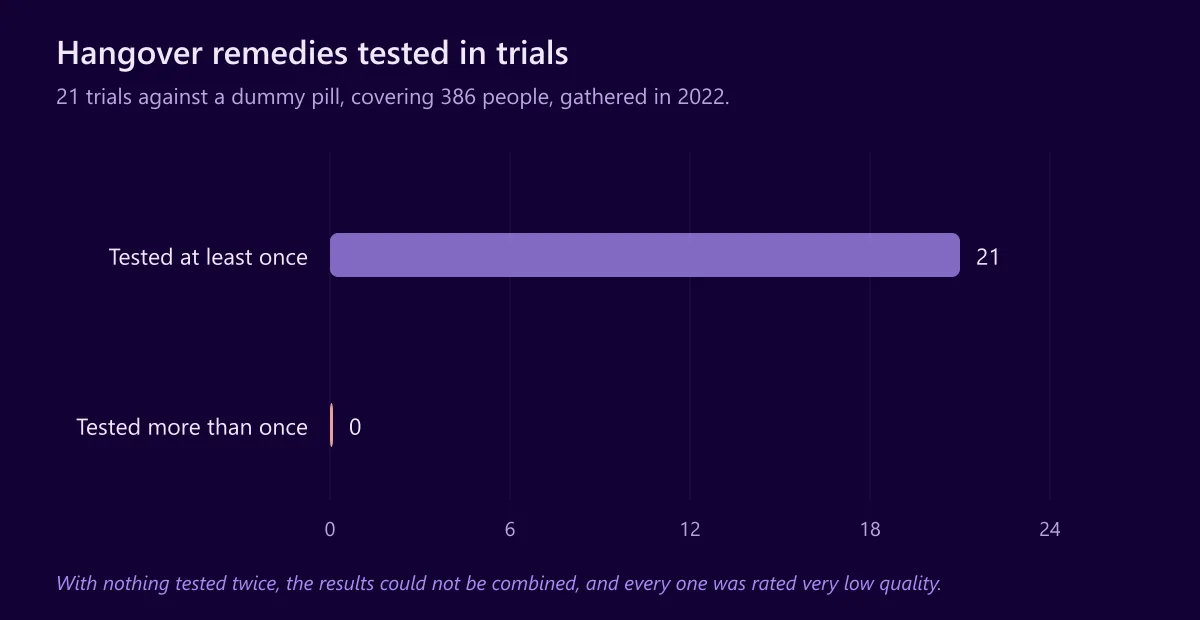
Start with what does not. In 2022 a review gathered every trial it could find that tested a hangover remedy against a dummy pill: 21 trials covering 386 people.
Then came the detail that settles it. No two of those trials tested the same thing. Every remedy had exactly one study behind it, which meant the researchers could not even combine them. They rated the quality of every single efficacy result as very low.
Seven remedies beat placebo in their one study each. That is what you would expect from twenty-one single studies whether or not anything worked.
What is left is boring and free: water, food, daylight, and getting the sleep back. The one thing worth avoiding is another drink, which postpones the same morning rather than cancelling it.
And give it the day. For most people this fades as the hangover does.
When it is a signal rather than a morning
Two patterns are worth taking seriously, and neither is about any single hangover.
Drinking to manage the anxiety. If alcohol has become the thing that makes social evenings possible, the research above says you are paying more for that than you are getting. In that study, the size of the next-day anxiety rise in shy drinkers was significantly linked to their scores on a standard alcohol screening questionnaire, and the authors suggested it might work as an early marker. It is one study and a correlation, so hold it loosely — but it points somewhere worth looking.
Anxiety that arrives with physical symptoms after heavier drinking, like shaking, sweating or a racing heart, especially when you stop or cut down. That is a different thing from a hangover and it is a reason to speak to a doctor rather than wait it out.
Our guide on talking to your doctor covers how to raise either, and a few weeks of notes is the most useful thing you can bring to that appointment.
Where this leaves Moodify
The research above gives you an average. It cannot tell you your own number, and your own number is the only one that would change what you do.
Here is the thing a study genuinely cannot answer: how long it takes you to come back. For some people the day after is the bad one. For others it is the second day, which is much harder to notice, because by then you have stopped connecting it to Friday.
That is a two-week question with a dull answer method. Log your mood daily, log your sleep, note the nights you drank. Then look at the pattern rather than at any single morning. Our guide on what to track besides mood explains why sleep is the field worth adding first, and spotting patterns covers reading your own data without talking yourself into something.
Moodify logs mood and sleep and keeps them next to each other, which is the whole trick. What Moodify is sets out what else is in it.
The part worth writing down
Memory is the wrong tool for this. It rebuilds how you felt from the sharpest moment and the most recent one, which our guide on why you cannot remember how you felt goes into. Ask yourself in December how drinking affected your mood in November and you will produce an answer that feels confident and is largely invented.
Thirty days of numbers will not feel like an insight. It will just be there, and it will settle the question.
Logging takes a few seconds in Moodify, and a paper diary does the same job. The anxiety self-check takes two minutes, and is more useful taken on an ordinary week than on a bad morning.
If you are worried about your drinking, that is worth raising with a doctor, and it is a far more ordinary conversation than it feels like beforehand. If you have been thinking about harming yourself, please talk to someone today — a doctor, a helpline, or a person you trust.
Common questions
- Why do I feel anxious the day after drinking?
- The most solid explanation is sleep. Alcohol delays and shortens dream sleep, starting at around two standard drinks, and short or broken sleep lowers the threshold for anxiety the next day. A rebound in brain chemistry after the alcohol clears is the popular explanation, but the direct evidence for that in humans is thinner than its confidence suggests.
- Is hangxiety real, or just a hangover?
- It is a real and measurable pattern, though it is not evenly spread. In one study of 97 drinkers, anxiety the day after rose significantly in people who described themselves as highly shy, and barely moved in everyone else. So the experience is real, and whether you get it strongly appears to depend partly on who you are.
- How many drinks before alcohol affects your sleep?
- About two. A 2025 review of 27 controlled studies found dream sleep was delayed and reduced at doses of roughly two standard drinks or fewer, and that the disruption got steadily worse as the dose rose. There is no dose in that review at which sleep was left undisturbed.
- Does alcohol actually help you sleep?
- It helps you fall asleep only at high doses, around five drinks, and the same review found that this likely makes the damage to dream sleep worse rather than better. So the thing it is famous for is both the smallest benefit and the one that costs the most.
- How long does hangover anxiety last?
- For most people it tracks the hangover and fades across the day. If anxiety after drinking lasts well beyond the physical symptoms, or arrives with shaking, sweating or a racing heart after a period of heavier drinking, that is worth a conversation with a doctor rather than a quiet wait.
- What actually helps hangover anxiety?
- Nothing in a bottle, on the current evidence. A 2022 review found 21 trials of hangover remedies covering 386 people, with no two trials testing the same thing, and rated the quality of every efficacy result as very low. What is left is unglamorous: water, food, daylight, and catching up on sleep.
- Is hangxiety a sign of a drinking problem?
- Not on its own. But in that study of shy drinkers, the size of the next-day anxiety rise was significantly linked to scores on a standard alcohol screening questionnaire. The authors suggested it might work as an early marker. Drinking specifically to quiet anxiety is the pattern worth watching, more than any single bad morning.
Sources
- Gardiner, Weakley, Burke et al. — The effect of alcohol on subsequent sleep in healthy adults: a systematic review and meta-analysis (Sleep Medicine Reviews, 2025;80:102030). 27 studies. REM sleep onset delayed and REM duration reduced; disruption present at low doses (0.50 g/kg or less, roughly two standard drinks) and worsening with dose. Reduced sleep onset latency and latency to N3 only at high doses (0.85 g/kg or more, roughly five standard drinks). Large uncertainty for total sleep time, sleep efficiency and wake after sleep onset
- Marsh, Carlyle, Carter et al. — Shyness, alcohol use disorders and hangxiety: a naturalistic study of social drinkers (Personality and Individual Differences, 2019;139:13-18). 97 participants tested at home, 50 drinking as usual and 47 remaining sober. Highly shy participants showed a marginal reduction in acute anxiety while drinking and a significant increase in anxiety the following day; in that group the size of the next-day rise correlated significantly with AUDIT scores
- Roberts, Smith, Hotopf & Drummond — The efficacy and tolerability of pharmacologically active interventions for alcohol-induced hangover symptomatology: a systematic review of randomised placebo-controlled trials (Addiction, 2022;117(8):2157-2167). 21 studies, 386 participants; no two studies reported on the same intervention, so no meta-analysis was possible, and all efficacy outcomes were rated very low quality under GRADE
- US National Institute on Alcohol Abuse and Alcoholism — alcohol use disorder
General information, not medical advice. See our editorial policy for how these guides are written and corrected.