Mind Matters
Social Anxiety or Introversion?
They get confused because they look alike from outside, and the difference is not how sociable you are. Introversion is a preference about where your energy goes. Social anxiety disorder is a persistent fear of situations where you might be judged, together with the avoidance that fear produces. The dividing line used clinically is cost: of US adults who had social anxiety disorder in a given year, around 30% were seriously held back and another 39% moderately so, meaning roughly seven in ten were having their lives measurably narrowed. The stereotype is also narrower than the reality. When researchers sorted 265 people diagnosed with social anxiety by personality, only a third matched the typical anxious, introverted picture. The largest group, 38%, did not. So being introverted is not what makes it social anxiety, and being outgoing does not rule it out.
The question usually gets asked the wrong way round. People ask how much they enjoy company, as though the answer sorted them into one box or the other.
It does not. You can dislike parties and have no disorder. You can be the funniest person in the room and still be afraid of it.
What each one actually is
Introversion is a preference. It is about where your energy goes: quieter settings are easier, large gatherings are tiring, and you are glad when it ends. You might enjoy the evening and still be relieved to leave.
Social anxiety disorder is a fear. The clinical definition is a lasting fear of social or performance settings where you might be judged, with the particular worry that you will act in some way that is embarrassing.
One describes what you would choose on a free evening. The other describes what you are afraid will happen if you do not get to choose.
| Introversion | Social anxiety | |
|---|---|---|
| The feeling | Depleted afterwards | Afraid beforehand |
| Why you decline | You would rather not | You are frightened of it |
| During the event | Often fine, sometimes enjoyable | Watching yourself, waiting for it to go wrong |
| Afterwards | Tired, needs quiet | Replaying what you said |
| The cost | Usually none | Things given up to avoid it |
That last row is the one that matters clinically.
Impairment is the dividing line
Discomfort is not a disorder. What gets a diagnosis is discomfort that is taking something from you.
Among US adults who had social anxiety disorder in a given year, about 30% were seriously held back and another 39% moderately so — roughly seven in ten with their lives measurably narrowed. The other 31% were mildly affected.
In practice that looks like: not applying for a job because it involves presenting, not making a phone call for weeks, leaving an event early every time, picking a course or a shift around who else will be there.
If nothing is being given up, the word “disorder” is doing no work. Being a person who finds socialising tiring is not a condition and does not need to be treated as one.
The stereotype is narrower than the reality
This is the finding that should change how the question is asked.
Researchers took 265 people diagnosed with social anxiety disorder and 164 people without, measured their personalities, and sorted the patients into groups by the shape of their results.
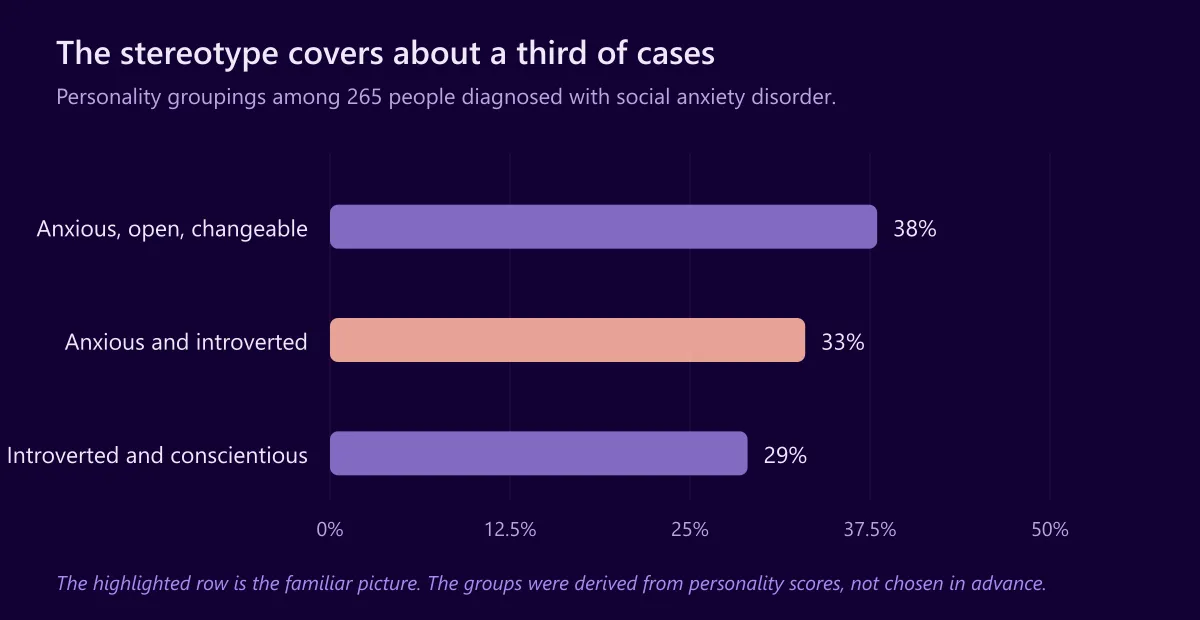
Three groups came out. The familiar one — anxious and introverted — accounted for only about a third. The largest group, 38%, was anxious and emotionally variable but also open rather than withdrawn. A third group, 29%, was introverted and conscientious with less extreme anxiety.
Two things follow from that.
Being introverted does not make it social anxiety. Plenty of introverted people in that study were in the less severe cluster, and plenty of people without any diagnosis are introverted.
Being outgoing does not rule it out. More than a third of this clinical sample were not the withdrawn type at all. Someone sociable, funny and visible can still be afraid of judgement and shaping their life around it — which is also why they are often the last to be taken seriously, a pattern our guide on high-functioning anxiety covers.
The researchers’ own conclusion was that social anxiety disorder holds a lot of personality variety, and that it is not one thing.
Better questions than “am I an introvert”
Ask these instead:
- What have I not done this year because of it? Not what you found hard. What you skipped.
- Is the fear about being judged specifically? Introversion is about stimulation. Social anxiety is about evaluation.
- How long does the dread last beforehand? Hours or days of it is a different thing from not fancying the evening.
- What happens afterwards? Tiredness is introversion’s cost. Replaying conversations for days is not.
- Would I go if I were certain nobody would judge me? If yes, the motivation is fear. If still no, it may just be preference.
The last one is the most useful question on the list, and the one nobody asks.
Some facts worth having
Social anxiety disorder affects an estimated 7.1% of US adults in a year and around 12.1% at some point in life. It is notably more common in younger adults — 9.1% of those aged 18 to 29 — and much less common after 60, at 3.1%.
That age pattern is worth noticing if you are in your twenties and convinced this is simply who you are. It is the most common period for it, and the figures do not stay at that level.
What helps, and what does not
Arguing yourself out of the fear does not work well, and neither does waiting until you feel ready. The approaches with the strongest evidence are cognitive behavioural ones that involve gradually approaching what is being avoided, in a planned way, usually with a clinician. That is deliberately not a self-help protocol, and we are not going to present it as one.
What you can do before that:
- Write down what you avoided, and when. Avoidance is invisible from the inside because it feels like preference. A fortnight of notes makes it visible.
- Separate the dread from the event. Note how bad you expected it to be and how bad it was. The gap is usually large and is the most persuasive thing you can show yourself.
- Do not use alcohol as the strategy. It works once and makes the fear worse over time.
Our guide on talking to a doctor covers how to raise this, which is itself a social situation and therefore a particularly unfair obstacle.
One honest note about the self-checks on this site: the anxiety self-check measures general anxiety, not social anxiety specifically. It is still useful to bring to an appointment, but a low score does not rule this out.
Why writing it down matters here especially
Of all the things people try to judge from memory, avoidance is the hardest, because it leaves no trace. A declined invitation does not feel like an event. It feels like a Tuesday.
A fortnight of notes — what came up, whether you went, how you felt before and after — turns a vague sense of being a homebody into something you can actually look at. Memory will not do this for you; it keeps the worst evening and the most recent one, as our guide on why you cannot remember how you felt explains.
A few seconds a day in Moodify is one way to keep that. A note on your phone is another. The thing that matters is having something other than an impression when you decide whether this is a preference or a problem.
Common questions
- What is the difference between social anxiety and introversion?
- Introversion is a preference: you find quieter settings easier and large social occasions tiring, and you can enjoy them while still being glad when they end. Social anxiety disorder is a persistent fear of situations where you might be judged or embarrassed, along with the avoidance of them. One is about where your energy goes. The other is about what you are afraid will happen, and what you give up to avoid it.
- Can you be an introvert and have social anxiety?
- Yes, and many people are both, but the two are not the same. In a study of 265 people diagnosed with social anxiety disorder, only about a third matched the familiar anxious and introverted picture. The largest group did not. Being introverted neither causes nor rules out the disorder.
- How do I know if my social anxiety is a disorder?
- The line is drawn at cost, not at discomfort. Among US adults with social anxiety disorder in a given year, about 30% were seriously held back and 39% moderately so. Most were losing something real: avoiding jobs that involve presenting, turning things down, not making calls. Discomfort you move through is not the same as a life shaped around avoiding.
- How common is social anxiety disorder?
- More common than most people assume. An estimated 7.1% of US adults had it in the past year, and about 12.1% experience it at some point in their lives. It is more common in younger adults, affecting 9.1% of those aged 18 to 29 in a year, and much less common after 60, at 3.1%.
- Is being shy the same as having social anxiety?
- No. Shyness is an ordinary trait. It is common and it is not a disorder. The clinical category is defined by lasting fear of being judged in social or performance settings, and by the cost that follows. Plenty of shy people have no diagnosis and need none.
- Does social anxiety get better?
- It is one of the more treatable anxiety conditions. The strongest evidence is for cognitive behavioural approaches, which usually mean slowly approaching what you avoid rather than arguing yourself out of the fear. That is work to do with a clinician. The figures also fall sharply with age, which suggests many people do not stay at one level for good.
Sources
- US National Institute of Mental Health — Social anxiety disorder statistics (National Comorbidity Survey Replication). Past-year prevalence 7.1% of US adults (female 8.0%, male 6.1%); 18-29 9.1%, 60+ 3.1%; lifetime 12.1%; impairment among past-year cases: serious 29.9%, moderate 38.8%, mild 31.3%
- Costache et al. — Higher- and lower-order personality traits and cluster subtypes in social anxiety disorder (PLOS ONE, 2020;15(4):e0232187). 265 patients, 164 controls; three clusters: Prototypical 33%, Introvert-Conscientious 29%, Instable-Open 38%
- US National Institute of Mental Health — anxiety disorders health topic
General information, not medical advice. See our editorial policy for how these guides are written and corrected.