Mind Matters
Does Venting Actually Help When You Are Angry?

Probably not, if by venting you mean doing something that winds you up further. A 2024 review gathered 154 studies covering 10,189 people and sorted anger activities by one thing: whether they raise or lower physical arousal. Activities that calmed the body down reduced anger by a moderate amount, and the result held across ages, countries, students and prisoners alike, and whether it was delivered by a therapist or through a screen. Activities that raised arousal did nothing measurable at all. The authors wrote that their findings do not support venting, or going for a run, as ways to manage anger. One thing this does not settle, and almost every write-up gets wrong: the studies sorted activities by what happens to your heart rate, not by whether you talk about what happened. Telling a friend calmly what went on is not the same as hitting something, and the review cannot tell those apart. So the useful rule is about temperature, not silence. Bringing the heat down is what works.
Somebody told you to let it out. Punch a pillow, go for a run, get it off your chest.
It is one of the most durable pieces of advice there is, and the research keeps declining to support it.
What they actually measured
In 2024 two researchers gathered 154 studies covering 10,189 people and did something clever. Instead of sorting anger activities by what they are called, they sorted them by what they do to your body.
- Activities that bring arousal down. Slow breathing, relaxation, meditation, taking a timeout.
- Activities that push arousal up. Hitting a bag, shouting, jogging, cycling.
Then they asked which group reduced anger.
The two numbers
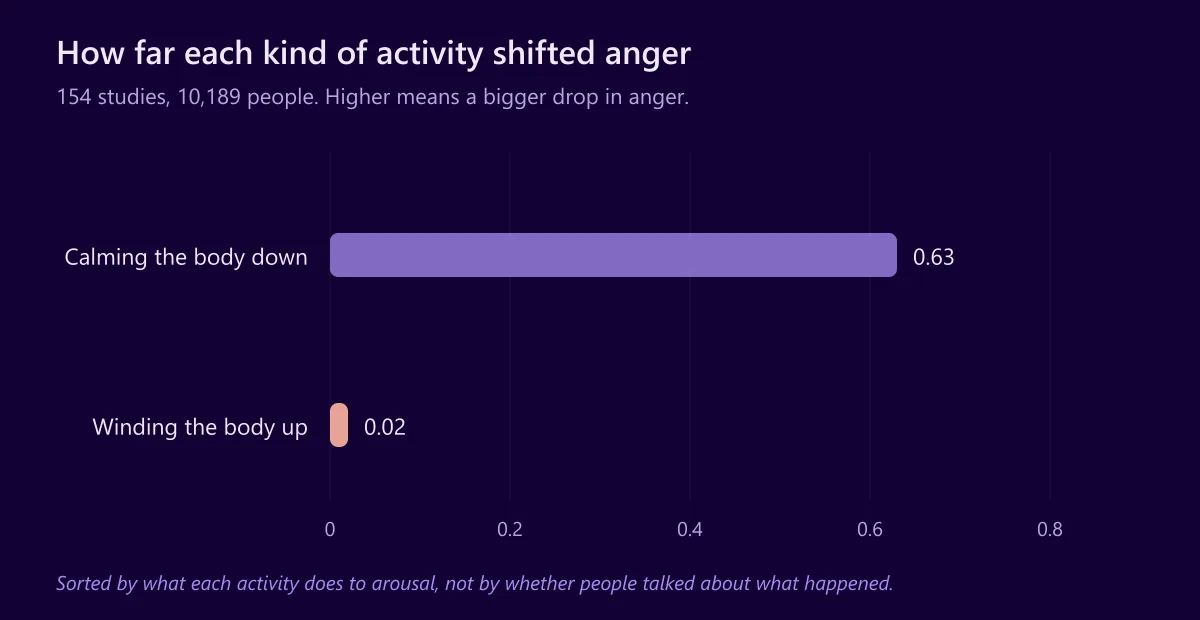
Calming the body down worked. The effect was 0.63 on the scale researchers use, where 0.2 is small and 0.5 is medium. That is a solidly moderate result, and for this field it is a large one.
Winding the body up did nothing. 0.02. Not a small benefit. Not a harm. A flat line.
The calming result was unusually sturdy. It held for men and women, across ages and countries, in students and in convicted offenders, in people with and without intellectual disabilities, in groups and alone, in laboratories and in real life — and whether it was taught by a therapist or delivered through a screen.
The authors wrote that their findings do not support venting anger, or going for a run, as effective ways to manage it.
What this study does not say
This is the part that gets mangled everywhere, so it is worth being careful.
It does not say bottling things up is good. The studies were sorted by arousal, not by expression. Nobody measured silence against speech. If you read this as “keep it to yourself”, you have read the opposite of what was tested.
It does not settle whether talking helps. Calmly telling a friend what happened and furiously rehearsing it for an hour are different things to your heart rate, and this review cannot tell them apart. Only the second one resembles what failed.
It does not mean exercise is bad for you. More on that next, because it is the objection everyone raises.
The honest summary is narrower and more useful than the headlines: the temperature is the thing. Bring it down, by whatever means, and the anger follows.
But exercise helps your mood, surely?
It does, and both things are true.
Our guide on whether exercise helps depression and anxiety covers the evidence that it does, over weeks. This review is about a different question: what to do in the twenty minutes when you are furious.
Anger is already a high-arousal state. Your heart rate is up, your muscles are tense, your breathing is shallow — the same physical picture our guide on the physical symptoms of anxiety describes. Going for a hard run adds to that picture rather than resolving it.
So: run on Tuesday for your mood. Do not run at 9pm on Thursday expecting it to discharge your argument.
Why “getting it out” feels so right
Because of what happens to attention, not to anger.
Hitting something is absorbing. For the minute you are doing it, you are not replaying the conversation. That feels like relief, and relief feels like progress.
Then you stop, and the thought is still there, and now your heart rate is higher than when you started. The research has been finding this for decades. The idea just refuses to die, because the first minute is genuinely convincing.
What to do instead
Short, dull, and backed by the better half of this review.
- Slow breathing, with the out-breath longer than the in. Our guide on whether breathing exercises work covers how much to expect from it — modest, and real.
- A timeout. Leaving the room is not avoidance; it is the thing that worked.
- Delay the conversation, do not cancel it. The point of coming down is to be able to say the thing properly, not to swallow it.
- Give it twenty minutes before deciding anything irreversible.
Worth saying plainly: none of this is about being nicer. It is about being able to say what you actually mean, which rage is famously bad at.
When anger is the symptom rather than the problem
Occasional anger is ordinary. A few patterns are worth noticing.
- Persistent irritability is a recognised feature of depression, and one that gets missed because people expect depression to look like sadness.
- Short sleep lowers the threshold for it. Our guide on what to do when you wake at 3am covers that loop.
- Anger that is new for you, or out of proportion to what set it off, is worth raising with a doctor rather than managing alone. Our guide on talking to your doctor covers how.
This is the kind of thing a record catches and memory does not. Ask yourself whether you have been more irritable lately and you will get a guess. Look at three weeks of logs and you get an answer.
Where this leaves Moodify
An honest note, because it cuts against us.
Moodify has an AI chat in it, and people use chats like that to vent. The review above raises a real question about which kind of activity that is. A conversation that helps you put the thing down is the sort that works. One that keeps you rehearsing the grievance at full volume looks much more like the sort that does not.
We have not tested which one ours does, and we are not going to claim it is the good kind because we would prefer that. What we can say is what the evidence favours: bring the arousal down first, then talk. Our guide on whether it is safe to talk to AI about mental health covers the wider version of this question.
The part of the app that is clearly useful here is duller. Logging mood daily catches irritability as a pattern, which is the thing you cannot see from inside a bad week. What Moodify is lists what is actually in it.
The pattern worth catching
Nobody logs anger in the moment. That is fine — the moment is not when this is useful.
What a few weeks of entries shows you is whether the bad days cluster, and what sits next to them. Short nights. Particular days. The week before something. Our guide on spotting patterns covers how to read that without inventing a story, and what to track besides mood explains why sleep is the field worth adding first.
Logging takes a few seconds in Moodify, and a note on your phone does the same job. The depression self-check takes two minutes, and is worth taking if irritability has been the main thing you have noticed.
If your anger has frightened you or someone else, that is worth taking to a professional rather than a technique, and it is a more ordinary conversation than it feels like beforehand. If you have been thinking about harming yourself or anyone else, please talk to someone today — a doctor, a helpline, or a person you trust.
Common questions
- Does venting actually help when you are angry?
- Not if venting means doing something that raises your heart rate, like hitting a bag or shouting. A 2024 review of 154 studies found those activities had no measurable effect on anger at all, while activities that calmed the body down reduced it by a moderate amount. The authors said plainly that their findings do not support venting as a way to manage anger.
- Is it bad to bottle up anger?
- That is not what this research says, and it is the most common misreading of it. The studies compared activities by whether they raise or lower physical arousal, not by whether people expressed themselves or stayed quiet. Nothing in it recommends suppressing anger. It recommends bringing your body down first, which usually makes the conversation afterwards go better rather than replacing it.
- Does hitting a pillow or a punching bag help?
- The evidence says no. Hitting things sits squarely in the group of activities that raise arousal, and that group showed no benefit for anger across 154 studies. The idea that aggression drains away if you act it out has been tested repeatedly and keeps failing.
- Does exercise help with anger?
- Not in the moment. The same review found going for a run was not supported as an anger management activity, which surprises people. That is not a contradiction of the evidence that exercise helps depression and anxiety over weeks. Anger is already a high-arousal state, so adding more arousal does not bring it down.
- What actually helps when you are angry?
- Anything that lowers physical arousal. In the review, slow breathing, relaxation, meditation and taking a timeout all sat in the group that worked, and the effect was moderate rather than small. It held whether the activity was taught by a therapist or delivered through an app.
- Does talking to someone about it help?
- The review cannot answer that, because it sorted activities by their effect on arousal rather than by whether people talked. Calmly telling someone what happened and angrily rehearsing it are very different things physically, and only the second one looks like what failed in these studies.
- When is anger a sign of something else?
- When it is persistent rather than occasional, when it is out of proportion to what set it off, or when it is new for you. Irritability is a recognised feature of depression and of poor sleep, and both are easier to spot in a few weeks of notes than in memory. If anger is damaging your relationships or your work, that is worth a conversation with a doctor.
Sources
- Kjærvik & Bushman — A meta-analytic review of anger management activities that increase or decrease arousal: what fuels or douses rage? (Clinical Psychology Review, 2024;109:102414). 154 studies, 184 independent samples, 10,189 participants. Arousal-decreasing activities reduced anger and aggression, Hedges' g = -0.63 (95% CI -0.82 to -0.43), with effects stable across genders, races, ages and cultures, in students and non-students, offenders and non-offenders, people with and without intellectual disabilities, delivered digitally or in person, in groups or individually, in field and laboratory settings. Arousal-increasing activities were ineffective overall, g = -0.02 (95% CI -0.13 to 0.09). The authors state the findings do not support venting anger or going for a run as effective anger management
- US National Institute of Mental Health — depression, which lists irritability among its symptoms
General information, not medical advice. See our editorial policy for how these guides are written and corrected.