Mind Matters
Does Exercise Actually Help Depression and Anxiety?

The evidence here is bigger than for almost anything else on this site. A 2023 overview pulled together 97 reviews, covering 1,039 trials and 128,119 people. It found medium-sized gains for depression, anxiety and general distress against usual care. The authors said moving should be a mainstay in managing all three. Two findings are worth acting on. Harder sessions did better than gentle ones. And short programmes did better than long ones, which is the opposite of what people expect, and probably says more about sticking with it than about the body. One caution belongs beside the headline. Of the 97 reviews, 77 were rated critically low in quality, so the exact numbers deserve less trust than the direction does. The direction is about as solid as this field gets.
“Have you tried exercise?” is one of the more annoying things anyone can say to a person who is depressed.
It is also, unfortunately, backed by a larger pile of evidence than almost anything else this site covers. Both of those can be true, and the useful question is what to do with it.
The size of the evidence
In 2023 researchers ran a review of reviews. They gathered 97 of them, covering 1,039 trials and 128,119 people, and asked what moving does for depression, anxiety and general distress.
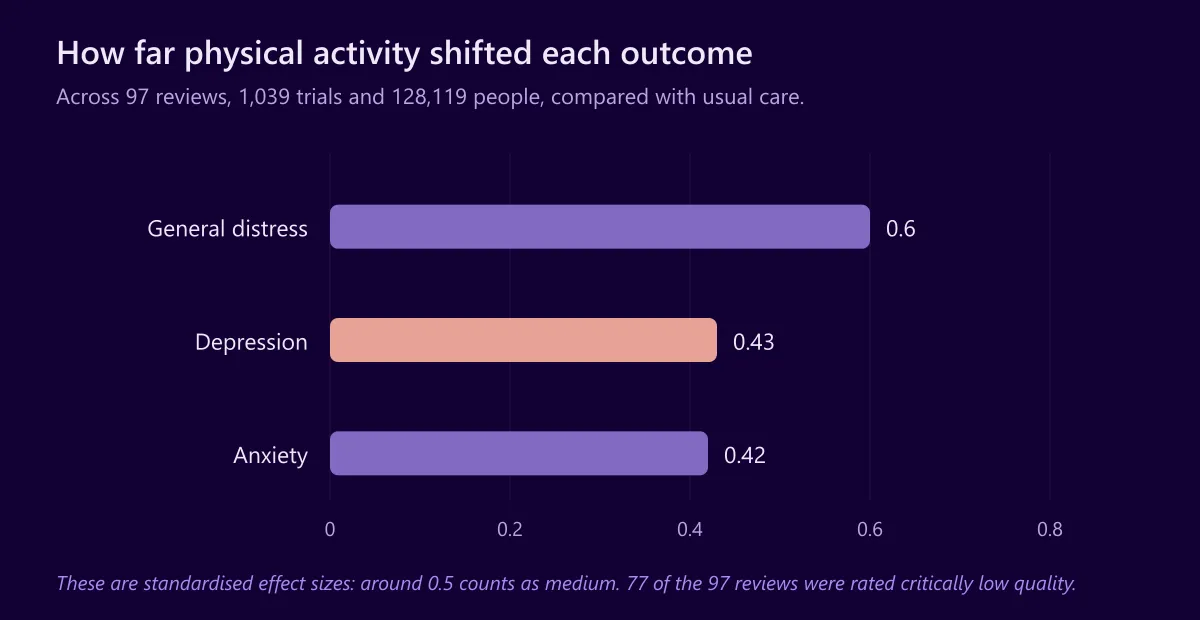
All three improved by a medium-sized amount against usual care. The biggest gains showed up in people with depression, in women during and after pregnancy, in people with HIV or kidney disease, and in healthy people.
The authors concluded that it should be a mainstay in managing these conditions, which is strong language for a research paper.
For scale, most things we cover here sit at small effects. The guides on mental health apps and worry time both describe gains a fraction of this size.
The caveat that belongs beside the headline
Of the 97 reviews included, 77 were rated critically low in quality.
That does not make the finding wrong. Reviews get marked down for how they report things, not for making things up, and the direction holds across a huge number of trials. It does mean the exact numbers should be held loosely.
The honest version: the direction is about as settled as anything in this field. The exact size is not.
Two findings worth acting on
Harder sessions did better. More intense activity produced bigger gains than gentle activity. That cuts against the usual advice to start with a stroll, though a stroll you do beats a session you skip.
Short programmes did better than long ones. The benefit went down as programmes ran longer. Nobody should pretend this is well understood. The likeliest reason is dull: people stick with short plans, trials lose people over time, and most of the change happens early.
Either way it points somewhere practical. A defined block with an end date beats an open-ended resolution. Six weeks of something specific is closer to what the evidence actually tested than “I’m going to start exercising”.
What this does not mean
It does not mean exercise replaces treatment. The authors noted the gains were about the same as, or a little bigger than, those seen for talking therapy and for drugs. But those are different studies compared at a distance, not a head to head. If something is working for you, this is no reason to stop it.
It does not mean failing to exercise is your fault. Low energy and lost drive are symptoms of depression, not proof you are not trying. Being told to exercise when getting to the kitchen is hard lands as blame, and nothing in this research justifies that.
It does not tell you which activity. No type came out on top. The trials behind it used walking, running, weights and cycling. How hard you went mattered. What it was called did not.
If you want to test it on yourself
The numbers above are averages across 128,119 people. Whether it does much for you is a different question, and one you can answer.
- Pick a block, not a lifestyle. Four to six weeks, with a start and a finish.
- Decide what you are testing beforehand. “Does this lift my mood” is vague. “Is my average day better in weeks three and four than in the two weeks before I started” is a test.
- Record daily, during. Not a verdict at the end — the verdict at the end is built from the best day and the last day.
- Keep the entry tiny. A number out of ten, and whether you moved. Our guide on what to track besides mood covers why adding more than that usually kills the habit.
- Expect a modest result. Medium-sized is real, and it is not a new life. Anything you have to squint to see is probably noise.
Why you need a record for this specifically
An effect of this size is exactly the kind that memory cannot resolve.
Ask yourself in six weeks whether it helped, and the answer gets built from the sharpest day and the most recent one. That is how memory sums up anything. Our guide on why you cannot remember how you felt goes into the mechanism and why it is not a personal failing.
Thirty numbers before and thirty after will settle in a glance what six weeks of reflection cannot.
Logging takes a few seconds in Moodify, where you can put the mood number and whether you moved in the same entry. A calendar with two marks a day does the same job. The point is deciding what you are testing before you start, rather than deciding afterwards how it felt.
If things have been bad for weeks and the idea of starting anything feels impossible, that is worth taking to a doctor rather than solving alone. The depression self-check takes two minutes and gives you a score to bring, and our guide on talking to a doctor covers what else is worth taking.
Common questions
- Does exercise really help depression and anxiety?
- Yes. A 2023 overview of 97 reviews, covering 1,039 trials and 128,119 people, found medium-sized gains in depression, anxiety and general distress against usual care. That is a far bigger evidence base than most things recommended for mood, and the authors said moving should be a mainstay in managing these conditions.
- How much exercise do you need for mental health?
- Less than people fear, and harder than they expect. In that overview, more intense activity produced bigger gains than gentle activity, and short programmes did better than long ones. There is no magic dose. The practical read is that a short, fairly demanding block beats a gentle plan you mean to keep forever.
- What kind of exercise is best for depression?
- The overview found gains across types rather than a single winner, so the honest answer is the kind you will actually do. How hard you went mattered more than what you did. Walking, running, weights and cycling all appear in the trials behind it.
- Is exercise as good as therapy or medication?
- The authors noted the gains were about the same as, or a little bigger than, those seen for talking therapy and for drugs. Treat that carefully. These are different kinds of studies, compared at a distance, and most of the reviews were low quality. It is a reason to take exercise seriously, not a reason to stop a treatment that is working.
- Why do shorter exercise programmes work better?
- Nobody knows for sure, and the likeliest reason is dull. People stick to short programmes, and longer trials lose people, which waters down the result. It may also be that most of the change happens early. Either way, it argues for a set block with an end date rather than a vague plan.
- What if I am too depressed to exercise?
- Then starting with exercise is the wrong first step, and saying so is not defeatism. Low energy and lost drive are symptoms, not unwillingness, and being told to go for a run can land as blame. At that point a talk with a doctor comes first. Movement can be something you add later rather than the thing you have to manage alone.
Sources
- Singh et al. — Effectiveness of physical activity interventions for improving depression, anxiety and distress: an overview of systematic reviews (British Journal of Sports Medicine, 2023;57(18):1203-1209). 97 reviews, 1,039 trials, 128,119 participants; median effect size -0.43 for depression (IQR -0.66 to -0.27), -0.42 for anxiety, -0.60 for psychological distress (95% CI -0.78 to -0.42); 77 of 97 reviews rated critically low on AMSTAR
- US National Institute of Mental Health — depression health topic
- US National Institute of Mental Health — anxiety disorders health topic
General information, not medical advice. See our editorial policy for how these guides are written and corrected.