Mind Matters
Do Breathing Exercises Actually Work for Anxiety?
Yes, modestly. The best evidence is a 2023 review of trials where people were put into groups at random. Across 12 trials and 785 people, breathwork left people less stressed than the comparison groups, by a small-to-medium amount. Anxiety and low mood moved by about the same. That is a real result and a small one, and three details matter more than the headline. Slow breathing worked; fast-paced breathing did not. Almost all of it was tested in people without a mental health diagnosis, so for people who have one there is a single trial rather than a body of evidence. And not one of the 12 trials was rated low risk of bias. The authors ended a positive paper by warning about a miscalibration between hype and evidence, which is not language people use about their own good news. Five minutes of slow breathing is still worth trying. It costs nothing, it is hard to get wrong, and a fortnight is enough to find out whether it does anything for you.
Every list of anxiety advice opens with breathing. It is free, it needs no equipment, and nobody has ever been put on a waiting list for it.
So it is worth knowing how much it actually does. The honest answer is a small amount, and a small amount is still worth five minutes.
What the evidence actually says
In 2023 a team gathered every trial they could find on deliberate breathing, counting only the ones that put people into groups at random. They screened 1,325 records and ended up with 26 usable ones.
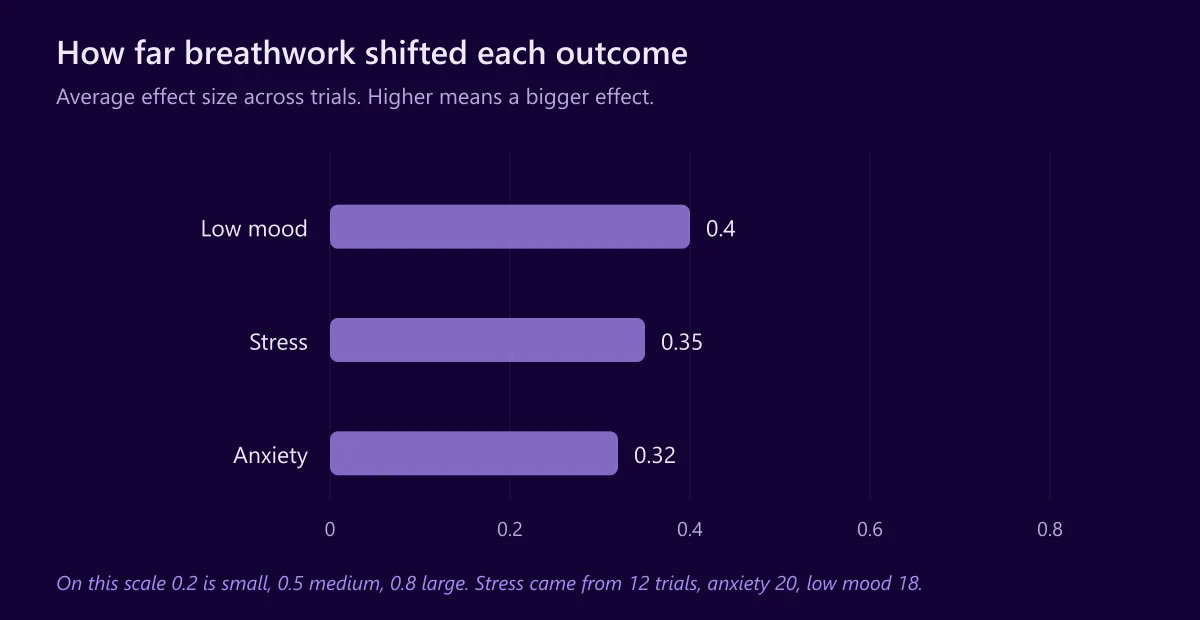
- Stress, the main thing they were testing: 12 trials, 785 people. People who did breathwork came out less stressed than the control groups by a small-to-medium amount.
- Anxiety: 20 trials, about the same size of effect.
- Low mood: 18 trials, slightly larger again.
Three results pointing the same way is more convincing than any one of them. The direction is not really in doubt. The size is where the honesty is needed.
What “small” actually means here
Researchers put these effects on a scale where 0.2 is small, 0.5 is medium and 0.8 is large. All three results here sat between 0.32 and 0.40.
In plain terms: a real nudge, not a transformation. If you expect breathing to remove anxiety, you will conclude it does not work. If you expect it to take some of the edge off the physical side, that matches what the trials found.
The part the headlines leave out
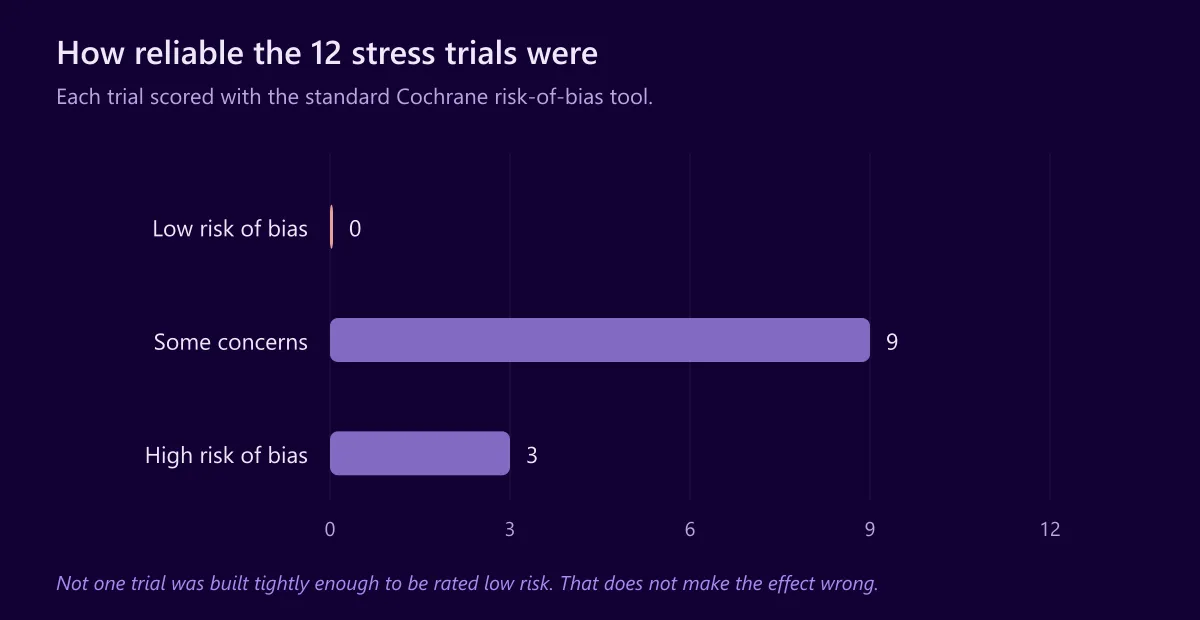
The researchers scored all 12 stress trials for how likely they were to be misleading. Three came out as high risk of bias. The other nine raised some concerns.
None of them was rated low risk. Not one.
That does not make the finding wrong. It means the finding rests on twelve studies, none of which was built tightly enough to settle the question. The authors closed their own positive paper by warning against “a miscalibration between hype and evidence” — which is not how people usually write about their own good news.
Slow worked. Fast did not.
This is the most useful split in the whole review.
Ten of the twelve trials tested slow breathing. Two tested fast-paced techniques, the rapid and forceful styles sold as breathwork workshops. The effect on stress held up for slow breathing and did not hold up for fast.
Two trials is far too few to call that settled. But if you are choosing where to spend five minutes, the slow kind is the one with something behind it.
Two more details worth having:
- It worked whether it was taught in person or remotely, and whether people did it alone or in a group. You do not need a class.
- It beat both kinds of comparison group: the people who did nothing, and the people given some other activity. That second one matters, because it suggests the result is not purely the effect of being handed something to do.
The study everyone quotes, and what it actually was
If you have seen breathing advice in the last three years, you have probably met “cyclic sighing” — two inhales through the nose, then a long slow exhale through the mouth.
The trial behind it deserves describing properly, because it is better than its reputation in one way and weaker in another.
What it did: 108 people, five minutes a day, for 28 days. Four groups — cyclic sighing, box breathing, fast breathing with breath holds, and mindfulness meditation as the comparison. Everyone improved. Cyclic sighing improved mood the most and slowed breathing rate the most. The benefit grew the more days in a row people kept it up.
What it was not: a large confirmatory trial. The participants were mostly students from one university psychology class. The groups were small once split four ways. And the researchers registered it as a trial only after it had run. They say all of this themselves, call it exploratory, and say a bigger pre-registered trial is the next step.
So: a good reason to try the long exhale first. Not proof that it beats everything else.
How to do the one with the most behind it
No app required, and no counting app either.
- Breathe in through your nose until your lungs feel comfortably full.
- Take a second, shorter sniff in on top of it.
- Let it out slowly through your mouth, taking longer over the out-breath than you did over both in-breaths.
- Repeat for five minutes.
If the double inhale feels fussy, plain slow breathing with a longer out-breath is the same idea. Four counts in, six or seven out. The out-breath being the longer one is the part that appears to matter.
Do it daily rather than only when you feel bad, since the trial found the benefit built up over consecutive days.
Where it can go wrong
Breathing exercises are about as safe as an intervention gets. Across the trials that looked for harms, none reported lasting bad effects. Only four of the twelve actively checked, which is its own small warning.
Two real cautions:
- Fast-paced breathwork is not the harmless one. In a trial of people with depression, some participants reported hot flushes, shortness of breath and sweating. They chose to carry on, and nobody dropped out because of it. But rapid breathing and breath holding deliberately produce the same sensations as anxiety. If those sensations are the thing that frightens you, that is a reason to stay with slow breathing. Our guide on the physical symptoms of anxiety covers why they are so convincing.
- Not as your first move in a panic attack. Controlled breathing can help, but trying to breathe “correctly” while panicking often just adds a second thing to fail at. Our guide on what to do during a panic attack sets out what helps in the moment.
Who this evidence does not cover
Worth being blunt. Of the 12 trials on stress, one involved people with a mental health condition. The rest were people with physical health problems, or people with no diagnosis at all.
So the honest claim is that breathing helps stressed people a little. The claim that it treats an anxiety disorder has a single study behind it, and a single study is not a finding. If anxiety is making your days hard, breathing is a reasonable thing to add and a poor thing to rely on. Our guide on managing mild anxiety without medication covers what else is on that list, and how to talk to your doctor covers raising it with someone.
Where this leaves Moodify
Moodify does not have a breathing exercise in it. We are not going to pretend otherwise, and we are not going to bolt one on this week because a study is popular.
What the app is for here is the other half of the problem: finding out whether it works for you. The research gives you an average across hundreds of people. It cannot tell you whether your own Tuesday is better after five minutes of slow breathing, and that is the only version of the question you actually care about.
The guided soundscapes in the app are a different tool for a different job — winding down, not paced breathing. What Moodify is lists what is actually in it.
Finding out whether it works for you
A fortnight is enough, and the method is dull on purpose.
- Do five minutes a day, at the same point in your day.
- Log your mood once a day, at the same time, whether you did the breathing or not.
- Look at the fortnight, not at any single day.
The days you skip are as informative as the days you do it. Our guide on spotting patterns covers how to read two weeks of your own numbers without fooling yourself, and how long until it becomes a habit explains why those first two weeks are the part worth protecting.
Logging takes a few seconds in Moodify, and a note on your phone does the same job. The anxiety self-check takes two minutes and gives you a score you can retake later.
If anxiety is severe, or you have been thinking about harming yourself, five minutes of breathing is not the answer and nobody should tell you it is. Please talk to a person today — a doctor, a helpline, or someone you trust.
Common questions
- Do breathing exercises actually work for anxiety?
- Yes, by a small amount. A 2023 review of 20 trials found breathwork left people less anxious than the groups it was compared against, with a small-to-medium effect. The same review found similar sized effects for stress and for depressive symptoms. It is a real effect, it is modest, and the trials behind it were not high quality.
- How long do you have to do breathing exercises for?
- Five minutes a day is the amount with the most direct evidence behind it. The trial that compared several techniques used five minutes daily for 28 days, and found the benefit grew the more consecutive days people practised. You do not need a long session, and there is no evidence that longer is better.
- Which breathing technique is best?
- The one with the most evidence is slow breathing where the out-breath is longer than the in-breath. In the one trial that compared techniques head to head, the exhale-focused pattern improved mood more than box breathing, more than fast breathing with breath holds, and more than mindfulness meditation.
- Does box breathing work?
- It helped, but less than exhale-focused breathing in the only trial that has compared them directly. Everyone in that trial improved, including the meditation group. If box breathing is the one you will actually do, the difference between techniques is smaller than the difference between doing it and not.
- Can breathing exercises make you feel worse?
- The slow kinds are very unlikely to. Fast-paced breathwork is a different matter: in one trial of people with depression, some participants reported hot flushes, shortness of breath and sweating. Rapid breathing and breath holding produce the same sensations as anxiety itself, so if those sensations are what frighten you, start with slow breathing instead.
- Do breathing exercises work if you have an anxiety disorder?
- Nobody can say yet. Of the 12 trials in the main analysis of stress, exactly one studied people with a mental health condition. Everything else was tested in people without a diagnosis or with a physical health problem. The evidence is about stressed people in general, not about treating a disorder.
- Is breathwork better than meditation?
- In the one trial comparing them, five minutes of daily breathwork improved mood more than five minutes of mindfulness meditation. But that trial was exploratory, it was mostly university students, and the researchers registered it only after it had run. Treat it as a good reason to try breathing rather than as a settled answer.
Sources
- Fincham, Strauss, Montero-Marin & Cavanagh — Effect of breathwork on stress and mental health: a meta-analysis of randomised-controlled trials (Scientific Reports, 2023;13:432). Stress k = 12, n = 785, Hedges g = -0.35 (95% CI -0.55 to -0.14), p = 0.0009, I-squared = 42%; anxiety k = 20, g = -0.32, p < 0.0001; depressive symptoms k = 18, g = -0.40, p < 0.0001. Of the 12 stress trials, 3 were rated high risk of bias and 9 raised some concerns; none was rated low risk
- Balban et al. — Brief structured respiration practices enhance mood and reduce physiological arousal (Cell Reports Medicine, 2023;4(1):100895). Remote randomised trial, 108 enrolled: 30 cyclic sighing, 21 box breathing, 33 cyclic hyperventilation with retention, 24 mindfulness meditation control; 5 minutes daily for 28 days. Cyclic sighing produced greater improvement in mood and greater reduction in respiratory rate than meditation (both p < 0.05). Participants were mostly Stanford undergraduates; the trial was exploratory and was registered retrospectively
- US National Institute of Mental Health — anxiety disorders
General information, not medical advice. See our editorial policy for how these guides are written and corrected.