Guides and Tools
Do Weighted Blankets Actually Work?
For anxiety, probably, by a small amount. For sleep, which is what the packaging is about, the evidence is much weaker than the marketing. Two separate teams went through the trials in 2024 and reached almost the same number for anxiety: a small but real improvement, found again by a second team working from an overlapping but different set of studies. Sleep is the other story. One team could not combine the insomnia results into a clear answer at all. The other did not try. The trial everyone quotes, from 2020, found an effect on insomnia so large it would be remarkable in any field, and it was a trial in which everyone could tell which blanket they had been given by lifting it. That is not a reason to throw yours out. Nothing in this research suggests weighted blankets do harm, and no serious side effects turned up anywhere. It is a reason to buy one for the thing it has actually been shown to do.
A weighted blanket is sold as a sleep product. It sits in the bedding aisle, the box has a bed on it, and the promise is that you will sleep better.
The research has tested that, and it has also tested something else. The something else is where the good news is.
The number two separate teams agreed on
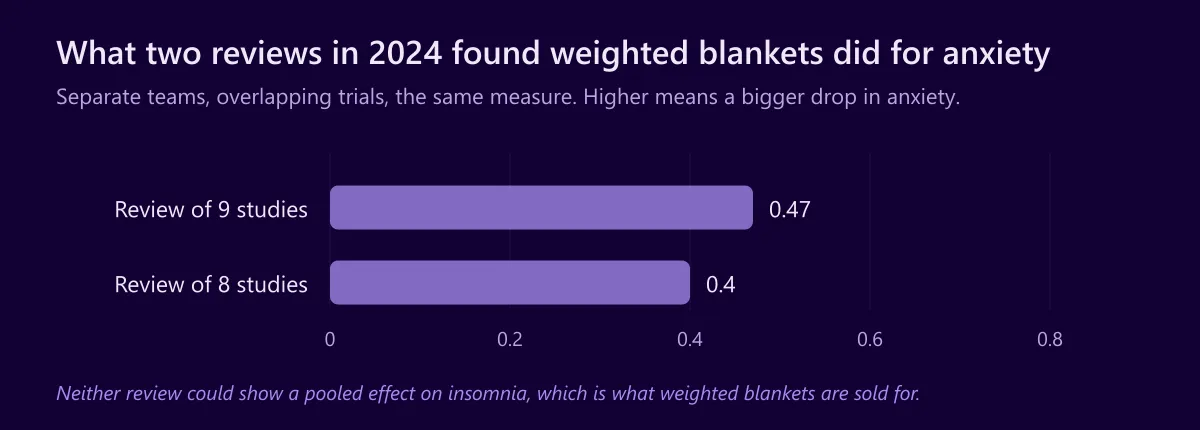
In 2024, two groups of researchers independently went through the trials of weighted blankets in people with mental health diagnoses. They used different search methods, finished with overlapping but not identical sets of studies, and came out at almost the same place on anxiety.
- One team, working from nine studies: an improvement of 0.47, where 0.2 counts as small and 0.5 as medium.
- The other, working from eight: 0.40.
Two teams, two sets of trials, the same answer. That is about as much agreement as this field ever produces, and it is worth taking seriously.
What it is not is a sleep result.
What happened when they looked at sleep
One of the two teams tried to combine the insomnia results. Three trials had measured it, and together they produced a number that was not clear enough to count — close to the line, but on the wrong side of it.
When that team dropped the one study that did not resemble the others, the remaining two did show a benefit. That is a real finding and it is also a fragile one, because leaving a study out and watching the answer change is exactly what you would expect from a small set of trials.
The other team did not combine the sleep results at all. They described four studies that reported something and left it there.
So the honest position on sleep is: maybe, from very little.
The trial everyone quotes
Now the study that sits behind most of the marketing.
In 2020 a team in Sweden gave 120 patients either a weighted metal chain blanket or a light plastic chain one for four weeks. The weighted group’s insomnia scores improved enormously — by 1.9 on the scale researchers use for this, where 0.8 is conventionally called large.
An effect of 1.9 is not large. It is extraordinary. Nothing in sleep research produces numbers like that, and when a number like that appears, the first question is what else could have produced it.
Here it is not hard to find. Everyone in that trial knew which blanket they had. You cannot blind a person to weight; it is the entire treatment. And the main outcome was a questionnaire the participants filled in themselves about how they felt they had slept.
That does not make the trial dishonest or useless. The team compared against another blanket rather than against nothing, which is a better design than most products in this category ever get tested with. It makes the size of the result the thing to be careful about, not the direction.
This is the same shape of problem our guide on whether a sad lamp actually works runs into: you cannot easily hide a bright light from someone either.
Why anxiety and sleep might genuinely come apart
Here is the part worth sitting with, because it makes the pattern make sense.
Whatever a weighted blanket does, it does it while you are awake. The weight is a steady, even pressure, and that is a signal your body reads as calm. If that is the mechanism, then the thing it should change is how settled you feel — which is what the trials keep finding.
Sleep is downstream of that, and a lot of other things sit in between. You can feel calmer at eleven and still be awake at one because you drank coffee at four, or because the room is too warm, or because of the pattern our guide on what to do when you wake at 3am describes.
A product that reliably makes bedtime feel better and unreliably makes sleep longer is exactly what you would predict from a calming mechanism. That is what the evidence looks like.
What the quality of this research is actually like
Three things, stated plainly, because they apply to every number above.
- Half the trials in one review were rated high risk of being skewed, and the stated reason was the blinding problem — people knew which blanket they had, and then reported on themselves.
- The study counts are tiny. Nine studies in one review, eight in the other, and only a handful measuring any one outcome.
- No serious harms turned up. One review looked for them specifically and found none. People who disliked the blankets found them hot, heavy or uncomfortable.
That last point changes the decision. When something is cheapish, safe and possibly mildly helpful, the bar for trying it is low. The bar for claiming it fixes insomnia is much higher, and the claim has not cleared it.
Who should be more careful
A few groups where the general answer does not apply.
- Autistic children and young people. A practice guideline for sleep problems in this group suggests weighted blankets may not be an evidence-informed choice, and the trials there have tended not to find an objective sleep benefit even when children preferred the blanket.
- Anyone who could not move it off themselves, including young children and people with limited strength or mobility.
- Anyone who overheats at night, which was the most common complaint from people who stopped using them.
And the ordinary one: if you cannot sleep most nights, and have not been able to for months, that is worth raising with a doctor rather than solving in the bedding aisle. Our guide on talking to your doctor covers how that conversation goes, and sleep restriction therapy covers the approach with the strongest evidence behind it, which is free and which almost nobody is sold.
Where this leaves Moodify
Moodify does not sell blankets and has no partnership with anyone who does, which is worth saying because a lot of writing about this product does.
The connection is duller. If you buy one, you have a question you can answer about yourself: does it do anything for you? The averages above cannot tell you that, and the effects are small enough that your own case genuinely might differ from them.
What Moodify is lists what is actually in it.
Testing it on yourself properly
This is a good candidate for a self-test, because the thing being tested arrives on a known date.
- Log your mood and your sleep for two weeks before the blanket arrives. Without that, you have nothing to compare against.
- Keep logging for a month after.
- Log at the same time each day, and rate the night rather than trying to remember the week.
- Add one note: whether you used it. Some nights you will not.
Then look at the two months side by side. Our guide on spotting patterns covers how to read that without talking yourself into a result, and why you cannot remember how you felt explains why the before-and-after in your head will not do.
Be aware of what you are up against: you will know you have the blanket, which is the exact problem the trials had. That does not make your result worthless. It means a small improvement is hard to trust and a clear one is still worth having.
Logging takes a few seconds in Moodify, and a notebook does the same job. The depression self-check takes two minutes, and is worth taking if poor sleep has been going on for months, because the two travel together more closely than people expect.
If you have not slept properly for weeks and it is affecting your days, please raise it with a doctor — poor sleep is treatable and the treatments are good. If you have been thinking about harming yourself, please talk to someone today — a doctor, a helpline, or a person you trust.
Common questions
- Do weighted blankets actually work?
- For anxiety, probably a little. Two separate reviews in 2024 both found a small improvement in anxiety when the trials were put together, using different sets of studies and reaching almost the same number. For sleep, the evidence is much weaker. One of those reviews could not combine the insomnia results into a clear answer at all.
- Do weighted blankets help with insomnia?
- Less clearly than you would guess from how they are sold. When one 2024 team combined the three trials that measured insomnia, the result was not clear enough to count. A single trial from 2020 found a very large benefit, but nobody in it could be blind to which blanket they had, because the whole treatment is weight you can feel.
- How heavy should a weighted blanket be?
- The usual advice is around a tenth of your body weight, and no trial has tested that rule against alternatives. The studies used a range of weights and none of them compared one weight with another, so there is no evidence-based number to give you. Comfortable is the honest answer.
- Are weighted blankets safe?
- For most adults, yes, on the evidence so far. One 2024 review looked specifically for harms and found no serious adverse events reported anywhere. The people who struggled with them tended to find them hot, heavy or uncomfortable rather than harmful. They are not recommended for young children or for anyone who could not move one off themselves.
- Do weighted blankets help with ADHD or autism?
- Not reliably for sleep. A practice guideline for sleep problems in autistic children and young people suggests weighted blankets may not be an evidence-informed choice, and the trials in that group have generally not found an objective sleep benefit even when people preferred the blanket.
- Why do weighted blankets feel so good then?
- Because feeling calmer is the thing the evidence actually supports, and it is a real effect rather than an imagined one. The gap is between calm and sleep, not between real and fake. A blanket that settles you at bedtime is doing something worth having even if it does not change how long you sleep.
- Should I buy a weighted blanket?
- If you want one for the settling feeling at bedtime, that is the use the research supports, and they appear to be safe. If you are buying one to fix insomnia, the evidence behind that promise is thin, and the money may be better spent on the sleep approaches with much stronger support behind them.
Sources
- Wong et al. — The effect of weighted blankets on sleep quality and mental health symptoms in people with psychiatric disorders in inpatient and outpatient settings: a systematic review and meta-analysis (Journal of Psychiatric Research, 2024 Nov). Nine studies, 553 psychiatric inpatients and outpatients (289 weighted blanket, 264 control), with diagnoses including depression, bipolar disorder, ADHD and autism; intervention length 5 minutes to one year. Versus placebo, anxiety SMD -0.47 (95% CI -0.68 to -0.25, p < 0.001). Four studies reported evidence on insomnia, total sleep time and sleep onset latency; six reported reduced anxiety. One RCT was low risk of bias, 3 had some concerns, 1 was high risk; three cohort studies were rated fair and one poor
- Zhao et al. — Safety and effectiveness of weighted blankets for symptom management in patients with mental disorders: a systematic review and meta-analysis of randomized controlled trials (Complementary Therapies in Medicine, 2024 Dec). Eight randomised trials, 426 patients. Half were rated high risk of bias, primarily for failure to blind participants on participant-reported measures. No serious adverse events. Anxiety across five studies: SMD 0.40, a small effect. Insomnia across three studies: MD -1.92 (95% CI -3.92 to 0.09), p = 0.06, nonsignificant; a leave-one-out analysis of the two remaining homogeneous studies gave MD -2.78 (95% CI -4.44 to -1.12), p = 0.001. Summary estimates for fatigue and depression were not computed because of heterogeneity. Notes an existing practice guideline suggesting weighted blankets may not be evidence-informed practice for insomnia in children and adolescents with autism spectrum disorder
- Ekholm, Spulber & Adler — A randomized controlled study of weighted chain blankets for insomnia in psychiatric disorders (Journal of Clinical Sleep Medicine, 2020). 120 patients with major depressive disorder, bipolar disorder, generalised anxiety disorder or ADHD randomised 1:1 to a weighted metal chain blanket or a light plastic chain blanket for 4 weeks. Insomnia Severity Index was the primary outcome: advantage to the weighted blanket at 4 weeks (P < .001), Cohen's d 1.90. Also better sleep maintenance, higher daytime activity and reduced daytime fatigue, depression and anxiety. No serious adverse events. 12-month open follow-up. ClinicalTrials.gov NCT03546036
- US National Institute of Mental Health — depression
General information, not medical advice. See our editorial policy for how these guides are written and corrected.