Guides and Tools
Does a SAD Lamp Actually Work?
Gathering up 19 trials, bright light came out modestly better than a dummy lamp for seasonal depression, with more people responding to it than to the dummy. The same review found those trials were small and at fair risk of being skewed, and called for better ones. The NHS, looking at the same field, says there is not enough evidence to show whether light therapy works — while noting that many people find it helps. Both positions are defensible, and the gap between them is really a gap between "probably does something" and "proven well enough to fund". If you want to try one, the specifications matter more than the brand: around 10,000 lux, UV-free, used within an hour of waking for about half an hour, every day, for at least a few weeks. And check with a doctor first if you have bipolar disorder, an eye condition, or take anything that makes you sensitive to light.
Two credible answers exist to this question, and they do not match.
The research says a SAD lamp probably helps a bit. The NHS says there is not enough evidence to know. Both are honest readings of the same field, and the difference between them tells you most of what you need.
What the research found
A review gathered up 19 trials of bright light for seasonal depression. Light came out better than a dummy lamp, by a modest margin. More people responded to it than to the dummy — roughly four for every three.
The same review was candid about what it was working with. The trials were small, varied a good deal, and were at fair risk of being skewed. Its authors concluded both that light therapy works and that the field needs larger, better studies. Both halves of that are the finding.
Why the NHS is less convinced
The NHS lists light therapy as a treatment for seasonal affective disorder. Then it says plainly that it is not usually available on the NHS, because there is not enough evidence to show whether it works. It adds that many people find it helps their symptoms.
That is not a contradiction of the research. It is a different question.
“Did this beat a dummy lamp in small studies?” sets a lower bar than “is this proven well enough to spend public money on?” Light therapy sits between the two. The honest summary: good enough to try, not good enough to be sure about.
Worth adding, since we have written about bright light before: our guide on morning anxiety reports a trial where bright light did nothing for anxiety. That is not a conflict. Seasonal depression and anxiety are different conditions with separate evidence bases, and light looks better for the first than the second.
How bright, really
This is where most disappointment comes from. The research used around 10,000 lux, and so does the NHS guidance for anyone buying a lamp. Ordinary indoor lighting is a few hundred.
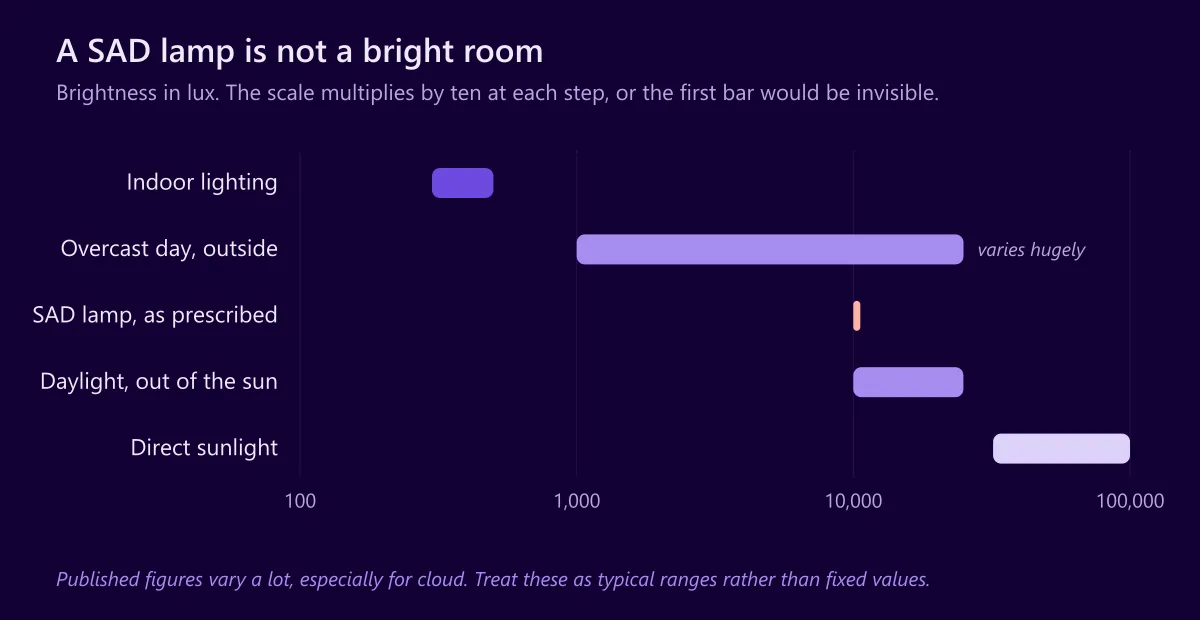
A well-lit room is not a weak version of light therapy. It is roughly one-twentieth of it. Sitting near a window on a dull day will generally do more than turning on every lamp in the house.
The specifications that matter, per the NHS: around 10,000 lux, UV-free, and carrying a UKCA or CE mark. Beyond that, use it the way the manufacturer says, because the lux figure only holds at a particular distance.
How to use one
| When | Morning, as soon after waking as you can manage |
| How long | About 30 minutes a day |
| How far | As specified — commonly 40–60 cm from your face |
| How often | Every day, not when you remember |
| How long before judging it | At least three weeks, though some notice a change in the first |
You do not stare at it. You sit near it with it off to one side and in your field of view, and get on with breakfast or email.
Daily use is the part people get wrong. The research protocols are daily, at a consistent time — not a long session at the weekend to make up for a missed week.
Who should check with a doctor first
This section is short, and it matters more than the rest.
If you have bipolar disorder, ask before you start. Bright light can trigger mania, and it is not advised during or shortly after a manic or hypomanic episode. This is the one genuinely serious risk here, and it is the thing consumer reviews leave out.
Also worth a conversation first if you:
- have a retinal or other eye condition
- take medication that increases light sensitivity — some antibiotics and anti-inflammatories do, and so does St John’s wort
- are already being treated for depression and want to add this to it
The common side effects are mild: eye strain, headache, nausea, irritability, sometimes disturbed sleep. They usually settle within a few days, and can often be eased by moving the lamp further away or shortening the session rather than abandoning it.
What else helps in winter
Light therapy is one option, and the NHS puts two others ahead of it: talking therapies such as CBT, and antidepressants where appropriate. In England you can refer yourself to NHS talking therapies without going through a GP.
Alongside those, the NHS suggests the unglamorous things — getting outside in daylight, exercising, staying in touch with people, keeping sleep times consistent, going easy on alcohol.
If winter low mood is heavy enough to be worth discussing, our guide on talking to a doctor covers what to take with you. The depression self-check gives you a score and a date to bring.
How to tell whether it is working for you
Because the average effect is modest, you cannot tell from how you feel on any given morning. Winter mood moves around for lots of reasons, and a good Tuesday proves nothing.
What does tell you something is a few weeks of ratings either side of starting. Note a number out of ten each day, and when you used the lamp. After three or four weeks the comparison is at least worth looking at — far better than trying to remember whether February felt different from January.
Logging a mood in a few seconds, the way you can in Moodify, makes that before-and-after easy to see. A paper calendar on the wall does it too. The point is deciding in advance how you will judge it, rather than deciding afterwards whether it felt like it helped.
Common questions
- Do SAD lamps actually work?
- Modestly, on the available evidence. A review gathering up 19 trials found bright light beat a dummy lamp for seasonal depression, and that more people responded to it. The same review judged those trials small and at fair risk of being skewed. The NHS takes a stricter reading and says there is not enough evidence to show whether it works, though it notes many people find it helps.
- How bright does a SAD lamp need to be?
- Around 10,000 lux, which is the level nearly all the research used, and the figure the NHS points to for anyone buying one. For comparison, ordinary indoor lighting is a few hundred lux — so a bright room is not a substitute, and neither is a desk lamp. The NHS also advises choosing one that is UV-free and carries a UKCA or CE mark.
- When and how long should you use a SAD lamp?
- In the morning, as soon after waking as is practical, for about thirty minutes a day at the distance the manufacturer specifies — commonly around 40 to 60 centimetres. Daily use matters more than any single session, and clinics generally suggest giving it at least three weeks before judging it, though some people notice a change within the first week.
- Who should not use a SAD lamp?
- Check with a doctor first if you have bipolar disorder, because bright light can trigger mania and it is not advised during or shortly after a manic or hypomanic episode. The same applies if you have a retinal or other eye condition, or take medication that increases light sensitivity — some antibiotics and anti-inflammatories do, as does St John's wort.
- What are the side effects of light therapy?
- The common ones are mild and usually settle within a few days: eye strain, headache, nausea, irritability and sometimes disturbed sleep. They can often be reduced by moving the lamp further away or shortening the session rather than stopping. The serious concern is the mania risk for people with bipolar disorder.
- Is light therapy available on the NHS?
- Not usually. The NHS lists it as a treatment for seasonal affective disorder but says it is not generally available, on the grounds that the evidence is not strong enough. What it does recommend is talking therapies such as CBT, and antidepressants where appropriate — and in England you can refer yourself to NHS talking therapies without going through a GP.
Sources
- NHS — Seasonal affective disorder (SAD): treatment
- Systematic review and meta-analysis of randomised trials of bright light therapy in seasonal affective disorder (Psychotherapy and Psychosomatics, 2020)
- Yale Winter Depression Research Clinic — light treatment guidance
- University of Michigan Health — using a light box
- US National Institute of Mental Health — health topics
General information, not medical advice. See our editorial policy for how these guides are written and corrected.