Daily Rituals
Sleep Restriction: Why Less Time in Bed Can Mean Better Sleep
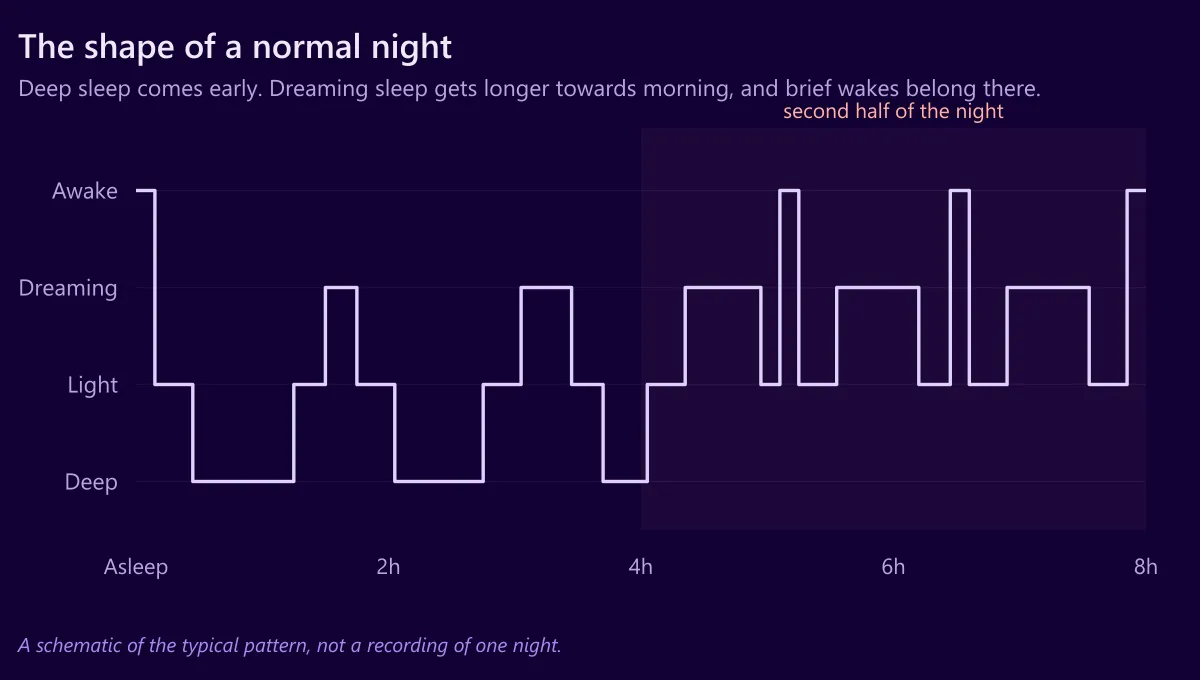
Sleep restriction means cutting the hours you spend in bed to roughly the hours you actually sleep, then adding time back slowly as your sleep fills the window. It sounds like a punishment and it is one of the better supported parts of insomnia treatment. A review of eight trials found large improvements in insomnia severity, in how long people took to fall asleep, and in time spent awake during the night, with effects about as big as full insomnia therapy. Here is the part nobody mentions: it produced no change at all in total sleep time. You do not end up sleeping more. You end up sleeping more solidly, in a shorter window, and feeling less broken by it. Two honest warnings. The evidence base is small, most of the trials carried a high risk of bias, and almost none followed people beyond three months. And the first two weeks make you sleepier, which is why this is a thing to do with a clinician rather than from an article.
Most sleep advice asks you to do something pleasant: a bath, a dark room, no screens. This one asks you to spend less time in bed when you are already desperate for sleep.
It is also one of the better supported things in the field, which is an awkward combination.
This article explains what it is and what the evidence says. It is not a set of instructions, and the last section explains why.
What it actually is
If you lie in bed for nine hours and sleep for six of them, you spend three hours awake in the place you are trying to sleep. Night after night, the bed stops being a cue for sleep and becomes a cue for lying there frustrated.
Sleep restriction shrinks the window. You cut time in bed to roughly the time you are actually sleeping, hold it there, and then widen it slowly as the sleep fills the space.
The point is not less sleep. The point is less awake.
What the evidence shows
A review brought together eight trials comparing it against control groups.
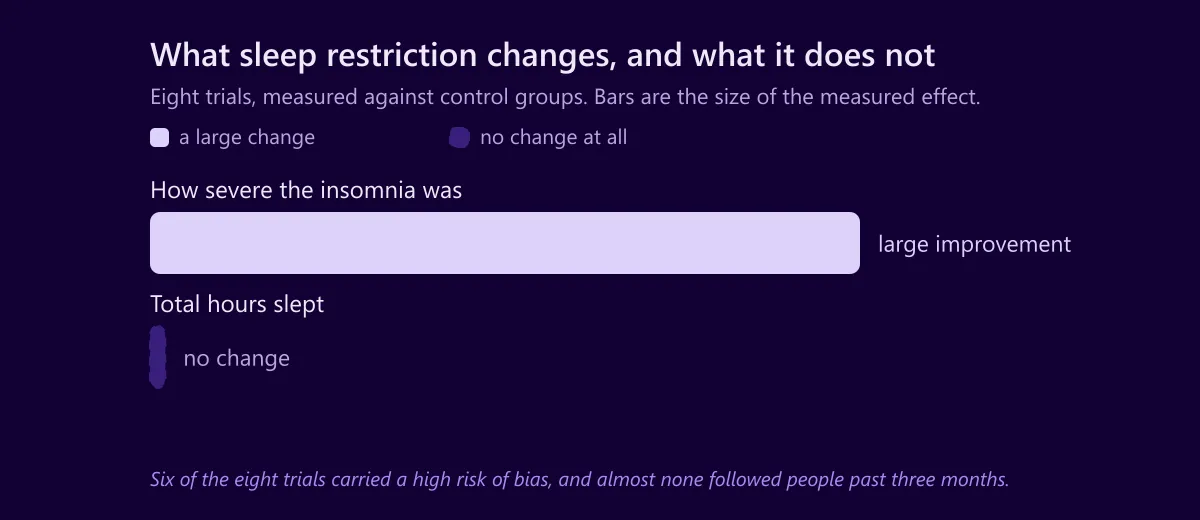
The improvements were large: in how severe the insomnia was, in how long people took to fall asleep, and in how much of the night they spent awake. The reviewers noted the effects looked about as big as full multi-part insomnia therapy, of which this is normally one component.
And then the finding that gets left out of every summary:
Total sleep time did not change at all.
Sit with that, because it reframes the whole thing. This does not give you more hours. It makes the hours you already get more solid, and it makes the insomnia itself less severe. People finish feeling better without sleeping longer.
Where the evidence is thin
Being straight about this, since the effect sizes above are the kind that get quoted without their footnotes.
- Eight trials, with no more than six comparisons behind any single outcome.
- Six of those eight were judged at high risk of bias.
- Almost none followed people past three months, so whether the benefit lasts is genuinely unknown.
- The reviewers called for trials against control groups matched for the general effects of being treated, which is exactly the comparison missing.
So: a real effect, repeatedly found, on a small and imperfect base.
The part that makes it hard
The first couple of weeks are worse. That is not a side effect, it is the mechanism — you are deliberately building up sleep pressure so that the shorter window fills.
The obvious question is whether that leaves you impaired during the day. One small study followed sixteen adults through two weeks of it and measured reaction time, inhibition and performance on a driving simulator. It found no significant change in any of them, nor in self-reported sleepiness.
That is reassuring and it is thin. Sixteen people, no control group, and the authors were explicit that it only applies where total sleep time stays roughly unchanged. Plenty of other work on short sleep in general finds exactly the impairment you would expect.
The sensible reading is not “it is proven safe to drive”. It is “plan for being sleepy, and treat driving as the thing to be careful about”.
Why this is not a do-it-yourself protocol
We write a lot of things here you can do on your own. This is not one of them, for four reasons.
| Why it needs supervision | What goes wrong alone |
|---|---|
| The starting window is set from your own sleep diary | Guessing produces a window too short or pointless |
| It needs adjusting weekly on rules | People widen it the moment it is uncomfortable, which undoes it |
| Several conditions change the calculation | Untreated sleep apnoea, epilepsy, bipolar disorder |
| Sleepiness has to be managed around real life | Driving and machinery are the risk |
The window is also not simply “sleep less”. Going below about five hours in bed is not part of the standard approach, and the protocol includes rules for widening the window as sleep efficiency improves. Those rules are the treatment as much as the restriction is.
How to get it: ask a doctor about cognitive behavioural therapy for insomnia, which is the recommended first treatment for long-running insomnia in most guidelines and which contains this as one component. Our guide on talking to a doctor covers how to raise it, and a few weeks of sleep notes is the single most useful thing to bring.
What you can do without supervision
The milder relatives of this idea are safe and often enough:
- Get up when you have been awake a long time. Not as a rule with a stopwatch, but the principle holds: do not lie there practising wakefulness. Our guide on waking at 3am covers the small-hours version.
- Keep one fixed wake time. It is the single most useful thing you can change, and it costs nothing.
- Stop going to bed early to catch up. More time in bed is the instinct and it reliably makes things worse. Our guide on staying up late when you are tired covers the other end of the same problem.
- Keep a sleep record for two weeks before asking for help. This is the thing clinicians need and nobody arrives with.
The record is the prerequisite
Everything above starts from knowing how much you actually sleep, and nobody knows that from memory. People reliably overestimate how long they lie awake and underestimate how much they get, and a bad night colours the whole week’s recollection, which our guide on why you cannot remember how you felt explains.
Two numbers a day will do: roughly when you went to bed and got up, and your own verdict on the night out of ten. A fortnight of that is what a clinician will ask for, and it is what sets the starting window if you do end up doing this properly.
Logging it takes seconds in Moodify, which has a sleep tracker alongside the mood log. A paper diary is what the trials themselves used. Either way, the fortnight before the appointment is the part that makes the appointment work.
Common questions
- What is sleep restriction therapy?
- It is the part of insomnia treatment where you cut the time you spend in bed down to roughly the time you actually sleep, hold that for a while, then widen the window gradually as your sleep fills it. The aim is to stop long stretches of lying awake, which is what trains a bed to become the place where you lie awake.
- Does sleep restriction make you sleep more?
- No, and this surprises people. In a review of eight trials, it produced large improvements in insomnia severity, in falling asleep and in time spent awake at night, but no change at all in total sleep time. What changes is how solid the sleep is and how severe the insomnia feels, not how many hours you get.
- How well does sleep restriction work?
- Well, by the standards of this field. The same review found effects on insomnia severity about as large as full multi-part insomnia therapy. Worth tempering that: only eight trials, six of them at high risk of bias, and almost none followed people past three months, so the long-term picture is genuinely unknown.
- Is sleep restriction dangerous?
- The main risk is daytime sleepiness in the first weeks, which matters if you drive or operate machinery. One small study of sixteen people found no measurable drop in driving-simulator performance or reaction time during two weeks of it, but the authors stressed it was preliminary, had no control group, and only applied when total sleep time stayed roughly unchanged. Treat sleepiness as a real risk to plan around.
- Who should not try sleep restriction?
- It is not for everyone, and the exclusions are the reason this needs a clinician rather than an article. Conditions where reducing sleep carries specific risk, such as epilepsy or bipolar disorder, and untreated sleep apnoea, all change the calculation. So does any job where being sleepy is dangerous. If you are pregnant or have another significant health condition, ask first.
- Why does lying in bed awake make insomnia worse?
- Because the bed stops being a cue for sleep and becomes a cue for lying awake, frustrated. Spending nine hours in bed to get six hours of sleep means three hours of practising wakefulness in the place you are trying to sleep. Shrinking the window removes the practice.
Sources
- Maurer, Espie & Kyle — The clinical effects of sleep restriction therapy for insomnia: a meta-analysis of randomised controlled trials (Sleep Medicine Reviews, 2021;58:101493). Eight trials; insomnia severity g = -0.93 (95% CI -1.15 to -0.71), sleep efficiency g = 0.91, sleep onset latency g = -0.62, wake after sleep onset g = -0.83, total sleep time g = 0.02 (no effect); 6 of 8 trials at high risk of bias
- Daytime sleepiness, driving performance, reaction time and inhibitory control during sleep restriction therapy for chronic insomnia disorder (Sleep Medicine, 2018). Sixteen adults over two weeks; no significant change in sleepiness, reaction time or driving-simulator performance, described by the authors as preliminary
- US National Institute of Mental Health — health topics
General information, not medical advice. See our editorial policy for how these guides are written and corrected.