Mind Matters
Does Quitting Smoking Make Anxiety Worse?
No, and the evidence points firmly the other way. The belief that smoking steadies your nerves, and that stopping will wreck them, is one of the most widely held ideas about mental health there is. A 2021 review gathered 102 studies covering more than 169,500 people and compared those who stopped smoking with those who carried on. Anxiety improved. Low mood improved. Anxiety and low mood together improved. Stress improved, feeling positive improved, quality of life improved. Nothing moved the other way. The improvements showed up in people with diagnosed mental health conditions as well as everyone else, which matters because that is the group most often told to wait until they feel better. Two honest caveats. The first few weeks are genuinely hard, and these studies measured what happened after that, not during it. And almost all of this evidence watches what people do rather than assigning them, so it cannot prove the direction. A 2025 review went at that problem directly, and found that people whose attempt failed did not end up worse off than before.
Almost everyone believes smoking settles the nerves. Smokers believe it, non-smokers believe it, and it is a standard reason for putting off quitting until a calmer month that never quite arrives.
It is one of the most thoroughly tested beliefs on this site, and it does not survive the testing.
What they found
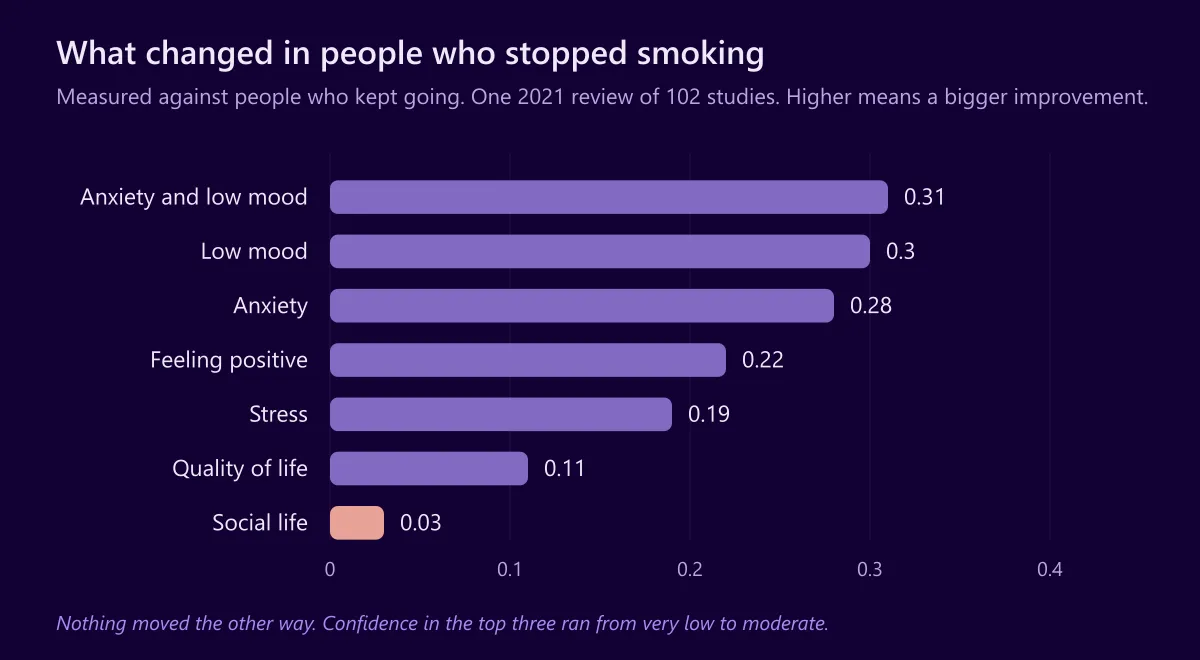
In 2021 a team went through 102 studies covering more than 169,500 people, comparing those who stopped smoking against those who carried on.
Seven different measures of mental health. Every one of them moved towards the people who quit.
- Anxiety and low mood together, 0.31, where 0.2 counts as small.
- Low mood, 0.30. Anxiety, 0.28.
- Feeling positive, 0.22. Stress, 0.19.
- Quality of life, 0.11, and the social side of life barely moved at all.
None of these is a large effect. That is not the striking part. The striking part is that across 102 studies and seven measures, nothing at all went the way most people confidently expect it to.
Why smoking feels calming when it is not
The reviewers set out the explanation that makes the whole pattern fit together, and it is worth understanding rather than just being told.
Nicotine leaves the body quickly. An hour or two after a cigarette, levels have dropped far enough that mild withdrawal begins — restlessness, irritability, a thin edge of anxiety. The next cigarette removes it.
So the relief is real and the smoker is reading it correctly as relief. What they are relieved of is the state the previous cigarette created. A person smoking through the day is cycling in and out of a low-grade anxious state a dozen times, and experiencing only the pleasant half of the cycle as something the cigarette did for them.
Put that way, a steady improvement after quitting is what you would predict. You are not losing a calming agent. You are getting off a loop.
The first few weeks are a different question
This needs saying clearly, because the research above does not cover it and it is the part people actually experience.
Both of these reviews deliberately measured mental health from at least six weeks onwards. They were asking what quitting does, not what withdrawal does. Withdrawal is real, it is unpleasant, and for the first days to weeks it can include exactly the anxiety and irritability people were afraid of.
What the evidence says is that the first fortnight is a terrible guide to the year. If you have tried before and remember it as proof that you cannot cope without cigarettes, that memory is of the withdrawal window rather than of what came after.
The obvious objection, and the study that addresses it
Here is the problem with everything above: almost all of it watches people rather than assigning them. People who successfully quit might simply be people whose lives were already going better, and the mental health might be the cause rather than the result.
That objection is serious. The reviewers took it seriously too — they rated every single study as carrying a real risk of exactly this problem, and graded their confidence as very low for low mood, low for anxiety, and moderate only for the two measured together.
In 2025 a different team went at the problem from a smarter angle. They gathered 62 studies covering 36,150 people and compared people who quit successfully against people who tried and did not manage it. Everyone in both groups had attempted. That strips out a lot of the difference between people who try and people who never do.
The successful quitters still came out ahead on both anxiety and low mood.
And the finding that matters most if you are nervous about trying: the people whose attempt failed did not end up worse off than when they started.
What this means if you have a mental health condition
This is the group most often told to wait, and the advice is usually well-meant.
The 2021 review checked specifically whether the benefits were smaller for people diagnosed with mental health conditions. They were not. The improvements showed up in that group much as they did in everyone else.
That is not a recommendation to quit tomorrow, and timing is a reasonable thing to talk through with a doctor or a stop-smoking service — who can also offer treatments that work considerably better than willpower alone. It is a reason not to treat “my mental health is not good enough yet” as settled fact.
Our guide on talking to your doctor covers how that conversation tends to go.
How this sits with the rest of the evidence on this site
It fits a pattern worth naming.
Our guide on why you feel anxious the day after drinking describes the same shape with alcohol: a substance that reliably relieves anxiety in the short term and reliably produces it afterwards, which is precisely why it feels so effective.
Our guide on whether venting helps when you are angry covers a third version — something that feels like relief in the moment and does nothing measurable to the underlying state.
Immediate relief is a poor guide to what is happening over weeks. That is the single most repeated finding across this whole site, and it is why a record beats a memory.
Where this leaves Moodify
Moodify has no smoking tracker in it, and this research is not a reason to add one. Counting cigarettes is a job that dedicated quit apps and stop-smoking services already do better.
The honest connection is narrower and, for once, genuinely strong. The fear that stops people quitting is specifically a fear about mood. That is a claim about something you can measure on yourself, over weeks, with a daily log.
What Moodify is lists what is actually in it.
If you are going to try, log it
Set this up before you stop, not after.
- Log for two weeks before your quit date. Without a baseline you will compare the hard days against an imagined version of how you used to feel.
- Expect the first weeks to look bad, and keep logging through them anyway. That stretch is the withdrawal window, not the answer.
- Log sleep too. It is disturbed early on and recovers, and it drags mood with it in both directions.
- Read it at six weeks, not at six days. That is where the research starts and it is where your own data starts meaning something.
Our guide on spotting patterns covers reading a stretch like that without talking yourself into a result, and why you cannot remember how you felt explains why the version in your head will be dominated by the worst day.
Logging takes a few seconds in Moodify, and a notebook does the same job. The depression self-check takes two minutes and gives you a score you can retake in a month.
If you want to stop smoking, a doctor or a stop-smoking service can offer support and medication that raise your chances well above going it alone, and asking costs nothing. If your mood has been low for weeks, or you have been thinking about harming yourself, please talk to someone today — a doctor, a helpline, or a person you trust.
Common questions
- Does quitting smoking make anxiety worse?
- Not beyond the first few weeks, on the current evidence. A 2021 review of 102 studies found that people who stopped smoking had lower anxiety than people who carried on, along with better mood, less stress and better quality of life. The reviewers concluded that mental health does not worsen as a result of quitting.
- But smoking calms me down. Is that not real?
- The feeling is real. What is in question is what causes it. The reviewers set out the alternative explanation: between cigarettes, nicotine levels fall and withdrawal begins, which brings anxiety and irritability of its own. The next cigarette relieves the state the last one set up, and that relief feels like calm.
- How long does anxiety last after quitting smoking?
- The difficult stretch is usually the first few weeks. Both of the big reviews on this deliberately measured mental health from at least six weeks onwards, because the point was to find out what happens after withdrawal rather than during it. That is also why the first fortnight is a bad guide to how quitting will go.
- Should I wait until my mental health is better before quitting?
- It is the usual advice and the evidence does not support it. The 2021 review looked specifically at whether the benefits differed for people diagnosed with mental health conditions, and found they did not. That said, timing a quit attempt is a reasonable thing to discuss with a doctor rather than decide from an article.
- What if I try to quit and fail?
- A 2025 review of 62 studies looked at exactly this. People who successfully stopped did better on anxiety and low mood than people whose attempt did not stick. Just as importantly, the people whose attempt failed did not end up with worse mental health than they started with.
- How good is this evidence really?
- Mixed, and worth knowing. Almost all of it watches what people do rather than assigning them to quit, so something else could in principle explain the pattern. The reviewers rated their confidence as very low for low mood, low for anxiety and moderate for the two together. The consistency across 102 studies is the strongest part of it.
- Does vaping instead help your mental health?
- These reviews were about stopping smoking, not about switching, so they cannot answer that. Anyone making that choice is better served by a doctor or a stop-smoking service than by this page.
Sources
- Taylor et al. — Smoking cessation for improving mental health (Cochrane Database of Systematic Reviews, 2021; CD013522.pub2). 102 studies, over 169,500 participants; 63 provided change-in-mental-health data, 10 entered incidence meta-analyses, 31 synthesised narratively. Quitting versus continuing: anxiety symptoms SMD -0.28 (95% CI -0.43 to -0.13; 15 studies, 3,141 participants; I2 69%; low certainty); depression symptoms SMD -0.30 (95% CI -0.39 to -0.21; 34 studies, 7,156 participants; I2 69%; very low certainty); mixed anxiety and depression SMD -0.31 (95% CI -0.40 to -0.22; 8 studies, 2,829 participants; I2 0%; moderate certainty). Secondary outcomes: stress SMD -0.19, positive affect SMD 0.22, psychological quality of life SMD 0.11, social quality of life SMD 0.03. New mixed anxiety and depression OR 0.76 (95% CI 0.66 to 0.86). All studies were at serious risk of bias from time-varying confounding and three were at critical risk; there was some funnel plot asymmetry. The authors conclude that mental health does not worsen as a result of quitting smoking, with improvements seen in unselected samples and in people diagnosed with mental health conditions
- Crabb, Allen & Taylor — What if I fail? Unsuccessful smoking cessation attempts and symptoms of depression and anxiety: a systematic review and meta-analysis (BMJ Open, 2025;15(5):e091419). 62 studies, 36,150 participants, follow-up from 6 weeks to 4 years, measured beyond the withdrawal period. Successful quitting versus unsuccessful attempts: depression SMD -0.21 (95% CI -0.27 to -0.16), anxiety SMD -0.22 (95% CI -0.33 to -0.12); heterogeneity I2 50-69%. The authors state that those who made an unsuccessful quit attempt did not experience worse mental health. PROSPERO CRD42022314728
- US National Institute of Mental Health — depression
General information, not medical advice. See our editorial policy for how these guides are written and corrected.