Daily Rituals
Why You Want to Sleep More in Winter

The urge is real and most people feel it, but the research behind the headlines is thinner than the headlines were. The study everyone quoted looked at people attending a sleep clinic and found about thirty minutes more dreaming sleep in winter than in summer — a result that held up. It also found about an hour more total sleep, which did not hold up statistically, and the authors said plainly that more work was needed before drawing conclusions about healthy people. What does change reliably across studies is timing: in winter people wake later, and sleep shifts later overall, which fits the darkness rather than any need to hibernate. So the useful version is that your body clock drifts in winter and your sleep changes shape. Whether you genuinely need more hours is not settled.
Every winter the same headline comes round: humans need more sleep in the colder months. The feeling behind it is real. The study it came from showed something slightly different.
What the study actually found
Researchers looked at people attending a sleep clinic and compared their nights across the seasons. Two results came out of it, and they are not equally solid.
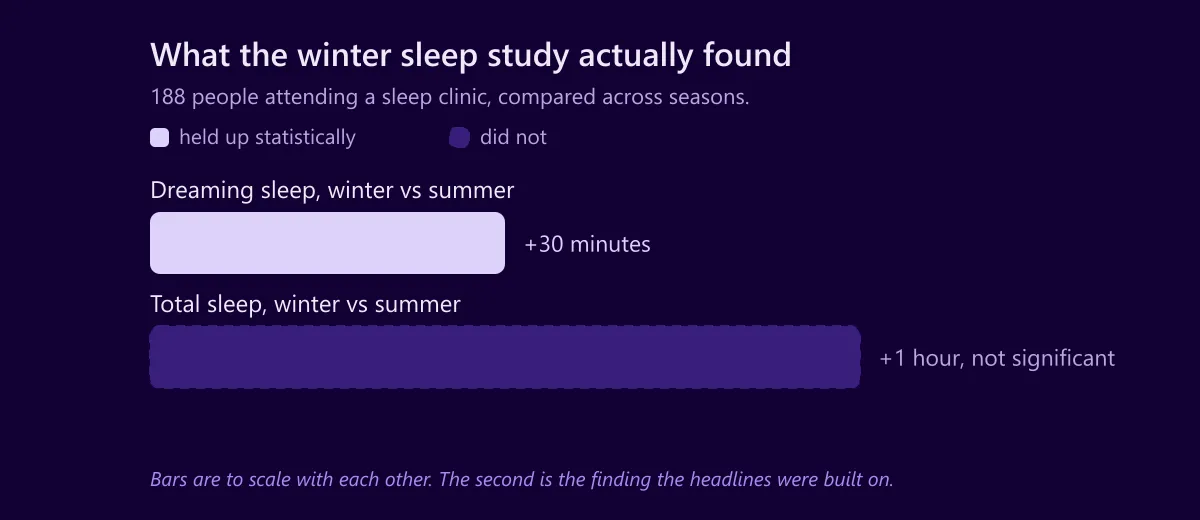
Dreaming sleep was about half an hour longer in winter. That held up.
Total sleep was about an hour longer. That one did not reach statistical significance — and it is the finding the headlines were built on.
The researchers were careful about this themselves, noting that more work was needed before drawing conclusions about seasonal sleep in healthy people. Their sample was people with sleep complaints, which is not the same as everyone.
None of that makes the result worthless. It makes it a smaller claim than it was reported as.
What does change reliably
Across studies, the consistent finding is not about length. It is about timing and shape.
- Sleep shifts later in winter. A small laboratory study following healthy men across four seasons found the sleep phase delayed by around an hour and a half in winter compared with summer.
- Waking drifts later. In a population studied without daylight saving changes to confuse things, when people fell asleep did not vary much by season — but when they woke did, reaching its latest point in winter.
- The mix changes. More dreaming sleep, less deep sleep, in winter than in summer.
So the thing your body is doing in winter is drifting, not hibernating.
Why you feel it anyway
Three ordinary things, none of which require a seasonal sleep requirement.
Your clock has moved but your alarm has not. If your body has drifted later and work has not, the alarm now lands at a point your night was not finished with. That is the same mismatch, in miniature, that makes Monday hard after a late weekend.
You are getting up in the dark. Morning light is the main signal that sets your clock, and in winter it arrives after you do. Without it the drift continues rather than correcting.
Indoor light is far dimmer than you think. A well-lit room is a fraction of what you would get outdoors even on a grey day, which is a point we go into in the SAD lamp guide.
What actually helps
- Hold your wake time, even though the pull is the other way. A drifting wake time pushes the clock further back and makes tomorrow worse.
- Get outside early, briefly. Ten minutes of a dull morning beats an hour of indoor lighting for this purpose.
- If you want more sleep, take it at the front. Going to bed earlier works with the drift; sleeping in works against it.
- Expect the evening pull to arrive earlier, and do not treat it as laziness. If you reliably want to sleep at nine in December, that is information about your clock.
- Watch the drift at weekends. Two late nights undo a week of steadiness, and in winter there is less morning light to put it right.
If the problem is the other end — lying awake rather than oversleeping — the guides on waking at 3am and staying up when you are tired cover different problems that can look similar in December.
When it is more than winter
Wanting an extra hour is ordinary. Some things are not:
- sleeping a great deal more and still feeling unrested
- sleeping through commitments, or being unable to get up at all
- losing interest in things you normally like
- it happening every winter, in the same months
Sleeping considerably more is one of the recognised features of winter-pattern depression, usually alongside eating more and withdrawing from people. Our guide on seasonal depression covers where the line sits, and it is drawn at what the tiredness is stopping rather than at how tired you feel.
Worth writing down, for a reason specific to this
Winter tiredness is unusually hard to judge from memory, because the whole season gets remembered as one undifferentiated grey block.
What is actually useful is knowing when in the winter it hits — some people sag in November and recover by January, some are fine until February. That shape is not recoverable in hindsight, and it is the thing that lets you plan for it rather than be surprised by it again.
A number out of ten and the time you woke is enough. Logging it in a few seconds, as you can in Moodify, makes a whole-winter record realistic. A wall calendar with a number on each day does the same job. What matters is that next November you have something to read other than a feeling that winter is always like this.
Common questions
- Do humans need more sleep in winter?
- Less clearly than the headlines suggested. The study behind them found about an hour more total sleep in winter, but that result was not statistically significant, and it looked at people attending a sleep clinic rather than the general population. The finding that did hold was about thirty minutes more dreaming sleep. The honest answer is that sleep changes shape in winter; whether it needs to be longer is unsettled.
- Why do I feel so tired in winter?
- Mostly because of light and timing rather than a need for more hours. In winter people reliably wake later, and sleep shifts later overall, so the alarm arrives at a point your body has not finished with. Getting up in the dark also removes the main signal that would otherwise be telling your clock it is morning.
- Does sleep actually change in winter?
- Yes, in measurable ways. Studies find more dreaming sleep and less deep sleep in winter than in summer, and a later sleep phase overall — in one small laboratory study, delayed by around an hour and a half. The shape of the night changes even where the total length does not clearly.
- Should I sleep in later in winter?
- Keeping your wake time roughly steady is usually better, even though the pull is in the other direction. A later, drifting wake time pushes your clock further back, which makes the next morning harder. If you want more sleep in winter, the more reliable way to get it is going to bed earlier rather than getting up later.
- Is wanting to sleep all winter a sign of depression?
- It can be. Sleeping considerably more than usual is one of the recognised features of winter-pattern depression, and it tends to come with eating more and withdrawing from people. The distinction is what it is stopping: wanting an extra hour is ordinary, while sleeping through commitments and losing interest in things is worth taking to a doctor.
- Does a light box help with winter tiredness?
- It may help with the timing, which is the part most likely to be driving it. Morning light has reasonable support for shifting the body clock earlier. The evidence for light therapy treating seasonal depression is more modest and more contested than most articles admit.
Sources
- Seasonality in human sleep architecture — Frontiers in Neuroscience study coverage (2023)
- Seasonal variation in human sleep — laboratory study across four seasons (PubMed)
- Seasonal variation of sleep timing in a population without daylight saving time (Chronobiology International, 2018)
- US National Institute of Mental Health — health topics
General information, not medical advice. See our editorial policy for how these guides are written and corrected.