Mind Matters
What Actually Helps With Loneliness?
Something does help, which is worth saying first. A preregistered review published in 2026 gathered 280 studies and found that loneliness interventions reduced loneliness by a small-to-moderate amount, and that the effect was still there one to six months later rather than fading on contact with real life. But the kind that worked best is not the obvious one. Across the strongest study designs, psychological approaches came out ahead of simply increasing social contact or social support. A much older review found the same thing in 2011: of the four standard strategies, the one that did best in the most carefully designed studies addressed how people were reading social situations. That is not a polite way of saying it is in your head. Loneliness reliably changes how you interpret other people, which makes connection harder, which deepens the loneliness. Breaking that loop turns out to matter more than adding people to the room. One caution throughout: the reviewers graded their confidence in all of these numbers as low or very low.
The standard advice is to get out more. Join something. Message an old friend.
It is not useless advice. It is just not the advice with the best evidence behind it, and knowing why changes what you would actually try.
First, the good news
A review published in 2026 did this properly. The researchers registered their plan before starting, searched widely, and ended up with 280 studies.
Loneliness interventions worked. Across 122 trials where people were put into groups at random, the drop in loneliness was small to moderate — a real effect, not a rounding error.
And the finding that matters most practically: when people were followed up one to six months later, the effect was still about the same size. Most things measured this way fade once the programme ends. This did not.
So the first answer to “does anything help” is yes. That is not nothing, and if loneliness is where you are, it is the part to hold onto.
The unusual thing about the numbers
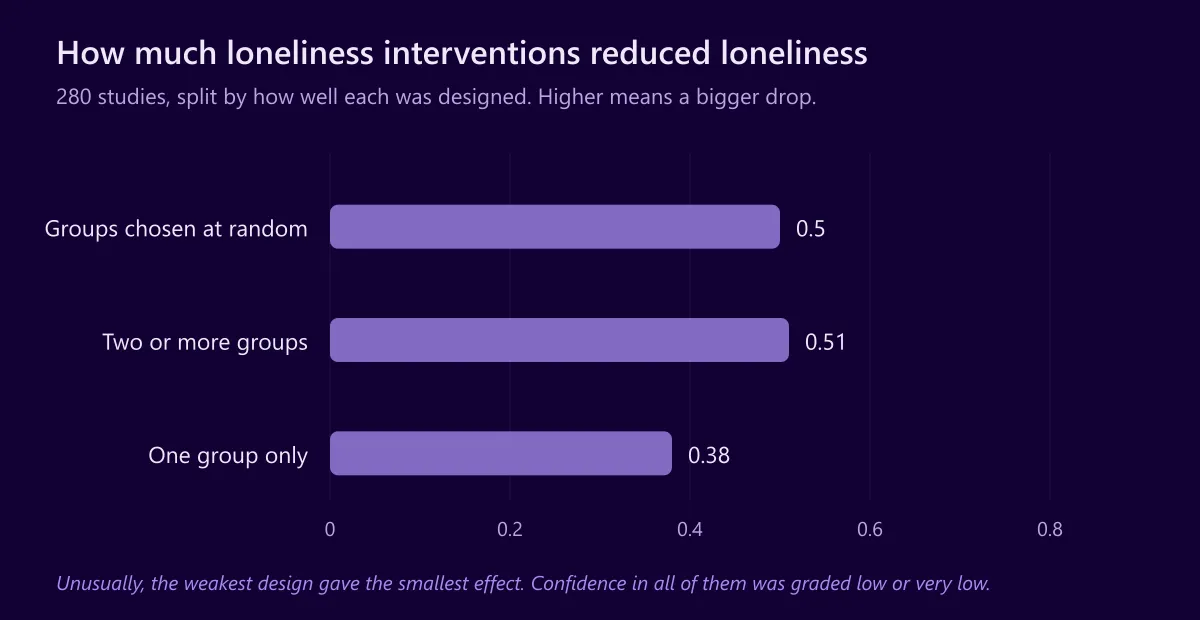
Look at the three study designs side by side.
- Groups chosen at random, the strongest design: 0.50.
- Two or more groups, compared without that: 0.51.
- One group only, the weakest: 0.38.
That ordering is backwards from the usual, and in a good way. Normally the sloppiest designs produce the most exciting numbers — the 2011 review of this same field found exactly that pattern. Here the best-designed studies found the largest effects.
It does not prove anything on its own. It does mean the result is not an artefact of weak methods, which is the first thing you would suspect.
The finding that surprises people
Now the part that changes what you would try.
The review sorted interventions by approach. Psychological approaches came out ahead — a moderate effect. Social and emotional skills training, social network schemes and social support all helped, by small to moderate amounts.
A review from 2011 reached the same conclusion from a different direction. It identified four standard strategies — teaching social skills, adding social support, creating opportunities to meet people, and addressing how people think about social situations. Among the better-designed studies, the last one did best.
Two reviews, fifteen years apart, different methods, same answer. The obvious fix is not the strongest one.
Why this is not “it is all in your head”
This finding gets reported badly, so let us be careful with it.
Loneliness is not a thinking error. It is the gap between the connection you have and the connection you want, and that gap is usually real.
What the research describes is what loneliness does once it is there. It reliably shifts how you read other people. Neutral faces start looking unimpressed. A slow reply starts meaning something. You withdraw slightly to avoid the rejection you are now expecting, the other person reads that as disinterest, and the thing you feared arranges itself.
That loop is why adding people to the room does not fix it. You can be lonely in a full office precisely because the problem is not the number of people present.
Addressing it is not being told to cheer up. It is interrupting a mechanism that makes connection harder than it needs to be.
What that looks like in practice
Concretely, and without overpromising:
- Noticing the interpretation, not just the feeling. “They did not reply” is an event. “They have gone off me” is a reading. The two feel identical from inside.
- Testing a reading rather than acting on it. Usually this means sending the message you assumed was unwelcome.
- Treating withdrawal as the symptom it is. The urge to cancel is the loop running, not a preference.
- Keeping the social thing small enough to repeat. Same argument as everywhere else on this site: the version you will do twice beats the version you will do once.
Our guides on how to stop overthinking and social anxiety or introversion cover neighbouring ground, and the second one matters here because the two get confused constantly.
The honest state of this evidence
Three caveats, none of which cancels the finding.
- Confidence in all of it was graded low or very low. That is the reviewers’ own assessment, under the standard system for grading evidence.
- It is not clear who benefits most. The review says so directly. Age made no significant difference, which is interesting, but beyond that nobody can yet say which people these approaches suit.
- “Psychological approaches” covers a lot of ground. It is a category, not a protocol you can download.
So: something helps, probably more than nothing and probably in the direction described, and the research is not yet good enough to tell you precisely what to do on Tuesday.
Where this leaves Moodify
An uncomfortable one, and worth stating plainly.
Moodify has an AI chat in it. The obvious pitch would be that it keeps you company. We are not going to make that pitch, because the plausible risk runs the other way: a conversation that is always available, never busy and never difficult could make human contact feel less necessary rather than more possible. That would be the loop above with a new participant.
There is no good evidence either way, and we are not going to fill that gap with a marketing claim. Our guide on whether it is safe to talk to AI about mental health sets out where we think the line is.
What the app is actually useful for here is duller and defensible, and it is the next section. What Moodify is lists what is in it.
What a record is for here
Loneliness is one of the hardest things to see clearly from inside, because the feeling rewrites the memory. A bad fortnight becomes “nobody ever gets in touch”, and that sentence then feels like evidence.
A log does something specific against that. It shows you the actual shape of your weeks: which days were worst, whether they follow short nights, whether the good days had something in common that you could do again on purpose.
- Log your mood daily, at the same time.
- Log sleep, because it moves this more than people expect.
- Note which days had real contact with someone. One word is enough.
- Read the month, not the day.
Our guide on spotting patterns covers how to read that honestly, and why you cannot remember how you felt covers why the month in your head is not the month you had.
Logging takes a few seconds in Moodify, and a notebook does the same job. The depression self-check takes two minutes, and is worth taking if the loneliness has been going on for months, because the two overlap more than people realise.
If loneliness has lasted months, or it has started shrinking what you do, that is worth raising with a doctor — it is a recognised risk factor for physical and mental illness, not a character failing, and it is a more ordinary conversation than it feels like beforehand. If you have been thinking about harming yourself, please talk to someone today — a doctor, a helpline, or a person you trust.
Common questions
- What actually helps with loneliness?
- The biggest review of it, covering 280 studies, found psychological approaches were the most effective strategy, ahead of social skills training, social network schemes and social support. All of them helped by some amount. The effect was small to moderate and the reviewers rated their confidence in it low.
- Does meeting more people fix loneliness?
- It helps some, but less than people expect and less than working on how you read social situations. Two reviews fifteen years apart reached the same conclusion. If simply being around people fixed loneliness, it would be rare at a busy workplace, and it is not.
- Why do I feel lonely even when I am around people?
- Because loneliness is about the gap between the connection you have and the connection you want, not about the number of people nearby. It also changes how you read other people, making neutral signals look like rejection, which is exactly why company alone does not resolve it.
- Is loneliness the same as being alone?
- No, and the distinction is the practical one. Being alone is a situation. Loneliness is how that situation feels, and people can be alone without being lonely or surrounded and deeply lonely. Research treats them as separate things because they behave separately.
- How long do loneliness interventions take to work?
- The review measured effects up to four weeks after an intervention ended, and then again at one to six months, and found them comparable. That is unusual and encouraging. Most things measured this way fade.
- Does talking to an AI help with loneliness?
- Nobody knows yet, and the honest concern runs the other way. A conversation that is always available and never difficult could plausibly make human contact feel less necessary rather than more possible. There is no good evidence either way, and we would not recommend it as a treatment for loneliness.
- When should you get help for loneliness?
- When it has lasted months rather than weeks, when it is changing what you do, or when it comes with low mood, poor sleep or a loss of interest in things. Persistent loneliness is a recognised risk factor for physical and mental illness, and it is a reasonable thing to raise with a doctor.
Sources
- Lasgaard et al. — Are loneliness interventions effective for reducing loneliness? A meta-analytic review of 280 studies (American Psychologist, 2026 Jan). Preregistered; 312 studies identified, 280 included (273 short-term, 72 long-term). Short-term effects up to 4 weeks after the intervention: 122 randomised controlled trials SMD = -0.50 (95% CI -0.60 to -0.39); 33 multicohort studies SMD = -0.51 (95% CI -0.68 to -0.34); 118 single-arm cohort studies SMD = -0.38 (95% CI -0.46 to -0.30). Long-term effects at 1 to 6 months were comparable. Psychological interventions appeared most effective; social and emotional skills training, social network and social support interventions showed small to moderate effects. No significant differences between age groups. Confidence graded low or very low under GRADE, and it remains unclear whom the interventions help most
- Masi, Chen, Hawkley & Cacioppo — A meta-analysis of interventions to reduce loneliness (Personality and Social Psychology Review, 2011;15(3):219-266). Identified four intervention strategies: improving social skills, enhancing social support, increasing opportunities for social contact, and addressing maladaptive social cognition. Single-group pre-post and nonrandomised studies produced larger effects than randomised comparisons; among randomised designs, the most successful interventions addressed maladaptive social cognition
- US National Institute of Mental Health — depression
General information, not medical advice. See our editorial policy for how these guides are written and corrected.