Daily Rituals
How Much Time in Nature Do You Actually Need?

Two hours a week, and the interesting part is that more than that did not help. The figure comes from a 2019 study of nearly 19,800 adults in England, asked how long they had spent in nature over the previous seven days. Under two hours looked no different from none at all. At two hours the odds of reporting good health jumped sharply, and then stopped climbing: people getting five hours a week were no better off than people getting two. It also made no difference whether the two hours came in one long visit or several short ones. That is a threshold, not a dose, which is the opposite of how the finding is usually passed on. The large caveat is that this is a single snapshot of one week, so it cannot show whether going outside improves health or healthy people go outside more. When nature has actually been prescribed in trials, depression and anxiety scores did improve by a moderate amount, though most of those studies carry a real risk of being skewed, and the benefit came mainly from programmes that had other people in them.
Two hours a week in nature. It is one of the few pieces of wellbeing advice with an actual number attached, which is probably why it travelled so far.
The number is real. The way it is usually passed on gets it backwards.
Where the two hours comes from
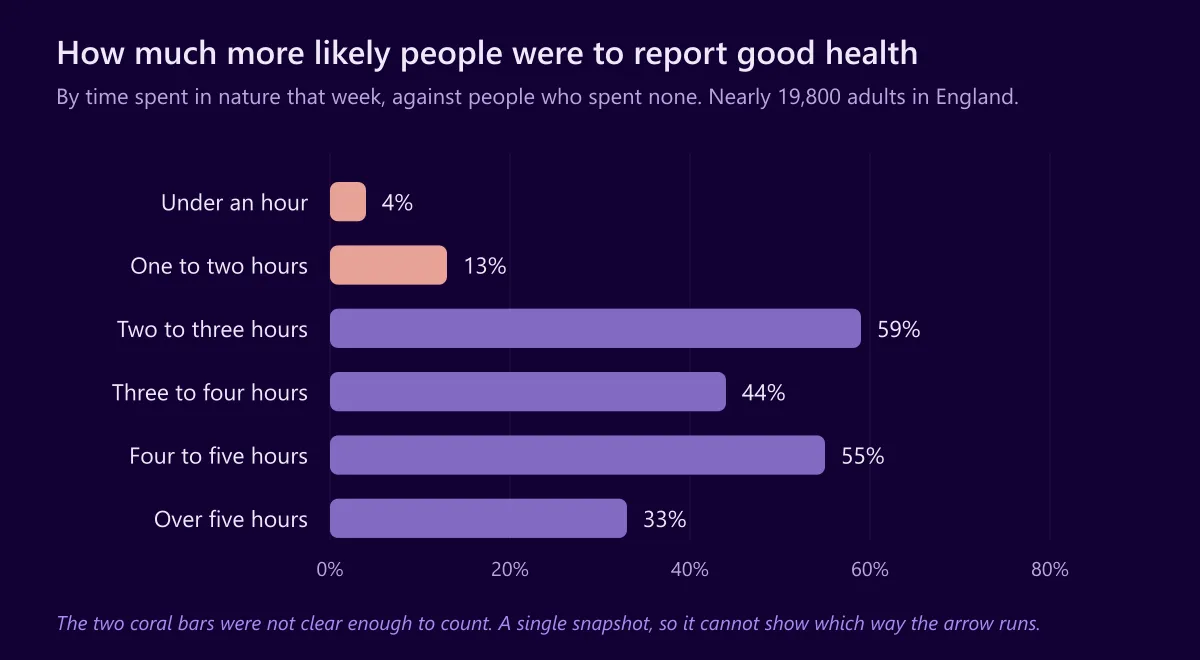
In 2019 a team asked nearly 19,800 adults in England how long they had spent in natural places over the previous seven days, then compared their answers against how they rated their own health and wellbeing.
Sorted into hour-long blocks, the pattern came out like this:
- Under an hour: no different from none at all.
- One to two hours: still no clear difference.
- Two to three hours: a jump. People were around 59% more likely to report good health than people who had gone nowhere.
- Then nothing more. Three to four hours, four to five, over five — all roughly the same as two.
Wellbeing followed the same shape, more weakly: no difference below two hours, then a modest lift that likewise did not climb with extra time.
Threshold, not dose
This is the part that gets lost, and it changes what you would do about it.
The finding is usually reported as “at least two hours”, which sounds like a floor you should aim to beat. The data does not say that. It says the benefit appears somewhere around two hours and then stops responding. Five hours a week looked no better than two.
The researchers also checked whether it mattered how you got there. It did not. One long Sunday walk and several short weekday ones landed in the same place.
So the practical version is not “spend as much time outside as possible”. It is “get to about two hours, in whatever shape fits your week, and then stop worrying about it”.
That is a much easier instruction, and our guide on how long until mood tracking becomes a habit explains why the easier instruction is the one that survives.
The problem with the two-hour study
It is a snapshot. One week, asked once.
Which means it cannot tell you which way the arrow runs. People in good health with energy and free time go outside more. That alone could produce this entire pattern without nature doing anything.
Two things make the finding harder to dismiss. The analysis adjusted for how much people exercised, and for how green their own neighbourhood was — so this is not simply fit people being fit, nor people with parks nearby being better off. And the pattern held across groups, including older adults and people with long-term health conditions.
But the authors are direct about it: studies that follow people over time, and studies that actually assign them, are the critical next step. They did not claim to have run one.
What happened when nature was prescribed
Some of that work exists. A 2023 review gathered 92 studies of programmes where a professional referred someone to spend time outdoors — walking groups, gardening schemes, organised visits.
Against control conditions, these produced:
- A moderate improvement in depression scores, and a similar one in anxiety.
- Lower blood pressure, by around five points systolic.
- About 900 extra steps a day.
So the effect survives being assigned rather than merely observed, which is more than can be said for a lot of wellbeing advice. The caveat is substantial: most of those studies carried a moderate to high risk of being skewed.
Nobody has separated the park from the walk
Here is the detail that reframes the whole field, and it sits in that same review.
The programmes increased daily step count by about 900 — but they did not increase the time people spent on moderate exercise. And the clearest benefits for anxiety and depression came from programmes run by social professionals rather than health professionals.
Read that together and the picture is less “nature is medicine” and more “a gentle walk, usually with other people, outdoors”. Three ingredients, and the studies cannot tell you which one is working.
That matters because two of them already have stronger evidence of their own. Our guide on whether exercise helps depression and anxiety covers the first, and what actually helps with loneliness covers the second.
None of this is a reason to skip the park. It is a reason to be relaxed about which part is doing the work, because you get all three at once anyway.
What this does not mean
- It does not mean you need a forest. The study counted ordinary green and natural spaces, and the association survived accounting for how green people’s own areas were.
- It does not mean two hours fixes anything clinical. This is a difference in how people rate their own health and mood, not a treatment.
- It does not mean less than two hours is worthless to you. The averages showed nothing below that line. Your own week is not an average.
Where this leaves Moodify
Moodify has no step counter and no location tracking, and this research is not a reason to add either. Plenty of apps count steps, and none of them need to know where you walked.
The honest connection is that this is an unusually testable claim. Two hours is a specific, countable thing, and whether it does anything for you is a question a month of notes can answer and a magazine article cannot.
What Moodify is lists what is actually in it.
Testing the two hours on yourself
The threshold shape makes this easier to test than most habits, because you are checking whether you crossed a line rather than tracking a quantity.
- Log your mood daily, at the same time.
- Add one note: roughly how long you were outside in a natural place. To the nearest half hour is plenty.
- Log sleep as well, because time outdoors and daylight and sleep all move together and will otherwise take each other’s credit.
- Read it by the week, not by the day. The claim is about weekly totals, so the week is the unit that can answer it.
Our guide on spotting patterns covers reading that without inventing a result, and what to track besides mood explains why sleep is the first field worth adding.
Logging takes a few seconds in Moodify, and a notebook does the same job. The depression self-check takes two minutes and gives you a score you can retake in a month.
If you have stopped going outside at all, and that is a change rather than a preference, it is worth mentioning to a doctor — withdrawal from ordinary activity is one of the more reliable signs of depression and one of the easiest to explain away. If you have been thinking about harming yourself, please talk to someone today — a doctor, a helpline, or a person you trust.
Common questions
- How much time in nature do you actually need?
- About two hours a week, on the best-known study of it. Nearly 19,800 adults in England were asked about the previous seven days. People reaching two hours were markedly more likely to report good health and higher wellbeing than people who got none, and anything under two hours looked no different from none at all.
- Is more time in nature better?
- Not according to that study, which is the part almost always dropped. The benefit appeared at two hours and then flattened. People getting four or five hours a week were no better off than people getting two. It looks like a threshold you cross rather than a quantity you accumulate.
- Does it have to be all at once?
- No. The study specifically checked, and it made no difference whether the two hours came in one long visit or several short ones across the week. A twenty-minute walk most days reached the same place as a single Sunday outing.
- Does nature actually cause the benefit, or are healthy people just outdoors more?
- That is the honest weakness of the big study, and its authors say so. It captured one week at one moment, so it cannot show which way the arrow runs. It did survive adjusting for how much people exercised and how green their neighbourhood was, which helps a little but does not settle it.
- What happened when nature was actually prescribed in trials?
- A 2023 review of programmes that referred people to spend time outdoors found moderate improvements in depression and anxiety scores, along with lower blood pressure and about 900 extra steps a day. Most of those studies carried a moderate to high risk of being skewed, so the numbers should be held loosely.
- Is it the nature or the walking?
- Nobody has separated them. Prescribed nature programmes raised daily step counts by around 900 but did not increase time spent in moderate exercise, and the clearest mood benefits came from programmes run by social professionals rather than health ones. Walking, company and being outdoors arrive together in almost every study.
- Does a city park count?
- In the large study, yes. It counted recreational visits to green and natural spaces broadly, and the association held after accounting for how green people's own neighbourhoods were, which suggests the going matters more than the living near.
Sources
- White et al. — Spending at least 120 minutes a week in nature is associated with good health and wellbeing (Scientific Reports, 2019;9:7730). Representative sample of adults in England; valid N = 20,264 unadjusted and 19,806 adjusted; nature contact in the previous 7 days in 60-minute blocks, 0 minutes as reference. Adjusted odds of reporting good health: 1-59 mins 1.04 (ns), 60-119 mins 1.13 (ns), 120-179 mins 1.59 (1.31-1.92), 180-239 mins 1.44, 240-299 mins 1.55, 300+ mins 1.33. Adjusted odds of high wellbeing: 0.99 (ns), 1.10 (ns), 1.23 (1.08-1.40), 1.16, 1.25, 1.20. Models adjusted for urbanicity, neighbourhood greenspace, area deprivation, background PM10, sex, age, SES, restricted functioning, physical activity, employment, relationship status, ethnicity, children in household, dog ownership and year. Associations peaked between 200-300 minutes with no further gain; the pattern held across subgroups including older adults and people with long-term health conditions; it did not matter whether the 120 minutes came in one visit or several. The design is cross-sectional, and the authors name prospective longitudinal and intervention studies as the critical next step
- Nguyen et al. — Effect of nature prescriptions on cardiometabolic and mental health, and physical activity: a systematic review (The Lancet Planetary Health, 2023;7(4)). 92 unique studies, 28 contributing to meta-analyses. Versus control: systolic blood pressure mean difference -4.82 mmHg (-8.92 to -0.72), diastolic -3.82 mmHg (-6.47 to -1.16); depression post-intervention SMD -0.50 (-0.84 to -0.16) and change from baseline -0.42 (-0.82 to -0.03); anxiety post-intervention SMD -0.57 (-1.12 to -0.03) and change from baseline -1.27 (-2.20 to -0.33); daily step count mean difference +900 steps (790 to 1010); weekly time of moderate physical activity mean difference 25.90 minutes (-10.26 to 62.06), not significant. Beneficial effects on anxiety and depression came mainly from interventions involving social professionals, while blood pressure and step count effects came mainly from those involving health professionals. Most studies had a moderate to high risk of bias
- US National Institute of Mental Health — depression
General information, not medical advice. See our editorial policy for how these guides are written and corrected.