Daily Rituals
How Long Until Logging Your Mood Becomes a Habit?
Longer than you have been told. A 2024 review of 20 studies looked for how long new health habits take to feel automatic. Only four of those studies had measured it. In those, the middle answer was 59 to 66 days, the averages ran to 106 and 154 days, and individual people took anywhere from 4 days to 335. The 21-day rule has nothing behind it. One finding matters more than the timing. In the study with the clearest threshold, under a quarter of people ever reached it. So the useful question is not how long, but what shifts the odds. Three things showed up. Morning beat evening. Habits people chose themselves beat habits assigned to them. And simple actions became automatic faster than effortful ones, which is the best news a ten-second mood log could get.
You downloaded something, logged your mood for six days, and then did not.
That is not a character flaw. It is the most common outcome there is, and the research on why is more useful than the advice built on top of it.
The honest answer on timing
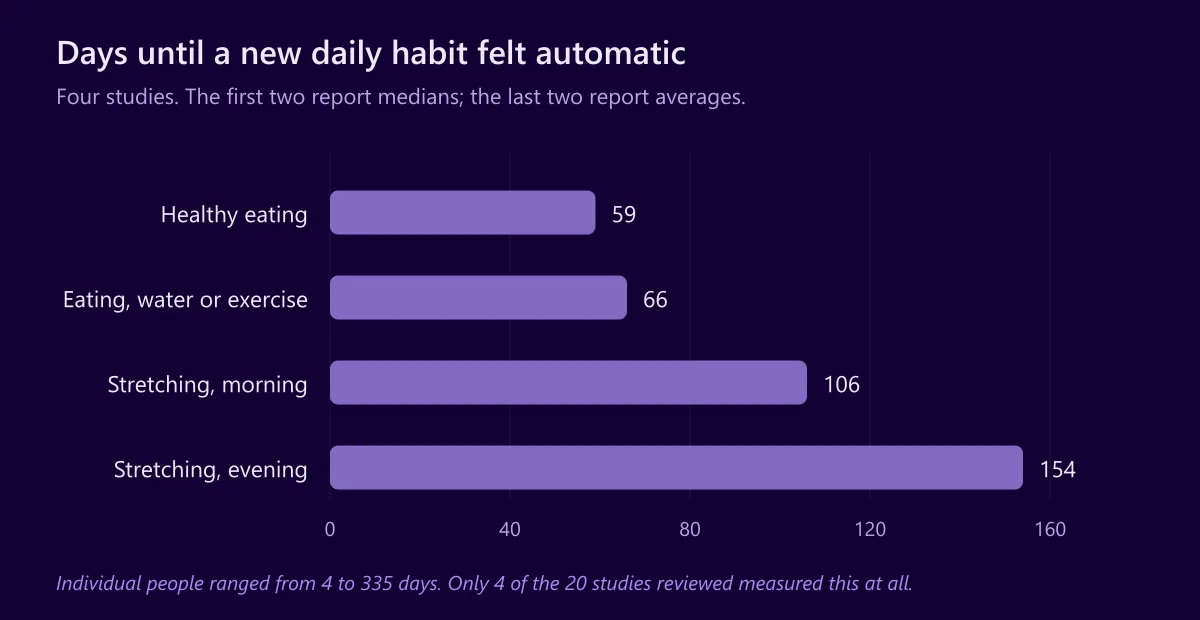
In 2024 a team went looking for studies that had actually measured how long a new health habit takes to feel automatic. They found 20 studies covering 2,601 people. Of those, only four had measured the timing at all.
Here is what those four found.
- 59 days was the middle answer for a healthy eating habit.
- 66 days was the middle answer for eating, drinking water or exercising.
- 106 days was the average for morning stretching, and 154 days for evening stretching.
- Individual people ranged from 4 days to 335 days.
The review’s own summary was two to five months, and that short challenges are unlikely to be enough. The 21-day rule comes from a 1960 self-help book. There is nothing behind it.
The number that matters more than the timing
In the study that set a clear threshold for “this is now a habit”, under a quarter of the people in it ever reached that threshold.
Read that next to what happens outside a study. Across 93 popular mental health apps, about three in a hundred people were still using them a month later, which our guide on whether mental health apps work covers in full.
So the question is not really how long it takes. It is what moves the odds.
Three things that moved the odds
Morning beat evening. The stretching study found the morning group got there in 106 days against 154 for the evening group. One study, one behaviour, so this is a sensible default rather than a law. But mornings are also more alike from day to day than evenings are, which fits everything else here.
Choosing it yourself beat being told. Habits people picked for themselves came out stronger than habits handed to them. If you are logging your mood because an app nagged you into it, that is a worse starting position than logging it because you want to see something.
Simple beat effortful. Drinking water became automatic more readily than exercising or eating more fruit. Across the whole review, the pattern was that short, repeatable actions with an obvious cue did best.
That last one is the whole case for keeping a mood entry tiny. A number out of ten belongs in the water-drinking category, not the exercise category. Our guide on what to track besides mood covers why adding fields quietly kills the habit.
The question people argue about, settled quietly
Should the cue be a time, like 9am? Or something you already do, like after brushing your teeth?
One of the studies tested exactly that and found no real difference between the two. Pick whichever is more reliable in your actual day. If your mornings start at a different hour every day, use the routine. If your routine is chaos but you always check your phone at the same time, use the clock.
This is worth saying because a great deal of habit advice is confident about this and the evidence is not.
If-then plans, with the number people leave out
“If it is 9pm, then I log my mood.” That shape of plan has a famous piece of research behind it, and the famous version is out of date.
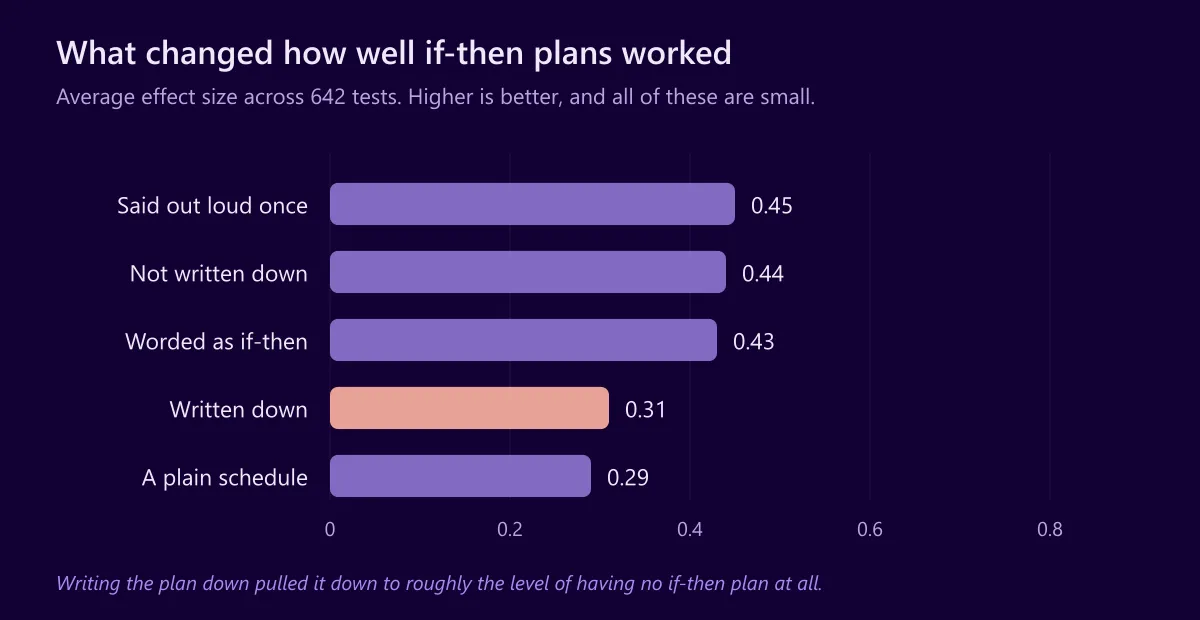
A 2025 review gathered 642 tests of it. The average effect was small, and smaller again for changing behaviour rather than thoughts or feelings. When the authors accounted for the fact that studies finding nothing often never get published, the estimate dropped further still. The older figure everyone quotes was about twice as large.
So this is a real but modest tool, not a trick. Three details inside it did hold up:
- The if-then wording beat a plain schedule. Writing “if X, then Y” worked better than listing when and where.
- Saying the plan once beat not saying it. Saying it more than once added nothing.
- Writing it down made it worse. That is not a typo, and it cuts against almost every productivity article ever published. The authors’ guess is that writing it sends you back to rethinking the plan, and rethinking is the opposite of automatic.
Also worth knowing: the effect was much larger in people who actually wanted to do the thing. In people with weak motivation, planning did roughly nothing. Plans do not supply the wanting.
Where the evidence is thin
Being straight about this, because the numbers above are quotable and their footnotes are not.
- Only four studies measured time to habit at all.
- Eleven of the 20 were rated high risk of bias.
- The studies disagreed with each other a great deal, which in plain terms means the averages hide a lot.
- None of this studied mood logging. It studied flossing, water, stretching, diet and exercise. The read-across is reasonable, not proven.
What to actually do with this
- Give it two months, not three weeks. If you quit at day eight believing it should have stuck by then, you quit on a false deadline.
- Make it small enough to be boring. One number. Ten seconds. The research favours the trivial action over the worthy one.
- Attach it to the most reliable moment in your day, and do not agonise over whether that is a time or a routine.
- Protect the first fortnight. Early repetitions did the most work.
- Expect gaps and keep going. The gains flatten out later, so a missed Tuesday in week six is not the thing that decides this.
- Pick it yourself, for a reason you can say out loud. “I want to know if Sundays are actually worse” survives a bad week better than “I should track my mood”.
Why the record is worth the two months
An entry you skip costs nothing. A month you cannot reconstruct costs the whole point.
Memory does not store how you felt — it rebuilds it from the sharpest day and the most recent one, which our guide on why you cannot remember how you felt explains. That is exactly the gap a daily number fills, and it only fills it if the days are there.
Logging takes a few seconds in Moodify, and a note on your phone or a mark on a calendar does the same job. Our guide on spotting patterns covers what the record is for once you have one.
If the reason logging feels impossible is that everything feels impossible, that is worth taking to a doctor rather than solving with a better system. The depression self-check takes two minutes and gives you a score to bring.
Common questions
- How long does it take for mood tracking to become a habit?
- Expect about two months rather than the three weeks people quote. A 2024 review found the middle answer across the few studies that measured it was 59 to 66 days, with averages of 106 and 154 days and a spread from 4 days to 335. Simple, quick actions sat at the faster end, and a mood log is one of the simplest.
- Is the 21-day rule true?
- No. It traces back to a 1960 self-help book, not research, and the evidence contradicts it. The review that gathered this up concluded people should expect two to five months for a new health habit, and said short challenges are unlikely to be enough on their own.
- Does the time of day matter?
- It appears to. In one study of daily stretching, the morning group reached the point of it feeling automatic in an average of 106 days against 154 days for the evening group. That is one study of one behaviour, so treat it as a sensible default rather than a rule.
- Should I attach the habit to a time or to something I already do?
- Either. This gets argued about a lot, and the one study that tested it directly found no real difference between a clock-based cue, such as 9am, and a routine-based one, such as after breakfast. Pick whichever is more reliable in your actual day.
- Do if-then plans help?
- Somewhat, and less than the famous number suggests. A 2025 review of 642 tests found a small average effect, smaller again for changing behaviour specifically, and smaller still once the authors accounted for studies that never got published. Three details held up: an if-then wording beat a plain schedule, saying the plan once beat not saying it, and writing it down made it worse.
- What if I keep missing days?
- Missing days is the normal shape of this, not a failure. The research found early repetitions do the most work and that gains flatten out later, so the first couple of weeks are worth protecting and a gap after that costs less than it feels like. A record with holes in it is still a record.
Sources
- Singh, Murphy, Maher & Smith — Time to Form a Habit: A Systematic Review and Meta-Analysis of Health Behaviour Habit Formation and Its Determinants (Healthcare, 2024;12(23):2488). 20 studies, 2,601 participants; four studies measured time to automaticity, giving medians of 59-66 days, means of 106-154 days and an individual range of 4-335 days; pooled change in habit score SMD = 0.69 (95% CI 0.49-0.88), I-squared = 87%; 11 of 20 studies rated high risk of bias on the PEDro scale
- Sheeran, Listrom & Gollwitzer — The when and how of planning: Meta-analysis of the scope and components of implementation intentions in 642 tests (European Review of Social Psychology, 2025;36(1):162-194). Sample-weighted average d = 0.36 (95% CI 0.33-0.40); behaviour outcomes d = 0.27; contingent if-then format d = 0.43 vs schedule format d = 0.29; rehearsed d = 0.45 vs 0.33; recorded d = 0.31 vs 0.44; substantial publication bias, with robust Bayesian meta-analysis giving d = 0.15 (95% CI 0.08-0.22)
- Baumel, Muench, Edan & Kane — Objective user engagement with mental health apps (Journal of Medical Internet Research, 2019;21(9):e14567). 93 apps; median 30-day retention 3.3%
- US National Institute of Mental Health — health topics
General information, not medical advice. See our editorial policy for how these guides are written and corrected.