Daily Rituals
Do Cold Showers Actually Help Your Mood?
Mood, no. Stress, yes, but at a time nobody expects. A 2025 review gathered 11 trials of cold water at 15 degrees Celsius or below and looked for effects on mood, stress, sleep, alertness and more. Mood did not shift. Stress did, and the timing is the whole story: nothing straight after the plunge, nothing an hour later, a large drop at 12 hours, and nothing at all by the next day. Inflammation went up immediately rather than down, which is the opposite of what the plunge is usually sold as doing. The reviewers also noted that the best-known claim about cold water lifting mood traces back to a small study run in a group at the beach, where company and the sea are hard to separate from the cold. None of this means do not do it. It means the rush you feel climbing out is not what was measured, the benefit that did show up arrives while you are asleep that night, and the evidence base is thin: eleven trials, and ten of them had no women in them at all.
The cold plunge is sold on a feeling. You get out, you are electric, and the day seems easier.
Researchers went looking for that feeling in the trials. What they found was real, and it was not where anyone was looking.
The timing is the finding
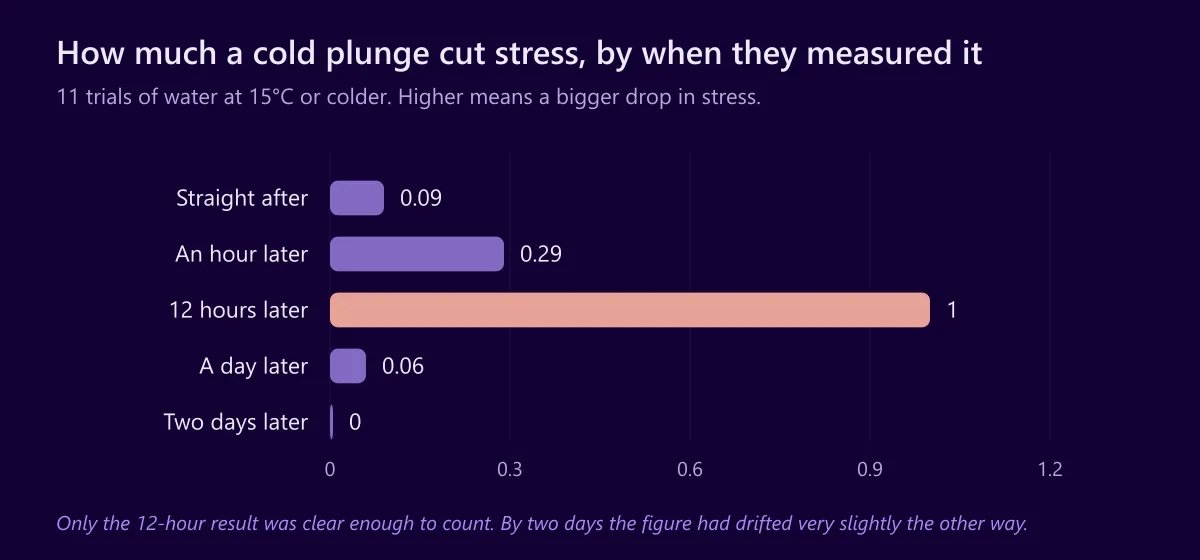
In 2025 a team gathered 11 trials of cold water at 15 degrees Celsius or below, held for anything from thirty seconds to two hours, and measured stress at five points afterwards.
- Straight after: nothing. 0.09, which is a rounding error.
- An hour later: 0.29, not clear enough to count.
- Twelve hours later: 1.00. A large drop, and the one result in the set that was unambiguous.
- A day later: nothing. Two days later: the number had drifted very slightly the other way.
One window, roughly half a day out, and silence on either side of it.
If that pattern is real, then a cold shower at seven in the morning is doing its work at seven in the evening — which is a long way from how anyone experiences it, and a long way from how it is advertised.
Mood did not move
This is the part that cuts against the entire category.
The reviewers looked for mood as a distinct outcome. They did not find a change in it. One of the included trials measured six separate mood states — active, energetic, restless, fatigued, exhausted, alert — and found no difference between the cold water group and the comparison group on any of them.
So the rush is not in dispute. What is in dispute is whether it is the same thing as feeling better, and when researchers measured the second one, it was not there.
Where the famous mood claim comes from
The reviewers traced it, and this detail is worth the price of the article.
The widely repeated finding that cold water acutely lifts mood comes from a small study where people were not assigned to groups, and where the cold water was taken together, in a group, at the beach.
Company, daylight, the sea, and a shared slightly ridiculous experience. The cold is one ingredient in that and it is the only one anybody credits.
That is not a criticism of the people who ran it. It is a reason why the larger, better-designed trials do not reproduce the result — and our guide on what actually helps with loneliness covers the ingredient that most plausibly did the work.
Inflammation went the wrong way
The cold plunge is routinely sold as reducing inflammation. In the short term the review found the reverse: inflammation rose immediately after immersion, and was still raised an hour later.
That is not alarming. It is what a body does when something physically demanding happens to it, and it is the same response exercise produces. But it does sit awkwardly beside the marketing, and it may be the clue to the odd timing above.
A plausible reading — and this is reading, not finding — is that the plunge is a stressor first and that whatever benefit follows is the body’s response to it, settling out over the following hours. That would explain why the stress drop appears at twelve hours and not at one. Nobody has shown it.
What else the review found, and how much to lean on it
Two more results, both weaker than they will be reported as.
- Sleep quality improved. This comes from a single small study in men after heat training, and was not combined with anything else. Treat it as a hint.
- Quality of life was slightly higher in a large study where people took 30, 60 or 90-second cold showers for a month. The same study reported 29% less sickness absence — though people reported their own absence, and oddly they did not report fewer days of actual illness.
Our guide on whether a sad lamp actually works runs into the same shape of problem: a real effect, measured in a way nobody could be blind to.
The thing nobody mentions about these trials
Eleven trials, and just over 3,000 people. More than half of those people were women — and every one of them came from a single study. The other ten trials were entirely male.
So nearly everything above, including the whole stress timeline, rests on trials in men. The reviewers say so themselves, listing few trials, small samples and a lack of diversity as the limits of the field.
That does not make the findings wrong. It makes them narrower than the confident advice built on top of them.
If you want to try it anyway
Reasonable. It is cheap, most people find it tolerable, and the review found nothing to suggest harm in healthy adults. A few honest notes.
- Ask a doctor first if you have any heart condition. The gasp reflex and the jump in heart rate and blood pressure are the whole mechanism, and they are not trivial for everyone.
- Cold open water is a different risk entirely. Cold shock causes involuntary gasping, and it drowns strong swimmers. A cold shower at home is not the same activity as a lake in November.
- There is no evidence-based dose. No trial compared one temperature or duration against another. Thirty seconds was enough to be included.
- Do not do it for the mood. That is the one outcome the evidence specifically failed to find.
Where this leaves Moodify
Moodify has no cold plunge timer and is not getting one. There is nothing here that would justify it.
What this research does point at is a genuine blind spot in how people judge habits, and it happens to be the one thing a mood log is good for.
If the benefit of a morning plunge lands twelve hours later, then judging it by how you feel climbing out of the shower will tell you precisely nothing. The rush is at minute zero. The effect, if it is there, is at hour twelve. Those are different days as far as your memory is concerned.
What Moodify is lists what is actually in it.
How to actually test it on yourself
This is one of the better self-experiments available, because the thing being tested has a sharp on-off switch.
- Log for two weeks first, before you start. The comparison is the point.
- Log in the evening, not after the shower. Given the timing above, the evening entry is the one that could carry a signal.
- Note whether you did it that morning. One word.
- Run it for a month, then read the two stretches side by side.
Our guide on how long until mood tracking becomes a habit covers why a one-word note survives and an elaborate log does not, and spotting patterns covers reading a month without inventing a result.
Be clear with yourself about one thing: you will know which mornings you did it, and you will have opinions about whether it works. That is the same problem the trials had. It does not make your answer worthless, but it does mean a small difference is not worth trusting and a large one might be.
Logging takes a few seconds in Moodify, and a notebook does the same job. The depression self-check takes two minutes and gives you a score you can retake in a month.
If your mood has been low for weeks, a cold shower is not the intervention to reach for, and a doctor is a more ordinary conversation than it feels like beforehand. If you have been thinking about harming yourself, please talk to someone today — a doctor, a helpline, or a person you trust.
Common questions
- Do cold showers actually help your mood?
- Not on the current evidence. A 2025 review of 11 trials of cold water looked for an effect on mood and did not find one. The same review did find a large drop in stress, but only when it was measured about 12 hours after the plunge rather than straight afterwards.
- Why do I feel amazing right after a cold shower?
- Because a sudden cold shock produces a strong physical response, and that feels like something. The research did not find it showing up as a change in mood when it was measured, and stress was unchanged immediately afterwards. The rush is real. It is just not the same thing as feeling better over a day.
- Do cold showers reduce stress?
- In one way, and at one time. The review found no change in stress straight after, no change an hour later, a large drop at 12 hours, and nothing by 24 or 48 hours. If that pattern holds, a morning plunge would do its work in the evening.
- Do cold showers reduce inflammation?
- The review found the opposite in the short term. Inflammation went up immediately after cold water and was still raised an hour later. That is an ordinary response to a physical stressor rather than a sign of harm, but it does not match how cold plunges are usually advertised.
- Do cold showers help you sleep?
- Possibly, on very little evidence. The sleep finding in this review came from a single small study in men following heat training, and was not combined with anything else. It is a reason to look further rather than a reason to believe it.
- How cold and how long does it need to be?
- The trials used water at 15 degrees Celsius or below, for anything from 30 seconds to two hours, mostly in baths rather than showers. No trial compared one dose against another, so there is no evidence-based number to aim for.
- Is cold water immersion safe?
- The trials were run in healthy adults, so they cannot tell you about anyone else. Sudden cold causes a sharp gasp and a jump in heart rate and blood pressure, which is why it is worth asking a doctor first if you have any heart condition, and why cold open water carries a real drowning risk even for strong swimmers.
Sources
- Cain et al. — Effects of cold-water immersion on health and wellbeing: a systematic review and meta-analysis (PLOS ONE, 2025;20(1):e0317615). 11 randomised studies, 3,177 participants, mean PEDro score 6.4 (7 moderate, 4 high quality); cold water at 7-15 degrees Celsius for 30 seconds to 2 hours, in baths (10 studies) or showers (1). Stress: no significant effect immediately (SMD -0.09), at 1 hour (SMD -0.29), at 24 hours (SMD -0.06) or at 48 hours (SMD 0.09); significant reduction at 12 hours (SMD -1.00, 95% CI -1.40 to -0.61, p < 0.01). Inflammation rose significantly immediately (SMD 1.03) and at 1 hour (SMD 1.26). No significant effect on immune function immediately or at 1 hour; narrative synthesis reported a 29% reduction in self-reported sickness absence among cold-shower participants. Improvements in sleep quality and quality of life but not mood. 55.4% of participants were female, but all of those came from a single 3,018-participant study; every other included study was 100% male. The authors note the evidence base is constrained by few trials, small samples and a lack of diversity, and that the often-cited acute mood benefit comes from a small non-randomised trial conducted in a group at the beach
- US National Institute of Mental Health — depression
General information, not medical advice. See our editorial policy for how these guides are written and corrected.