Guides and Tools
Can a Mental Health App Replace Therapy?
No, and the confusion is worth clearing up, because the research gets quoted loosely. There is strong evidence that online therapy works as well as sitting in a room with someone. A 2023 review of 31 trials across 16 conditions found no real difference between the two. But every one of those trials had a therapist reading what the person wrote and replying. That is not what a mental health app is. When you take the person away, the results drop. One large review found guided online programmes clearly better than unguided ones for depression. And the biggest look at apps on their own, 176 trials, found they beat nothing by a small amount and showed no advantage over an actual treatment. So there are three different things here, not one. A therapist. A programme with a therapist attached. An app by itself. They are not interchangeable, and only the third one is free.
Somebody always says it. “Studies show online therapy works just as well.”
They are right, and the sentence has a hole in it big enough to walk through.
Three things that get called the same thing
Most arguments about this collapse because two different products share a word. There are three:
- A therapist. A person, in a room or on a call, who knows your history.
- A programme with a therapist attached. You work through written material at home; a real therapist reads what you send each week and replies.
- An app on its own. You open it, it does something, nobody reads anything.
The research everyone quotes is about the second one. Most apps are the third.
What the evidence actually says about the second one
It is strong, and it deserves to be taken seriously.
A 2023 review gathered 31 trials across 16 different conditions and compared online cognitive behavioural therapy guided by a therapist against the face-to-face version. The two came out level — no meaningful difference either way. The earlier version of that same review, with 13 trials, found the same thing.
That is a genuinely important finding. It means the room is not the active ingredient. For a lot of problems, the work can happen through a screen.
But read what was in the box. In those trials, somebody qualified read what each person wrote and wrote back. The therapist was part of the treatment being tested.
What happens when you take the person out
This is the part that matters if you are holding a phone.
A review of 106 studies covering 11,854 people looked at digital programmes split by whether a human was involved. Guided programmes were clearly better than unguided ones for depression.
And the largest look at apps specifically — 176 trials — found that apps beat doing nothing by a small amount, but showed no advantage at all over an actual treatment. Our guide on whether mental health apps work goes through those numbers in full.
Put plainly: the evidence says a screen can carry therapy. It does not say an app can.
The thing that quietly explains a lot of it
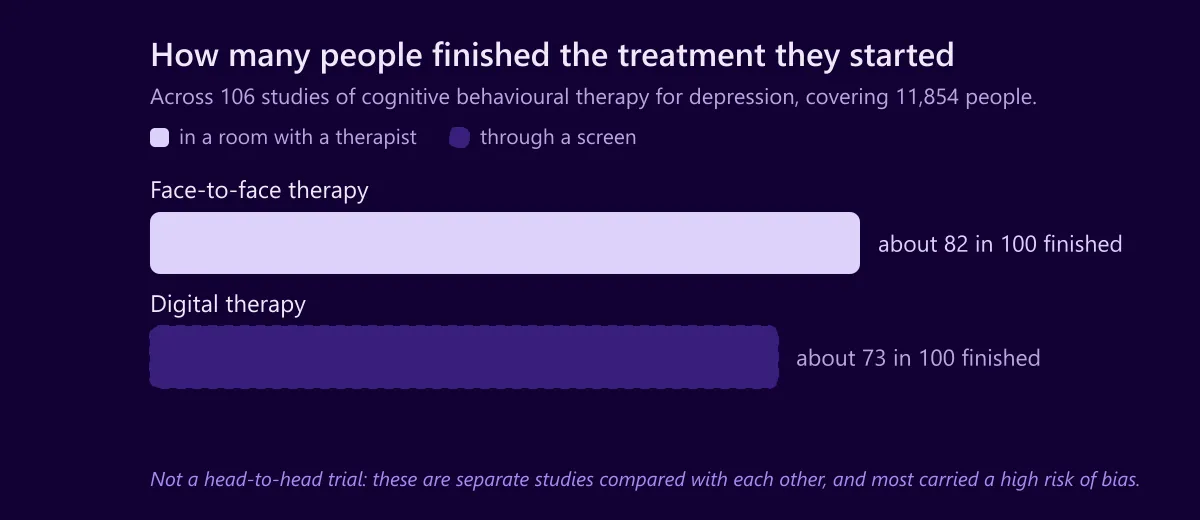
In that review of 106 studies, 82 in 100 people finished when it was face-to-face, against 73 in 100 when it was digital. The gap between face-to-face and app-style tools used alone was wider still.
Nine people in a hundred does not sound like much. It is enough to move an average, and it points at something simple. A person expecting to hear from you on Thursday changes what you do on Wednesday. Nothing in an app does that.
One honest note on the same review: it compared studies rather than running a head-to-head trial, most of the studies carried a high risk of bias, and the authors said that once you account for the differences between the groups of people studied, the two formats may well be comparable. Hold the exact numbers loosely. The pattern across the whole field is the solid part.
What therapy is doing that an app is not
Not a sales pitch for therapy. Just a list of jobs no app performs.
| What happens in therapy | What an app does |
|---|---|
| Someone works out what is actually wrong | Assumes you already know |
| Someone notices you are worse this week | Waits to be opened |
| The approach changes when it is not working | Does the same thing in week nine |
| Risk gets spotted and acted on | Shows a helpline number |
That last row is the one that matters most and gets discussed least.
What an app is genuinely good for
A short list, and everything on it is real.
- It is there at 2am, when nothing else is.
- It costs nothing or close to it, and there is no waiting list. Our guide on free mental health apps covers what that actually buys you.
- It keeps a record. This is the one use almost nobody argues with. Thirty days of numbers beats anyone’s recollection of the month, including yours.
- It fills the wait. If you are on a list, the weeks before the first appointment are not nothing.
None of those is treatment. All of them are worth having.
How to get the middle tier
If the guided version is the one with the evidence behind it, the obvious question is how to get it.
Ask a doctor about guided cognitive behavioural therapy. In a lot of health systems it is offered as a first step, precisely because it works and needs less therapist time than weekly sessions. It is not something you buy in an app store. Our guide on talking to a doctor covers how to raise it, and a few weeks of notes is the most useful thing to bring.
Where this leaves Moodify
Moodify is the third kind. An app you use on your own, with nobody reading what you write.
So by the evidence above, it is in the weakest of the three categories, and we are not going to dress that up. It has not been tested in a trial. What it is for is the record: a mood log, a sleep log, assessments you can retake, and a history you can show someone. That is the use the research supports best, and it is the one we build for. What Moodify is sets out what it does and what it costs, in plain terms.
If you are weighing an app against therapy, the honest answer is that it is not a choice between two versions of the same thing. Get the help if you can get it. Keep the record either way.
Logging takes a few seconds in Moodify, and a paper notebook does the same job. The depression self-check and the anxiety self-check take two minutes each and give you a score to bring with you.
If you have been thinking about harming yourself, that is not something to work through alone with an app. Please talk to a person today — a doctor, a helpline, or someone you trust.
Common questions
- Can a mental health app replace therapy?
- No. The evidence that online treatment matches face-to-face therapy comes from trials where a therapist read what the person wrote each week and replied. A 2023 review of 31 such trials found the two formats came out about level. An app with no person attached is a different thing, and the evidence for it is much weaker.
- Is online therapy as good as in-person therapy?
- When a real therapist is involved, the trials say yes. Across 31 trials covering 16 conditions, online cognitive behavioural therapy guided by a therapist produced effects about the same as face-to-face. The catch is that this says nothing about apps you use alone. The therapist was part of the treatment being tested.
- Do apps work better with a human involved?
- Yes, for depression. A review of 106 studies found guided digital programmes clearly better than unguided ones for depressive symptoms. Adding even light human contact changes the result, which is the single most useful thing this research tells you.
- What can an app do that therapy cannot?
- It can be there at 2am, it costs little or nothing, there is no waiting list, and it keeps a record of your days that no memory can match. Those are real advantages and none of them is treatment. They make an app a good thing to use alongside help, or while waiting for it.
- Why do fewer people finish a digital programme?
- Nobody knows for certain, though a person expecting to hear from you is an obvious candidate. In one large review, about 82 in 100 people finished face-to-face therapy against about 73 in 100 doing it digitally. The gap was bigger still between face-to-face and app-style tools used alone.
- Should I use an app instead of seeing someone?
- Not instead. If you are considering therapy and can get it, get it. An app is a reasonable thing to use while you wait, to keep a record worth bringing, or alongside treatment. If things are severe, or you have thought about harming yourself, that is a conversation with a person, not an app.
Sources
- Hedman-Lagerlöf et al. — Therapist-supported Internet-based cognitive behaviour therapy yields similar effects as face-to-face therapy for psychiatric and somatic disorders: an updated systematic review and meta-analysis (World Psychiatry, 2023). 31 randomised trials, 16 conditions; pooled Hedges' g = 0.02 (95% CI -0.09 to 0.14)
- Andersson, Topooco, Havik & Nordgreen — Guided Internet-based vs. face-to-face cognitive behavior therapy for psychiatric and somatic disorders (World Psychiatry, 2014). The earlier version of the same review: 13 trials, N = 1,053; pooled Hedges' g = -0.01 (95% CI -0.13 to 0.12)
- Kambeitz-Ilankovic et al. — A systematic review of digital and face-to-face cognitive behavioral therapy for depression (npj Digital Medicine, 2022;5:144). 106 studies, 11,854 patients; guided digital superior to unguided for depressive symptoms (p < 0.001); no difference between formats for anxiety (p = 0.240); treatment completion 82.4% face-to-face vs 72.9% digital (p = 0.014); overall high risk of bias, and the authors note the formats may be comparable once confounders are accounted for
- Linardon et al. — Current evidence on the efficacy of mental health smartphone apps for symptoms of depression and anxiety: a meta-analysis of 176 randomized controlled trials (World Psychiatry, 2024;23(1):139-149). Apps vs active interventions g = -0.08 (depression) and g = 0.11 (anxiety), both non-significant
- US National Institute of Mental Health — psychotherapies
General information, not medical advice. See our editorial policy for how these guides are written and corrected.