Mind Matters
What to Look For in a Mood Tracking App
Almost every comparison of mood tracking apps is a feature list, and feature lists are the wrong tool. The evidence points at three things instead. First, how little the app asks of you each day, because across 93 popular apps the typical one had about three in a hundred users left after a month, and an app you have stopped opening helps nobody. Second, what sits behind it: in a review of 176 trials, apps using cognitive behavioural techniques, mood monitoring or a chatbot produced larger effects than those without. Third, what happens to the data, since a mood record is among the most sensitive things you will ever type into a phone. Everything else — streaks, badges, mood emojis, the number of chart types — is decoration, and some of it works against you. We make one of these apps, so this guide names where ours is the wrong choice too.
Every comparison of these apps is a feature list, and the feature list is the least useful thing to compare. Three things predict whether one helps. None of them appears on a store page.
We make one of these, so there is a section near the end naming where ours is the wrong choice.
One: how little it asks of you
This is first because the evidence is blunt about it.
When researchers looked at independently measured usage of 93 popular apps, the typical one had about three in a hundred users still active after a month. An app that is perfect and abandoned is worth less than a crude one you still open.
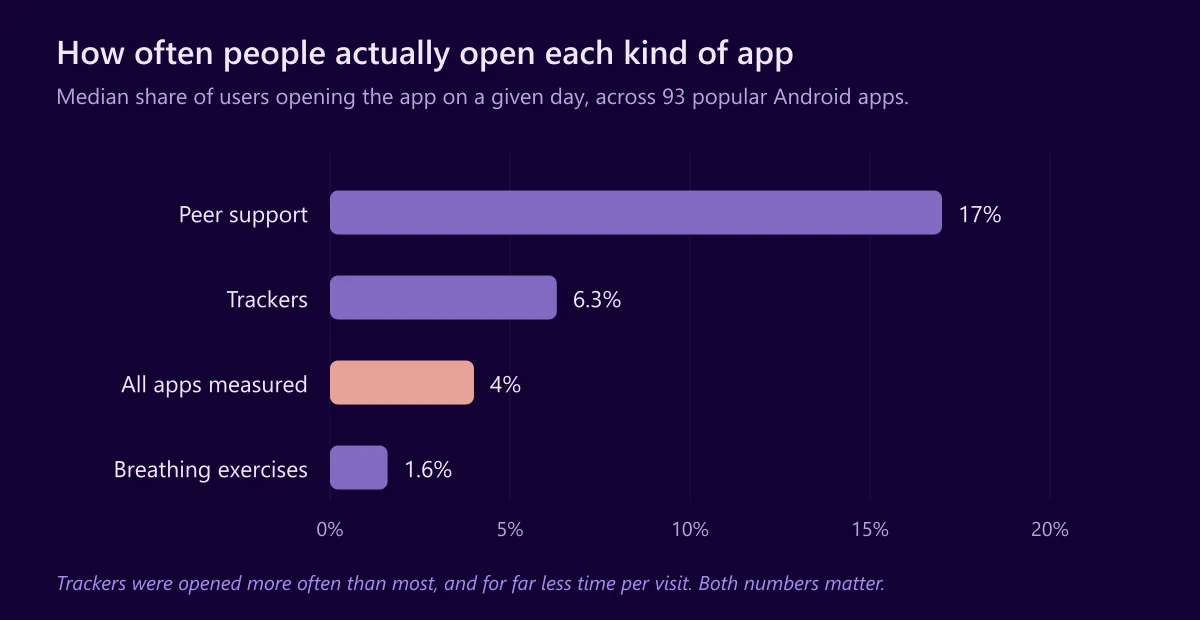
Two numbers from that work are worth putting side by side. Trackers were opened on a given day by about 6 in 100 users, against 1.6 in 100 for apps built around breathing exercises. But when people did open a tracker, they stayed for a few minutes at most, while meditation apps held people for about twenty.
Those two facts are the whole design argument. A tracker survives by being small. It is not competing for twenty minutes of your evening. It is competing with not bothering.
So the test to apply: how long does one ordinary day’s entry take? If the answer is more than about twenty seconds, ask honestly whether you will do it on a day when everything is going wrong. Those are the days whose data you most need.
Two: what sits behind it
In the review of 176 trials of mental health apps, some things were associated with larger effects:
| Worth having | Why |
|---|---|
| Cognitive behavioural techniques | Larger effects for both depression and anxiety |
| Mood monitoring | Larger effects for anxiety specifically |
| A chat companion | Larger effects for depression |
| A real crisis pathway | Not an effect size. It is the thing that matters on the worst night |
And things that sound substantial but are not evidence of anything: the number of chart types, mood emojis, colour themes, gratitude prompts, an AI label without any description of what it does.
Our guide on whether mental health apps actually work goes through those trial results properly, including the caveat that these are associations rather than proof that any one feature does the work.
Three: what happens to your data
A mood record is among the most sensitive things you will ever put in a phone. Before you type anything in, two minutes of checking is proportionate.
- Does it need an account at all? Some do not. One that does should say why.
- Who does it share data with? The privacy policy should name categories, not gesture at “partners”.
- Can you delete everything, and is the route obvious? A delete that requires emailing someone is not a delete.
- Does it ask for permissions it has no use for? Contacts and location are not needed to record how you felt.
This is not a theoretical worry. Researchers once took 36 top-ranked apps for depression and for quitting smoking, used each one, and watched what left the phone. Thirty-three of the 36 sent data to someone else. Of those, nine had no privacy policy at all, five had one that did not mention it, and three had one saying it would not happen. Twenty-nine sent data to services run by Facebook or Google, and fewer than half of those disclosed it accurately.
That was a small sample taken in 2019, and it is not a verdict on any app you are looking at today. It is a good reason to read the policy yourself rather than assume.
Things that are marketed as features and are not
Streaks. A streak turns a missed day into a visible failure. The days you miss are disproportionately the bad days — exactly the days when an app telling you that you have broken something is least welcome. A record with gaps is still a useful record.
Daily mood prompts that demand a reason. Being made to categorise why turns ten seconds into two minutes, and the honest answer is often “I don’t know”. An app that will not accept “I don’t know” is training you to make something up, which quietly poisons the record.
A score out of a hundred for your wellbeing. There is no validated scale behind these. If you want a number that means something, the GAD-7 and PHQ-9 are free, take two minutes, and are what a doctor will recognise.
Mood “insights” after a week. A week is not enough to see a pattern in anything with a weekly rhythm, which describes most of life. Our guide on using a mood tracker to spot patterns covers what you can and cannot read from a short record.
A two-minute test before you commit
Install it and check these before you build a habit on it:
- Log one mood and time it. Over twenty seconds is a warning sign.
- Try to log yesterday. If you cannot backfill, a missed day becomes a hole for ever.
- Find the delete-everything option. If you cannot find it in a minute, it is not really there.
- Open the chart view with one day of data. See whether it is honest about having nothing to show yet, or invents an insight.
- Look for what happens on the worst entry. Something at the bottom of the scale should produce support, not a cheerful badge.
Where Moodify is the wrong choice
We would rather say this than have you discover it.
Moodify is an Android app. There is no iPhone version yet, so if you are on iOS this guide is useful and our app is not.
It has not been tested in a trial. What it has is the features associated with larger effects in the research above, and a deliberately small daily action. That is a design argument, not a result, and we try to be careful about the difference.
If what you want is a long-form written journal, a tracker is the wrong shape of tool — journalling and tracking do different jobs. And if you are in treatment and your clinician has given you a form to fill in, use theirs. A second system is a reason to stop doing both.
Where it does fit: you want a few seconds a day, a record you can read in a month, and something concrete to take to an appointment. That is the job it is built for, and Moodify is free on Google Play.
The thing that matters more than which app
Whatever you choose, the value comes from writing it near the time.
Memory is unreliable about mood in a specific direction: you will remember the worst day and the most recent one, and those two will stand in for the whole month. Our guide on why you cannot remember how you felt explains why, and it is the reason any record beats no record.
An app, a note, a wall calendar with a number on each day. The method is the least important decision here. The timing is the whole thing.
Common questions
- What should I look for in a mood tracking app?
- Three things, in this order. How long a single day's entry takes, because most people stop using these apps within a month and the ones that survive are the ones that ask almost nothing. What techniques sit behind it, since apps using cognitive behavioural methods and mood monitoring showed larger effects across 176 trials. And what happens to your data, which for a mood record matters more than for almost anything else on your phone.
- Are paid mood tracking apps better than free ones?
- Not in any way the evidence distinguishes. No trial has found that price predicts benefit. What matters is whether the techniques have support behind them and whether you keep using it. A reasonable test is whether the thing you actually need daily is behind the paywall: if logging your mood is paid and only the extras are free, the app is built around billing rather than around the habit.
- How long does a mood entry need to take?
- Short enough that you will still do it on your worst day. Ten or twenty seconds is realistic; several minutes of questions is not, however useful the extra detail would be. The data on real-world use is blunt about this: apps requiring a longer sitting were abandoned fastest, and apps that were quick to open were used most often.
- Do streaks and reminders help you keep tracking?
- Reminders can help. Streaks are more questionable. A streak turns a missed day into a visible failure, and the days you are most likely to miss are the bad ones, which is exactly when being told you have failed is least useful. A record with gaps in it is still a useful record, and an app that treats it otherwise is optimising for its own numbers.
- Is it safe to put my mood data in an app?
- Treat it as sensitive, because it is. Before you start, check whether the app says who it shares data with, whether an account is required, and whether you can delete everything. Many mental health apps have been found to share data more widely than their descriptions suggest, so the privacy policy and the delete option are worth two minutes before you type anything into it.
- What should a mood tracker not be used for?
- Diagnosing yourself, or deciding whether to seek help. A tracker records what happened; it has no way to judge what it means. Its genuine value is giving you something concrete to bring to a doctor instead of trying to recall several weeks in a ten-minute appointment. If things are bad now, that appointment matters more than any amount of tracking.
Sources
- Baumel, Muench, Edan & Kane — Objective user engagement with mental health apps: systematic search and panel-based usage analysis (Journal of Medical Internet Research, 2019;21(9):e14567). 93 apps; trackers median daily open rate 6.3% vs 1.6% for breathing apps; median 30-day retention 3.3%
- Linardon et al. — Current evidence on the efficacy of mental health smartphone apps for symptoms of depression and anxiety: a meta-analysis of 176 randomized controlled trials (World Psychiatry, 2024;23(1):139-149). CBT features, chatbot technology and mood monitoring associated with larger effect sizes
- Huckvale, Torous & Larsen — Assessment of the data sharing and privacy practices of smartphone apps for depression and smoking cessation (JAMA Network Open, 2019;2(4):e192542). 36 apps; data transmission detected in 33, of which 9 had no privacy policy, 5 did not disclose it and 3 denied it
- US National Institute of Mental Health — health topics
General information, not medical advice. See our editorial policy for how these guides are written and corrected.