Mind Matters
Does What You Eat Actually Change Your Mood?

Less than the headlines say, and the gap between the two is instructive. The study everyone cites is a 2017 trial where people with depression saw a dietitian seven times over 12 weeks. The result was striking, and 56 people finished it. Then in 2025 a team gathered every trial that ran for three months or longer and found 25 of them. Almost everything thinned out. Advice to cut calories produced a small improvement in depressive symptoms, but only in adults already at raised risk of heart and metabolic disease, and the reviewers rated their confidence in it low. Advice to cut fat produced an effect they called very small. For other diets, for anxiety, and for diet compared against another active treatment rather than against nothing, there was not enough good evidence to say. None of that is a reason to eat badly. It is a reason to stop expecting a diet to lift a mood, and to notice that the one signal that survived points at metabolic health rather than at any particular food.
Eat better, feel better. It is one of those claims that sounds too sensible to check.
It has been checked, twice, and the two answers are very far apart.
The trial everyone quotes
In 2017 a team in Australia ran what became the most cited study in this field. People with moderate to severe depression saw a clinical dietitian seven times over 12 weeks and were coached onto a Mediterranean-style diet.
The result was large. On the standard depression scale the diet group improved far more than the comparison group, and about a third reached remission against one in twelve of the others.
That is a genuinely interesting finding, and it is worth knowing exactly what produced it:
- Sixty-seven people enrolled. Fifty-six finished.
- Twelve weeks, which is not long for a question about diet.
- It was an add-on. Most participants were already having therapy, taking medication, or both. Nobody tested diet instead of treatment.
- The comparison group got social visits on the same schedule, which is a fairer comparison than most and still not a blind one. You cannot hide from someone which diet they are eating.
A single small trial with a large effect is the exact shape of result that often shrinks when more evidence arrives. Which is what happened.
What happened when they gathered the longer trials
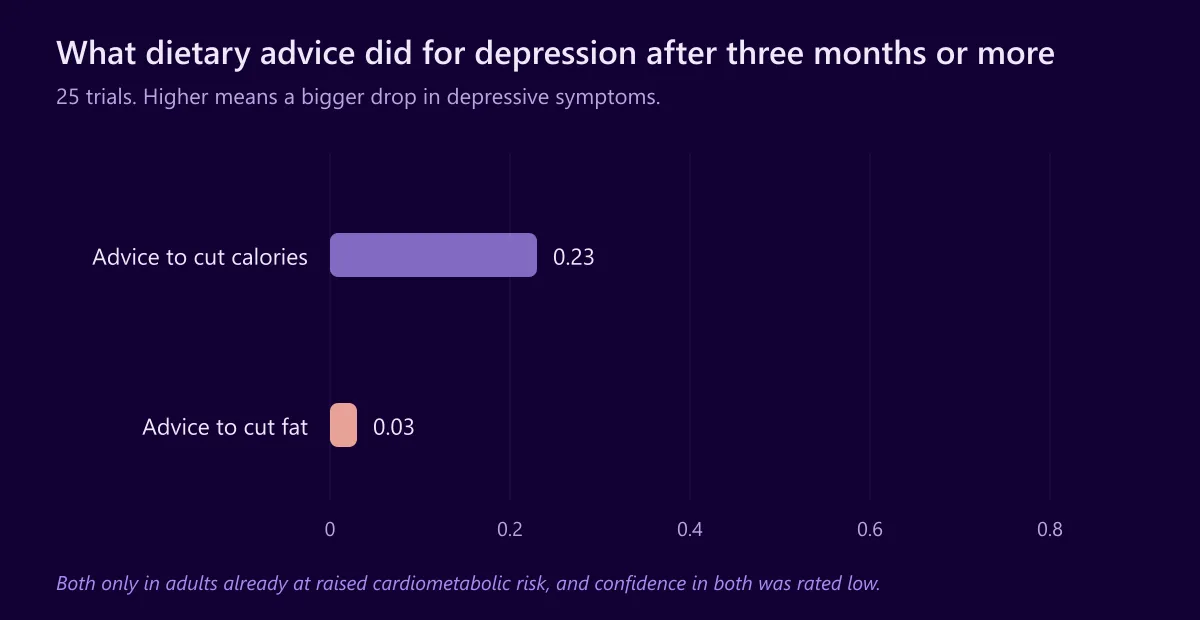
In 2025 reviewers gathered every trial of dietary advice that put people into groups at random, ran for three months or longer, and measured depression or anxiety. They found 25.
Two findings survived, and both are small.
- Advice to cut calories improved depressive symptoms by 0.23 on the standard scale, where 0.2 counts as small. This appeared only in adults already at raised risk of heart and metabolic disease.
- Advice to cut fat produced an effect the reviewers described as very small: 0.03.
The reviewers graded their confidence in both as low.
And then the longer list of what they could not answer: other diets, including the Mediterranean one. Anxiety. Diet compared against another real treatment rather than against no advice at all. In each case the evidence was too thin or too inconsistent to support a conclusion.
Why the two answers differ so much
Not because anyone is lying. Three ordinary reasons.
Small trials produce big numbers. Look at the confidence interval around the famous trial’s practical result: somewhere between 2 and 28 people would need the intervention for one extra person to reach remission. That range is so wide it is really saying “we do not know yet”. Press coverage used the lower end.
Twelve weeks is not three months of real life. It is roughly three months of seeing a dietitian weekly. The longer trials ask what happens after the scaffolding comes down.
You cannot blind a diet. Everyone knows which group they are in, including the person scoring their depression in some studies. That inflates results in a direction nobody intends.
The signal that did survive, and what it is pointing at
This is the part worth sitting with, because it is not the part anyone repeats.
The one reasonably solid finding was about calorie restriction in people at raised cardiometabolic risk. Not a superfood. Not a nutrient. Not a particular cuisine. A change in metabolic health in people whose metabolic health was already a problem.
That suggests whatever is going on here may run through the body’s general state rather than through anything specific about blueberries. Which would also explain why the effect does not show up in people who are metabolically well.
What this does not mean
Worth being explicit, because “the evidence is weak” gets misread.
- It does not mean eat badly. Diet matters enormously for physical health, and that is reason enough.
- It does not mean food has no effect on you. It means the average effect across thousands of people is small. Your own case is not an average.
- It does not mean the famous trial was wrong. It means it was one small trial, and one small trial is a reason to look further rather than a reason to conclude.
What it does mean is that if you are low and someone tells you to fix your diet, they are offering you something the evidence supports weakly, at best, for that purpose. Our guide on managing mild anxiety without medication covers what else is on the list, and whether exercise helps covers the one lifestyle change with much better evidence behind it.
Where this leaves Moodify
Moodify has no food diary in it, and this research is not a reason to add one. A daily log of what you ate is a lot of effort for a question the evidence says has a small answer — and our guide on how long until tracking becomes a habit explains what happens to logs that ask too much.
One honest connection, though. The app does track blood pressure and blood glucose, and the one dietary finding that survived was in people at raised cardiometabolic risk. Keeping an eye on those numbers is worth doing for its own sake. It is not a mood intervention, and we are not going to relabel it as one.
What Moodify is lists what is actually in it.
The version of this question you can actually answer
The research can tell you about averages. It cannot tell you whether you feel worse on the days after a bad week of eating, and that is answerable.
- Log your mood daily, at the same time.
- Add one note, not a food diary: whether the day’s eating was roughly good or roughly bad. One word.
- Log sleep too, because short nights and poor eating travel together and will otherwise take each other’s credit.
- Look at a month.
That last point matters more here than usual. Our guide on what to track besides mood covers why sleep is the field worth adding first, and spotting patterns covers reading a month without talking yourself into a result.
Logging takes a few seconds in Moodify, and a paper diary does the same job. The depression self-check takes two minutes and gives you a score you can retake in a month.
If your eating has become something you cannot control, or you are eating far less or far more than usual and it is distressing you, that is worth raising with a doctor and it is not a willpower problem. If you have been thinking about harming yourself, please talk to someone today — a doctor, a helpline, or a person you trust.
Common questions
- Does what you eat affect your mood?
- Probably a little, and much less than is usually claimed. A 2025 review of 25 trials lasting three months or more found advice to cut calories produced only a small improvement in depressive symptoms, and only in adults already at raised cardiometabolic risk. The reviewers rated their confidence in that finding as low.
- Can changing your diet treat depression?
- Not on the current evidence, and nobody serious claims it as a standalone treatment. Even the famous 2017 trial tested diet as an add-on to treatment people were already receiving, not instead of it. Over longer follow-up the combined effects are small and the confidence in them is low.
- What about the Mediterranean diet and depression?
- That is the diet in the best-known trial, which had 56 people complete it over 12 weeks. When reviewers looked at trials running three months or longer, the evidence on specific diets like that one was too limited to draw a conclusion. It may help. It has not been shown to.
- Does diet help with anxiety?
- There is not enough evidence to say. The 2025 review looked for it specifically and found the research on anxiety too limited and too inconsistent to support a conclusion either way. That is an absence of evidence rather than evidence of absence.
- Why do I feel better when I eat well?
- Quite possibly because you do, and the research simply cannot detect effects at the level of one person's week. It is also hard to separate eating well from sleeping better, drinking less and moving more, which tend to travel together. Your own experience is worth more here than it usually is, because the averages are so small.
- Does cutting sugar improve your mood?
- No trial in this review tested that specifically well enough to answer. What did show a small signal was calorie restriction in people at raised metabolic risk, which is a different thing from removing one ingredient.
- So should I bother eating well for my mental health?
- Yes, but for honest reasons. Eating well is worth doing for physical health on its own, and the one dietary signal that survived longer follow-up appeared in people whose metabolic health was already at risk. Expecting it to lift your mood directly is the part the evidence does not support.
Sources
- Abukmail et al. — Moderate- to long-term effect of dietary interventions for depression and anxiety: a systematic review and meta-analysis (Annals of Internal Medicine, 2025;178(7)). 25 randomised trials of dietary advice lasting 3 months or longer. Calorie restriction advice versus no specific dietary advice: SMD -0.23 (95% CI -0.38 to -0.09), low certainty, in adults with elevated cardiometabolic risk. Low-fat diets: SMD -0.03 (95% CI -0.04 to -0.01), low certainty. Evidence on other diets, on comparisons with active interventions and on anxiety was limited by study limitations and heterogeneity. PROSPERO CRD42023485953
- Jacka et al. — A randomised controlled trial of dietary improvement for adults with major depression (the SMILES trial) (BMC Medicine, 2017;15:23). 12-week, single-blind, adjunctive trial; 67 enrolled (33 diet, 34 control), 31 and 25 with complete data at 12 weeks; control was a social support protocol on the same visit schedule. MADRS improvement favoured diet, Cohen's d = -1.16; remission 32.3% versus 8.0% (p = 0.028), number needed to treat 4.1 (95% CI 2.3 to 27.8). A correction was published in 2018
- US National Institute of Mental Health — depression
General information, not medical advice. See our editorial policy for how these guides are written and corrected.