Daily Rituals
Does Self-Compassion Actually Work?

It depends entirely on what you compare it with, and that turns out to be the whole story. A 2023 review gathered 56 trials of self-compassion training and did something most reviews skip: it separated the trials that compared the training against people given nothing from the trials that compared it against people given some other activity. Against nothing, the training worked. Low mood, anxiety and stress all improved by a medium amount. Against another activity of roughly similar effort, the differences shrank to almost nothing, and for anxiety to as close to zero as a number gets. Only 25 of the 56 trials made that second comparison at all. The reviewers also rated the overall risk of the trials being skewed as high. None of this means being kinder to yourself is pointless. It means the evidence does not show self-compassion training beating other things you could spend the same half hour on, and the confident claims you have read are mostly built on the easier comparison.
Be kinder to yourself. It has become the standard advice, and there is a real research field behind it rather than just a mood.
The field has an answer. The answer depends completely on one question that almost nobody reporting it asks.
The question is: compared with what?
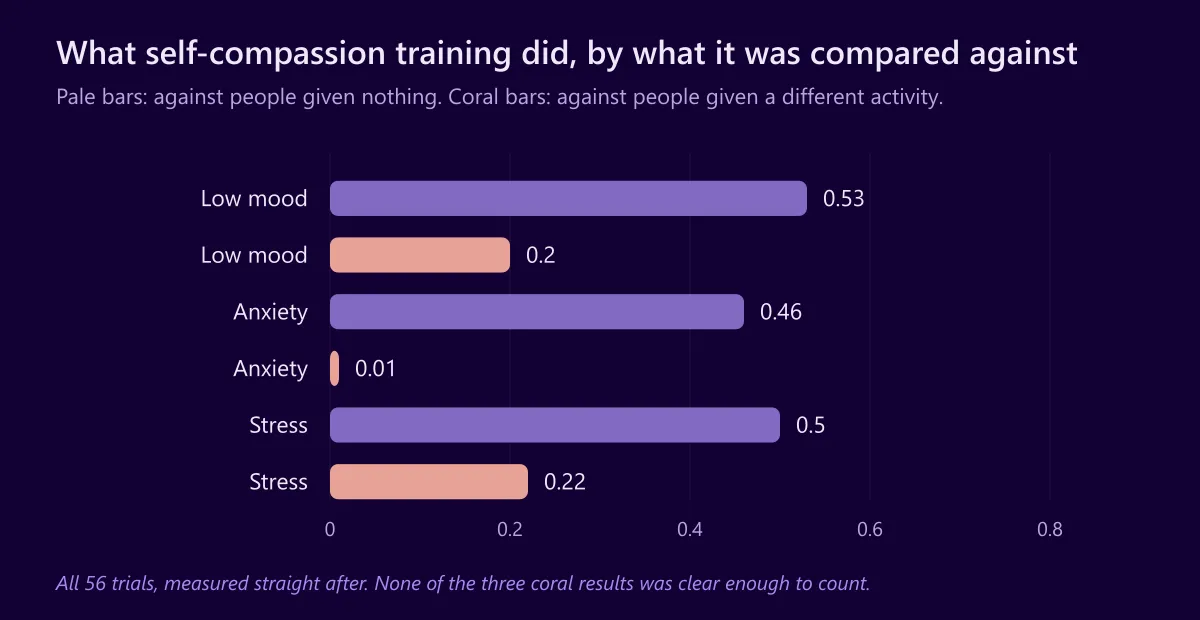
A 2023 review gathered 56 trials of self-compassion training and split them in two. Some trials compared the training against people who were given nothing at all — usually a waiting list. Others compared it against people given a different activity of roughly similar effort.
Against nothing:
- Low mood improved by 0.53, where 0.2 counts as small and 0.5 as medium.
- Anxiety by 0.46.
- Stress by 0.50.
Against another activity:
- Low mood, 0.20.
- Anxiety, 0.01.
- Stress, 0.22.
None of the three in that second group was clear enough to count. The anxiety number is not a small effect. It is a rounding error.
What that difference actually means
It is easy to read this as “so it does not work”, and that is the wrong reading. Two things are true at once.
The training does something. People who did it ended up better off than people who did nothing, consistently, across dozens of trials and three different outcomes. That is a real result about a real thing.
It has not been shown to beat the alternatives. When the comparison was a relaxation course, or a thinking-skills exercise, or any other structured activity taking similar time and effort, the difference between them mostly vanished.
Those are compatible. Lots of things help compared with nothing. The question a person actually faces is not “self-compassion or nothing” but “this, or the other thing I might do with that half hour”, and on that question the research has less to say than the confident version suggests.
There is a further wrinkle worth knowing: only 25 of the 56 trials made the harder comparison at all. The easier one is the one most researchers ran, which is also how the bigger numbers ended up in circulation.
Why the numbers you have seen are bigger
If you have read that self-compassion has large effects, you were probably reading about a different kind of study.
A 2026 review limited to university students found effects roughly twice the size of the ones above. It is a perfectly respectable piece of work. It is also 11 trials rather than 56, in one narrow group of people, and it combined every type of comparison together instead of separating them.
Narrower group, fewer trials, mixed comparisons, bigger number. That sequence shows up so often across this site that it is close to a rule. Our guide on whether gratitude journalling works runs into the same thing in the next field along.
What self-compassion is not
Two misreadings get in the way of this more than the evidence does.
It is not self-esteem. Self-esteem is a verdict on how you are doing, so it is highest when things are going well and lowest exactly when you need something. Self-compassion is about how you treat yourself regardless of the verdict, which is why the two come apart on bad days.
It is not letting yourself off. The practices in these trials involve noticing self-criticism and responding differently to difficulty. None of them asks you to drop a standard or skip a consequence. The worry that being kinder to yourself will make you lazy is the single most common objection, and there is nothing in these trials that supports it.
Our guide on how to stop overthinking covers the neighbouring mechanism, because self-criticism and rumination tend to run together.
What the practices actually are
Worth being concrete, because “be kind to yourself” is an instruction nobody can follow.
- Noticing the tone, not the content. The useful observation is usually not that a self-critical thought is wrong, but that you would not say it that way to anyone else.
- Naming the moment as a hard one. The trials often start here. It sounds trivial. It stops a difficulty becoming a verdict on you.
- Writing to yourself as you would to a friend. The letter exercise is in a lot of these programmes, and it is the one people report finding strangest and most useful.
- Remembering that the thing is common. Not as consolation. As a factual correction, because low mood makes experiences feel more singular than they are.
The honest state of this evidence
Three caveats, and they are not small ones.
- The overall risk of the trials being skewed was rated high. That is the reviewers’ own assessment of their own 56 studies.
- The comparison most people need was the one least often made.
- Follow-up is patchy. Against people given nothing, the benefit for low mood and stress was still there later. For anxiety, the later results across all the trials were not clear enough to conclude anything from.
So the defensible summary is: probably helpful, not shown to be more helpful than the alternatives, and studied less rigorously than the volume of writing about it suggests.
Where this leaves Moodify
This one is uncomfortable for us in a specific way.
Moodify, like most apps in this category, talks to you in an instructing voice. Do this. Try that. Keep your streak. That register is the opposite of the thing described above — it is a standard being set, and on a bad day a standard is one more thing to fall short of.
We have not fixed that, and saying so here is more honest than quietly adding a self-compassion exercise and calling it addressed. The research above would not justify that exercise anyway. What it does justify is being careful about the tone of an app that people open on their worst days, and that is a design problem rather than a feature.
Our guide on whether it is safe to talk to AI about mental health covers the wider version of this question, and what Moodify is lists what is actually in it.
The part a record helps with
Self-criticism is very hard to observe from inside, because it does not feel like criticism at the time. It feels like an accurate assessment.
A few weeks of notes does something specific about that. Written down, the same sentence turns up on the same kinds of days, which is the clue that it is a response to a state rather than a reading of the facts.
- Log your mood daily, at the same time.
- When the day was bad, note the sentence, not the event. One line.
- Log sleep, because short nights sharpen the tone of all of this.
- Read the month rather than the day.
Our guide on mood tracking or journalling covers which of those two does which job, and spotting patterns covers reading a month without inventing a story about it.
Logging takes a few seconds in Moodify, and a notebook does the same job. The depression self-check takes two minutes and gives you a score you can retake in a month.
If the way you talk to yourself has become relentless, or you find yourself believing you deserve to feel this way, that is worth taking to a doctor or a therapist rather than to an exercise. It is a recognised feature of depression rather than a fact about you. If you have been thinking about harming yourself, please talk to someone today — a doctor, a helpline, or a person you trust.
Common questions
- Does self-compassion actually work?
- Against doing nothing, yes. A 2023 review of 56 trials found medium improvements in low mood, anxiety and stress straight after the training. Against people given a different activity instead, the differences were too small and too uncertain to count, on all three outcomes.
- Is self-compassion better than other things I could try?
- The evidence does not show that it is. When the review separated out the trials that compared self-compassion training against another activity, the advantage largely disappeared. That is not evidence it fails. It is an absence of evidence that it beats the alternatives, which is a different and more modest claim than the one usually made.
- Is self-compassion the same as self-esteem?
- No, and the difference is the useful part. Self-esteem is a judgment about whether you are doing well, so it rises and falls with how things are going. Self-compassion is how you treat yourself regardless of how things are going, which is why it is most relevant on exactly the days self-esteem is lowest.
- Is being self-compassionate just letting yourself off?
- It is the most common worry about it and the research does not support it. The practices studied in these trials involve noticing self-criticism and responding to difficulty differently, not excusing anything. Nothing in them asks you to lower a standard or skip a consequence.
- How long does self-compassion training take to work?
- The trials in the 2023 review mostly measured straight after the programme, which usually ran a few weeks. Benefits against people given nothing were still there at follow-up for low mood and stress. For anxiety, the follow-up results across all the trials were not clear enough to draw a conclusion from.
- Why do some studies report much bigger effects?
- Usually because of what they compared against and who they studied. A 2026 review limited to university students reported effects roughly twice the size, and it combined every type of comparison together rather than separating them. Narrower groups and easier comparisons produce larger numbers, which is a general rule rather than a criticism of that study.
- Should I try self-compassion exercises?
- They are free, there is no sign of harm, and against doing nothing they help. That is a reasonable basis for trying them. What the evidence does not support is choosing them over something else you would actually keep doing, because on the current trials those come out about the same.
Sources
- Han & Kim — Effects of Self-Compassion Interventions on Reducing Depressive Symptoms, Anxiety, and Stress: A Meta-Analysis (Mindfulness, 2023). 56 randomised controlled trials; 31 involved passive control groups only, 16 active control groups only, 9 both. Depressive symptoms at immediate posttest: 36 RCTs, N = 2,960, overall SMD 0.44 (95% CI 0.31 to 0.57); versus passive controls 0.53 (26 RCTs); versus active controls 0.20 (10 RCTs, 95% CI -0.05 to 0.45), not significant; subgroup difference p = 0.03. Anxiety at posttest: 31 RCTs, N = 2,508, overall 0.36; versus passive 0.46 (22 RCTs); versus active 0.01 (9 RCTs, 95% CI -0.54 to 0.57). Stress at posttest: 30 RCTs, N = 4,020, overall 0.43; versus passive 0.50 (21 RCTs); versus active 0.22 (9 RCTs, 95% CI -0.04 to 0.48). At follow-up, depressive symptoms versus active controls -0.12 (4 RCTs) and anxiety overall 0.13 (14 RCTs), neither significant. The overall risk of bias across included RCTs was high; the review was not preregistered
- Sobhaninia et al. — The role of self-compassion interventions in reducing anxiety and depression among university students: a systematic review and meta-analysis (BMC Psychology, 2026;14:1334). 11 randomised controlled trials, 803 participants, searched 2015-2025, PROSPERO CRD420261443161. Anxiety Hedges' g -0.854 (95% CI -1.088 to -0.620, p < 0.001), I2 48.5%; depression g -0.694 (95% CI -0.904 to -0.485, p < 0.001), I2 41.1%. Comparison conditions were defined to include wait-list, no intervention, usual care, psychoeducational and other active controls, and were combined rather than analysed separately. The authors note that most included studies had small samples and were single-centre, and that follow-up was short or not reported in most
- US National Institute of Mental Health — depression
General information, not medical advice. See our editorial policy for how these guides are written and corrected.