Daily Rituals
Does Gratitude Journalling Actually Work?
It depends which question you are asking, and the two get mixed up constantly. For general well-being, yes, a little. The largest look at it so far gathered 145 papers and 24,804 people across 28 countries, and found gratitude exercises produced a small but consistent lift. The effect was bigger when the thing being measured was positive feelings, and bigger in better-run trials rather than worse ones, which is not the usual pattern and counts in its favour. For symptoms of depression and anxiety, the answer is much weaker. A review of 27 trials found a small effect that got smaller at follow-up, and that shrank further when gratitude was compared against some other activity rather than against nothing at all. Those authors ended by recommending that anyone trying to reduce real symptoms use something with better evidence behind it. So gratitude journalling appears to add a bit of good. It does not appear to subtract much bad. Both of those are worth knowing before you decide it is failing you.
Three good things, every night. It is the most recommended two minutes in wellness, and the claims made for it range from reasonable to absurd.
The research is in better shape than most of this field. It just answers a narrower question than the one people think it answers.
Two different questions wearing one name
Almost every argument about gratitude journalling collapses because two things are being measured:
- Does it make life feel a bit better? General well-being. Mood, positive feelings, satisfaction.
- Does it reduce symptoms of depression or anxiety? A clinical question about people who are unwell.
The evidence gives different answers to those, and the gap between them is the whole story.
Question one: a small, stubborn yes
In 2025 a team ran the largest look at this so far. They had registered their plan in advance, which matters, and they gathered 145 papers, 727 separate results and 24,804 people across 28 countries.
Gratitude exercises produced a small lift in well-being. Small, but it showed up positively in every country they looked at.
Three details make it more convincing than most small findings:
- The effect was larger in the better-run trials, not smaller. That is the opposite of the usual pattern, where sloppy studies produce the exciting numbers.
- It held up when they checked for publication bias, the tendency for studies finding nothing to never get printed.
- It was biggest when what was measured was positive feelings rather than the absence of bad ones.
That last point is the hinge of this whole article. Hold onto it.
Question two: a much weaker answer
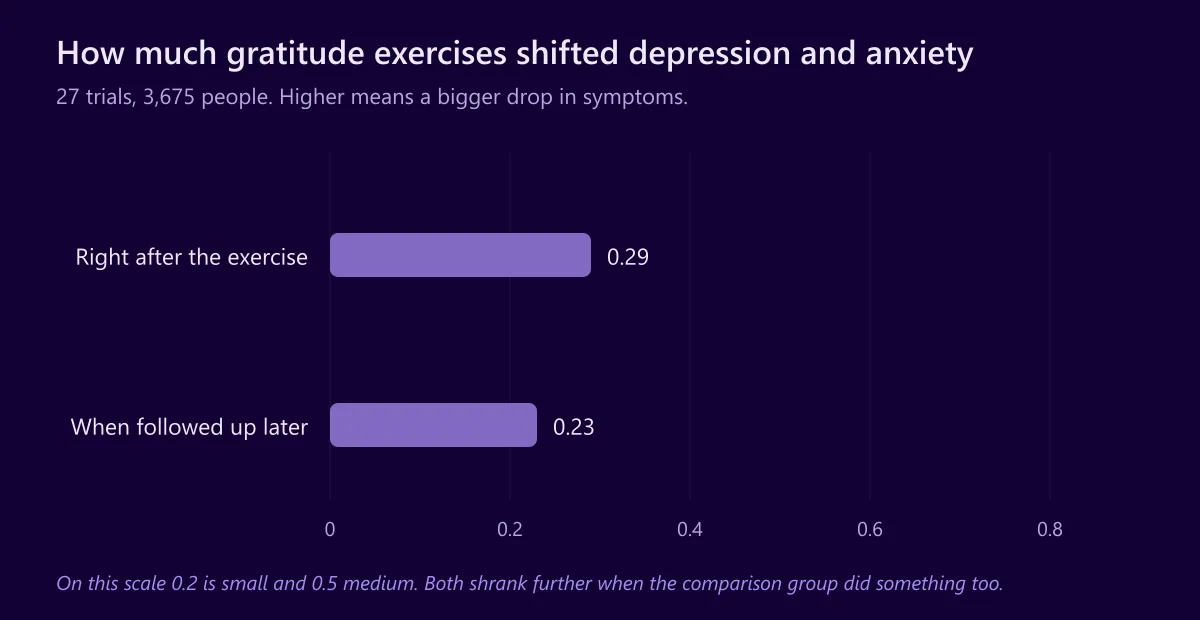
A separate review looked at 27 trials covering 3,675 people, and asked whether gratitude exercises reduced symptoms of depression and anxiety.
The effect was small straight after the programme, and smaller again when people were followed up later. On the scale researchers use, where 0.2 is small and 0.5 is medium, it started at 0.29 and faded to 0.23.
Then the authors did something researchers rarely do. They ended their own paper by recommending that people trying to reduce symptoms of depression and anxiety use interventions with stronger evidence behind them.
When the people who studied a thing tell you to use something else for this particular job, that is worth more than any number in the paper.
The comparison that inflates everything
Here is the detail that explains why gratitude journalling sounds more powerful than it measures.
The effect was bigger when the comparison group was a waiting list — people who did nothing at all — than when the comparison group was given some other activity to do.
That gap is not a quirk of gratitude research. It is the single most useful thing to know about wellness claims in general. Beating nothing is easy. Beating doing something else deliberately for two minutes a night is the honest test, and far fewer things pass it.
So when you read that a practice is “proven”, the question to ask is: proven against what?
Why it still might be worth your two minutes
None of the above says don’t.
- It is free, quick and harmless. The downside risk is two minutes.
- The well-being finding is real and consistent, across 28 countries, and held up under the checks that sink a lot of popular findings.
- It appears to work by adding good feelings rather than removing bad ones, which is a genuine thing to want and is not the same as treatment.
That reframing is the useful takeaway. If you have been doing it to fix something and concluding you are doing it wrong, you may have been holding it to a standard the research never set.
When it lands badly
Being told to count your blessings during a bad week is annoying for a reason. If your life contains a real problem, listing three good things does not address it, and can feel like being asked to pretend.
Nothing in the research suggests harm. But if the exercise makes you feel like you are failing at being grateful, stop. That is a signal, not a discipline problem. Our guide on prescriptive wellness advice and what to do instead touches on the same trap.
What else writing is good for
Gratitude is one of several things you can do with a notebook, and it is not the one with the strongest evidence behind it.
- Expressive writing — writing about a difficult experience rather than a pleasant one — has its own and rather different research, including the finding that it often makes you feel worse before it helps. Our 7-day anxiety journalling plan walks through it.
- Plain mood tracking answers a different question again: not how you feel about your life, but what your weeks actually look like. Our guide on mood tracking or journalling sets out when each one is the right tool.
Where this leaves Moodify
Moodify has a journal in it. We are not going to put a gratitude prompt at the top of it and imply that it treats anything.
What the research above supports is modest and real: a short daily practice that nudges positive feelings. That is a reasonable thing for an app to offer and a dishonest thing to sell as therapy. Our guide on whether an app can replace therapy covers where the line sits. What Moodify is lists what is actually in it.
Finding out whether it works for you
The effect sizes above are averages across thousands of people. They cannot tell you about your own fortnight, and your own fortnight is the only one you are living.
- Write your three things at the same point each day.
- Log a mood score daily, separately, including the days you skip the writing.
- Compare a fortnight of doing it against a fortnight of not.
That last step is the one almost nobody does, and it is the only one that answers the question. Our guide on spotting patterns covers reading your own numbers without talking yourself into a result, and how long until it becomes a habit explains why most people quit before the fortnight is up.
Logging takes a few seconds in Moodify, and a paper notebook does the same job. The depression self-check takes two minutes and gives you a score you can retake in a month.
If you are low enough that gratitude feels impossible rather than merely pointless, that is worth raising with a doctor. If you have been thinking about harming yourself, please talk to someone today — a doctor, a helpline, or a person you trust.
Common questions
- Does gratitude journalling actually work?
- For general well-being, yes, by a small amount. A 2025 review of 145 papers covering 24,804 people in 28 countries found a small but consistent lift, and the effect was positive in every country studied. For symptoms of depression and anxiety it does much less, and the researchers who looked at that recommended using something with stronger evidence instead.
- How long does it take for gratitude journalling to work?
- The honest answer is that the effect is small enough that you may not be able to tell from how you feel. In the review of depression and anxiety symptoms, the effect was already small right after the programmes ended and smaller again at follow-up. If you want to know whether it does anything for you, a daily mood score over a few weeks will tell you more than your impression will.
- Why do people say gratitude journalling changed their life?
- Partly because it genuinely helps some people, and partly because of how the studies were set up. Effects looked larger when gratitude was compared with a waiting list, where the comparison group did nothing at all, than when it was compared with another activity. A lot of what looks like the power of gratitude is the ordinary benefit of doing something deliberate.
- Is gratitude journalling better than normal journalling?
- Nobody can say from the evidence. They have not been properly compared head to head often enough. What the research does suggest is that the gap between any two writing exercises is smaller than the gap between writing and not writing, so the version you will actually keep up is probably the right one.
- Can gratitude journalling make you feel worse?
- It can feel hollow or irritating if things are genuinely bad, and being told to count your blessings during a hard week lands badly for good reason. Nothing in the research suggests it is harmful. But if listing three good things makes you feel like you are failing at it, that is a sign to stop rather than a sign to try harder.
- Does gratitude journalling help with depression?
- Not much on the current evidence. A review of 27 trials found only a small effect on symptoms of depression and anxiety, fading at follow-up. The authors recommended that people seeking to reduce those symptoms use treatments with stronger evidence. It is a reasonable thing to do alongside treatment and a poor thing to use instead of it.
- What should you write in a gratitude journal?
- Specific and small beats large and abstract, and three items is the usual format. The research gives no clear winner between prompts, so the practical advice is to keep it short enough that you will still be doing it in three weeks, which is the point at which most people have stopped.
Sources
- Choi, Cha, Coles & Oishi — A meta-analysis of the effectiveness of gratitude interventions on well-being across cultures (PNAS, 2025;122(28)). Preregistered; 145 papers, 163 samples, 727 effect sizes, 24,804 participants across 28 countries. Hedges' g = 0.19 (95% CI 0.15 to 0.22). Effects were larger when well-being was measured as positive affect, when several gratitude exercises were combined, and in randomised trials; robust against publication bias. Significant differences between countries, with no moderator explaining them
- Cregg & Cheavens — Gratitude Interventions: Effective Self-help? A Meta-analysis of the Impact on Symptoms of Depression and Anxiety (Journal of Happiness Studies, 2021;22:413-445). 27 trials, N = 3,675. Hedges' g = -0.29 (SE 0.06) at post-test and -0.23 (SE 0.06) at follow-up. Effect sizes were larger for studies using waitlist rather than active control conditions. The authors recommend that individuals seeking to reduce symptoms of depression and anxiety engage in interventions with stronger evidence
- US National Institute of Mental Health — depression
General information, not medical advice. See our editorial policy for how these guides are written and corrected.