Mind Matters
Does Listening to Music Actually Help Your Mood?

Yes, by a small but steady amount. The big numbers you have read are not about listening at all. They come from music therapy for depression. That means a trained therapist, usually making music with you rather than playing it at you, on top of the treatment someone was already having. A 2017 review found a large benefit there. It rests on four small trials covering about 219 people, and the range runs from tiny to huge. Listening is a different question. A 2026 review asked it directly. It put everyday listening next to structured programmes and found both landed near 0.3 on anxiety, low mood and wellbeing. That is small, and it is real. The gap between the two was not clear enough to call. One hint did come out of it: taking part, rather than only listening, went with stronger effects. So a playlist is worth having and is not a treatment. That is about where we would put the audio in our own app.
Music helps your mood. Nobody needs convincing, and the research agrees.
The trouble starts with the size of the claim, because two very different activities get reported under the same word.
The big number, and what it is actually about
If you have read that music has a large effect on depression, the source is almost certainly a 2017 review of music therapy.
It found a large improvement in depression when music therapy was added to the treatment someone was already having. The reviewers called the effect large and rated the evidence moderate in quality.
Worth knowing exactly what produced it:
- Nine studies, 421 people in total, and the headline figure rests on four of them covering about 219.
- The range around that figure runs from barely anything to enormous. It is a large average with a lot of room either side.
- It was an add-on, never a replacement for treatment.
- Quality of life did not improve, on weaker evidence.
- Compared against psychological therapy rather than usual care, there was no clear difference either way — though that comparison rested on poor evidence.
And the crucial one: music therapy is a trained therapist in a room with you, usually making music together rather than playing it at you. Whatever produced that result, it was not a playlist.
What listening on your own does
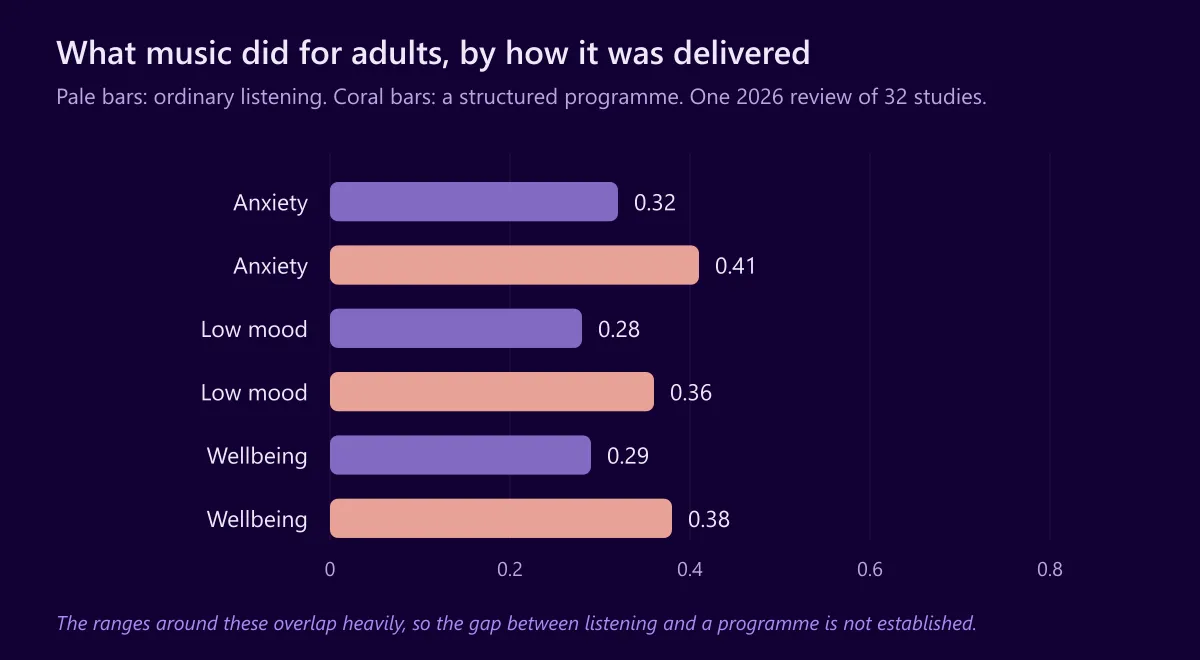
A 2026 review asked the more ordinary question. It gathered 32 studies and deliberately split them: sixteen on everyday listening, sixteen on structured music programmes, so the two could be read side by side.
Listening on its own:
- Anxiety, 0.32, where 0.2 counts as small and 0.5 as medium.
- Low mood, 0.28.
- Wellbeing, 0.29.
Structured programmes came out a little higher on all three: 0.41, 0.36 and 0.38. The reviewers were careful here. The ranges around those numbers overlap heavily, so the gap between the two is not established.
The useful summary is that both are small and real, and that nothing in this review resembles the large number above.
So which is it?
Both, and they are answers to different questions.
The 2017 review asked what a therapist can do for someone with diagnosed depression. The 2026 review asked what music does for adults in general, however it reaches them. A large effect in a small trial and a small effect across a whole population are not in conflict. They rarely are. Our guide on whether gratitude journalling works runs into the same pairing.
What would be wrong is to take the first number and attach it to the second activity. That is the move almost every article about music and mental health makes, and it is the reason people expect more from a playlist than a playlist can give.
The one hint about mechanism
The 2026 reviewers looked at what distinguished the stronger results from the weaker ones across their studies. Four things lined up with bigger effects: older participants, people with a diagnosed condition, longer programmes, and taking part actively rather than only receiving.
That last one is the interesting one. Singing, playing, moving to it — on this evidence those sit above passive listening, which fits the therapy result rather neatly.
It is a pattern across studies rather than a test of the question, so hold it loosely. But if you were choosing between putting an album on and actually playing something badly for twenty minutes, the evidence mildly favours the second.
The honest state of this evidence
- The big result is four small trials. That is the single most important thing to know about it.
- The listening results show some sign of small-study effects. That is the pattern you get when small studies finding nothing quietly go unpublished.
- Overall confidence for the emotional benefits was rated moderate, which for this field is reasonably good.
- Nothing suggests harm. Across both reviews, almost no study reported music making things worse.
So: a small, dependable, essentially free benefit, and a large one that belongs to an activity involving a trained professional.
Where this leaves Moodify
This is the rare post on this site where the evidence supports something we actually ship, so it is worth being careful rather than pleased.
Moodify has audio in it. On the evidence above, that is worth having — a small, real effect, roughly the same size as most things we write about here.
Two commitments follow from that, and they are the reason this post exists.
We are not going to call it therapy. The audio in the app is audio. The large number in this post was produced by a person in a room, and attaching it to a track list would be the exact error described above.
It is not behind the paywall, and it is not going to be. A benefit this small and this cheap to deliver has no business being a reason to charge someone. If audio helps you a little on a bad evening, that should not depend on whether you subscribed.
Our guide on whether free mental health apps are any good sets out how we think about that line generally, and what Moodify is lists what is actually in it.
Using it deliberately rather than passively
If music is one of the things you reach for, it is worth knowing whether it works for you and when.
- Log your mood daily, at the same time.
- Note whether you listened deliberately — not background music while doing something else, but putting something on because you wanted it.
- Note roughly what kind. One word.
- Read the month rather than the evening.
There is a reason to log rather than trust your sense of it. Music turns up on bad days more than good ones, because that is when people reach for it. That alone can make a thing that helps look like a thing that shows up in trouble. Our guide on spotting patterns covers how to read around that, and how to use soundscapes for better sleep covers the narrower night-time version of this question.
Logging takes a few seconds in Moodify, and a notebook does the same job. The depression self-check takes two minutes and gives you a score you can retake in a month.
If low mood has lasted weeks and music is the only thing touching it, that is worth raising with a doctor rather than managing alone — the treatments with the large numbers behind them are the ones involving people. If you have been thinking about harming yourself, please talk to someone today — a doctor, a helpline, or a person you trust.
Common questions
- Does listening to music actually help your mood?
- A little, and fairly consistently. A 2026 review covering 32 studies found everyday listening improved anxiety, low mood and wellbeing by around 0.3, where 0.2 counts as small. Almost no study in it found music made things worse.
- Why do some articles say music has a large effect on depression?
- Because they are describing music therapy, not listening. A 2017 review found a large benefit when music therapy was added to someone's existing treatment for depression. But that came from four small trials covering about 219 people. The range of the result ran from small to very large.
- What is the difference between music therapy and listening to music?
- Music therapy is run by a trained therapist. It usually means making music together rather than being played to. Listening is what you do with a playlist. The two are studied apart, and they produce very different numbers. Those numbers do not carry across.
- Is a structured music programme better than just listening?
- Slightly, on the numbers, but not clearly enough to say so. In the 2026 review the structured programmes came out a little ahead on all three measures. The ranges around those figures overlapped heavily. The reviewers said plainly that the difference is not established.
- Does playing an instrument help more than listening?
- Possibly. The 2026 review found that taking part, rather than only receiving music, went with stronger effects. So did older age, having a diagnosed condition, and longer programmes. That is a pattern across studies rather than a direct test of it.
- Does sad music make you feel worse?
- These reviews did not test it, so there is no good answer here. They did find that almost no study reported music making mood worse overall. That is some reassurance. It is not an answer about any one kind of music.
- Can a music app treat depression?
- No, and nobody should claim it can. The evidence for a large effect comes from a therapist working with someone alongside their existing treatment. An app plays audio. That is the small-effect version of this. It is worth having on those terms, and not worth relabelling.
Sources
- Aalbers et al. — Music therapy for depression (Cochrane Database of Systematic Reviews, 2017; CD004517.pub3). Nine studies, 421 participants, 411 in the short-term analysis. Music therapy plus treatment as usual versus treatment as usual alone: clinician-rated depressive symptoms SMD -0.98 (95% CI -1.69 to -0.27; 3 RCTs and 1 CCT, n = 219) and patient-reported depressive symptoms SMD -0.85 (95% CI -1.37 to -0.34; 3 RCTs and 1 CCT, n = 142), described as moderate-quality evidence of large effects. No difference in adverse events. Music therapy plus usual care was superior for anxiety and functioning, but not for quality of life (SMD 0.32, 95% CI -0.17 to 0.80, n = 67, low-quality evidence). No significant difference was found against psychological therapy, on very low to low quality evidence
- Liu — Psychological effects of music listening habits on emotional wellbeing and cognitive performance in adults: a systematic review and meta-analysis (Frontiers in Psychology, 2026;17:1846437). 32 studies, 16 on music listening and 16 on music-based interventions, searched to March 2026; risk of bias by ROBINS-I and RoB 2.0, certainty by GRADE. Pooled Hedges' g, listening versus interventions: state anxiety -0.32 (10 studies) versus -0.41 (12 studies); depressive symptoms -0.28 (8) versus -0.36 (14); emotional wellbeing 0.29 (7) versus 0.38 (11). Intervals overlap substantially and the paper states structured interventions were only slightly higher. Interventions also produced small gains in global cognition (0.27), memory (0.24), executive function (0.22) and attention (0.19). Meta-regression associated older age, clinical status, longer duration and active rather than purely receptive formats with stronger effects. Risk of bias mostly low to moderate, with some evidence of small-study effects for emotional outcomes; overall certainty moderate for emotional benefits
- US National Institute of Mental Health — depression
General information, not medical advice. See our editorial policy for how these guides are written and corrected.