Mind Matters
Why Is Anxiety Worse in the Morning?
For a lot of people anxiety really is worst in the first hour of the day, and research backs the pattern up: when 136 adults rated their anxiety three times a day for a week, it was highest in the morning and fell towards the evening. The explanation you will read everywhere is cortisol — the surge that arrives shortly after you wake. That surge is real, but it is doing far less explanatory work than people think. Across 212 studies, psychological factors accounted for only about 1% to 3.6% of the variation in it, and the two strongest studies on anxiety and the cortisol awakening response point in opposite directions. Better-supported explanations are more ordinary: how you slept last night predicts morning anxiety but not evening anxiety, the grogginess after waking can take up to about 35 minutes to clear, and the morning is when an unstructured mind first meets the day. The most useful thing is not the general explanation but your own pattern.
If your worst hour is the one right after you open your eyes, you are not imagining it, and you are not unusual. What is worth knowing is that the explanation repeated in almost every article about this — that it is your cortisol — is much shakier than it sounds.
Is anxiety actually worse in the morning?
At a group level, yes. In a 2022 study, 136 adults rated their anxiety in the morning, afternoon and evening every day for a week. Anxiety was highest in the morning and declined towards the evening, replicating earlier work that found the same shape.
The more interesting finding was who did not follow that curve. People high in worry proneness — the trait of worrying habitually rather than occasionally — stayed anxious at roughly the same level all day. The usual daytime decline simply did not happen for them.
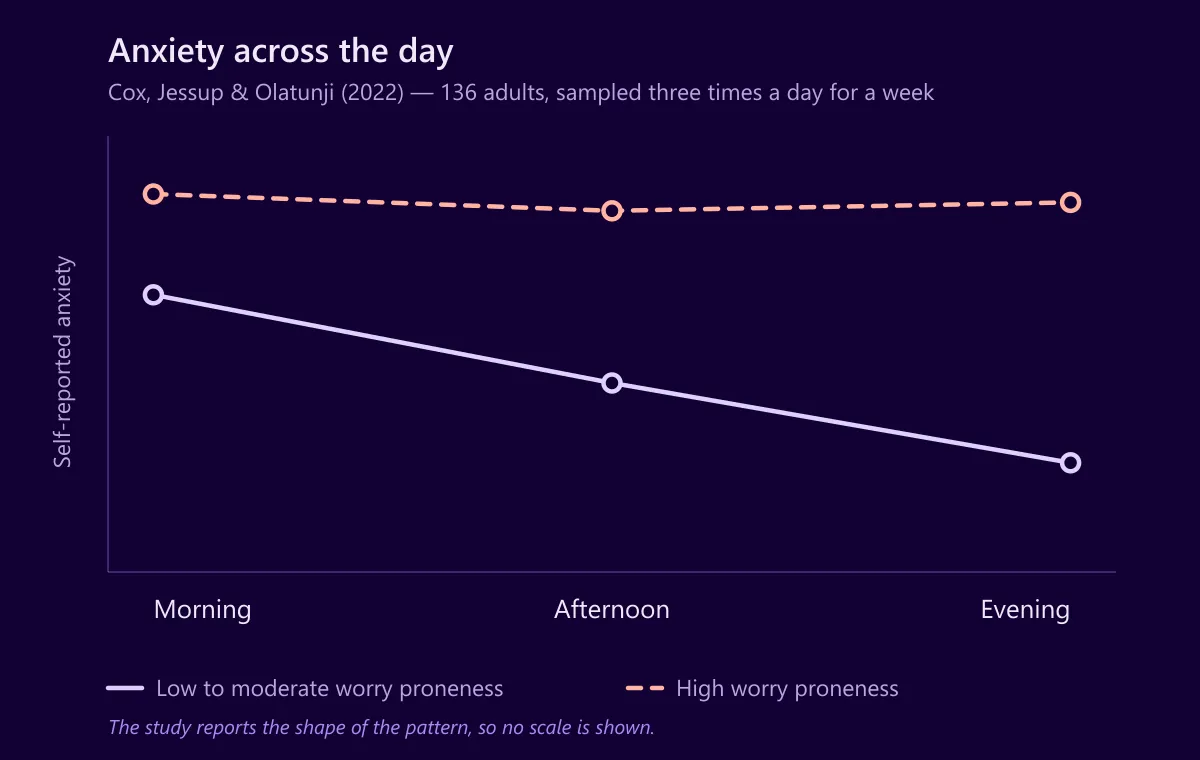
So “anxiety is worse in the morning” is really two different statements. For most people it means the morning is the peak and it eases. For habitual worriers it means something closer to the morning being where you notice it first, because it never really drops.
That is a small, non-clinical sample, and it measures three points in a day rather than a continuous curve. Treat it as evidence that the pattern is real, not as a precise map of your day.
What is the cortisol awakening response?
Cortisol follows a daily rhythm, and it does something distinctive around waking: it rises sharply, peaking roughly 30 to 45 minutes after you open your eyes, then falls away across the day. This is the cortisol awakening response, or CAR.
The size of it is genuinely substantial. Reviews put the rise at somewhere between 38% and 75% — often summarised as about 50% — and it appears in roughly three quarters of healthy people. It is one of the more reliable findings in human stress physiology.
Which is exactly why it is such a tempting explanation. There is a real hormonal surge, it happens at the right time of day, and the hormone has “stress” in its job description.
So is cortisol why anxiety is worse in the morning?
This is where the popular account falls apart, and it is worth being precise about how.
In 2017 a team pooled 709 findings from 212 studies to ask how strongly psychosocial factors — stress, mood, personality, mental health — relate to the cortisol awakening response at all. The answer: they explained roughly 1% to 3.6% of the variance. The relationships were real, but tiny. The same analysis calculated that a study would need something like 617 to 783 participants to detect them reliably, which means the great majority of published CAR studies are too small to say much.
Then there is the direction of the effect, where the two strongest anxiety studies disagree outright.
| Study | Who | What it found |
|---|---|---|
| Adam et al. (2014) | 232 adolescents, six-year follow-up | A higher CAR predicted first onset of an anxiety disorder (HR 2.20; 5.37 for social anxiety) |
| Hek et al. (2013) | 1,788 older adults, population sample | People who already had an anxiety disorder showed a lower CAR (p = 0.02), most markedly in generalised anxiety |
| Boggero et al. (2017) | 212 studies pooled | Psychosocial factors explain only 1–3.6% of the variance in CAR |
These are not necessarily contradictory. One looks at who later develops anxiety, the other at people who already have it, and chronic anxiety may down-regulate the system over years. But between them they make one thing clear: there is no simple “cortisol spike equals morning dread” mechanism to point at.
The honest summary is that the cortisol awakening response is real, your morning anxiety is real, and the link between the two is far weaker and far messier than most articles suggest.
What explains it better?
Three things, none of them exotic.
How you slept. In a study of 138 adults reporting several times a day, a night’s sleep measured against that person’s own usual sleep predicted their anxiety in the morning and the afternoon — but not in the evening. That time-limited effect is a better fit for morning anxiety than a hormone that rises in nearly everyone, anxious or not.
Sleep inertia. For a while after waking you are measurably impaired: slower, foggier, worse at exactly the kind of thinking that keeps a worry in proportion. A systematic review put the duration at anywhere from nothing to about 35 minutes, with some studies reporting effects up to an hour and a half. It gets worse if you are short on sleep, and worse again if you wake during the biological night.
One detail matters more than the rest: people are bad at judging their own sleep inertia. Subjective grogginess correlates poorly with how impaired someone actually is. So the first half hour is both the time your thinking is least reliable and the time you are least able to tell.
The shape of the morning. Waking is the one moment when the whole day is still ahead of you and nothing in it has been dealt with yet. There is no task in progress to hold your attention and no evidence yet about how the day is going. An unstructured mind reaches for whatever is unresolved, and first thing in the morning everything is unresolved.
Does morning sunlight help?
Less reliably than you have been told.
The strongest trial found here gave 69 veterans either 30 minutes of 10,000 lux light within an hour of waking or a placebo device, for four weeks. The light group improved more on PTSD symptoms — but anxiety, depression and sleep showed no difference between the groups. Other trials are small, use different doses and populations, and point in various directions.
Morning light does have reasonable support for shifting sleep timing. So if your sleep schedule is irregular, it may help you indirectly by improving the sleep that predicts your morning anxiety. That is a sensible thing to try. It is not the anxiety treatment it is usually sold as.
What helps in the first hour
Nothing here is a cure, and none of it replaces treatment if you need treatment. These are adjustments that fit what the evidence suggests is going on.
| What | Why it follows from the evidence |
|---|---|
| Give the first 30 minutes no decisions | This is the sleep-inertia window, when thinking is measurably worse and you cannot feel that it is |
| Avoid auditing the day from bed | Lying still with nothing to do is the condition the morning problem is made of |
| Treat last night as information, not failure | Short sleep raises this morning’s anxiety specifically, which makes the feeling less mysterious |
| Delay the first coffee a little | Caffeine reproduces the physical signs of anxiety, which can then be read as more anxiety |
| Get one concrete thing underway | Not for productivity, but because an occupied mind has something other than the unresolved to hold |
| Keep wake time roughly steady | The most reliable lever on morning anxiety is the sleep before it, and regular timing is what stabilises sleep |
If mornings are consistently the hardest part of your day, that is also worth saying out loud to someone. A recurring daily pattern is useful clinical information, not a complaint.
How do you know whether this is actually your pattern?
Here is what the research cannot tell you: all of the above describes averages across groups of people. It says nothing about whether your anxiety peaks in the morning, or only on particular mornings, or only after short nights.
And you are unusually badly placed to answer that from memory. Mornings blur together, bad ones are more memorable than ordinary ones, and the window you are trying to recall is the exact window when your thinking was least reliable.
The only way to find out is to record it close to the time, for long enough that a pattern can show — a few weeks, not a few days. Note when you woke, roughly how you slept, and how anxious you felt within an hour of waking. What you are looking for is not a single bad morning but the shape: whether the worst mornings follow the worst nights, whether certain days cluster, whether it eases by midday or stays flat.
That is the kind of record Moodify is built to make easy — logging a mood in a few seconds with the time attached, so the daily shape becomes visible rather than remembered. A paper notebook does the same job perfectly well. What matters is that it is written down near the moment rather than reconstructed later.
If a pattern does emerge, it is also one of the more useful things you can bring to a doctor. “I feel anxious a lot” is hard to act on. “It is worst within an hour of waking, it is worse after nights under six hours, and it eases by lunchtime” is a description someone can work with.
Common questions
- Why is anxiety worse in the morning?
- Studies that sample people repeatedly through the day find anxiety tends to be highest in the morning and lowest in the evening. The most commonly given reason is the cortisol awakening response, but the evidence for cortisol as the cause is weak. Explanations with better support include poor or short sleep the night before, sleep inertia in the first half hour after waking, and the fact that waking is when the demands of the day arrive all at once before anything has been dealt with.
- Is morning anxiety caused by high cortisol?
- Probably not, or at least not mainly. Cortisol does rise about 50% in the first 30 minutes after waking in most people, but a meta-analysis of 709 findings from 212 studies found psychosocial factors explained only 1% to 3.6% of the variance in that response. The two strongest anxiety studies also disagree: one found a higher response predicted later anxiety onset in adolescents, while a study of 1,788 older adults found a lower response in people who already had an anxiety disorder.
- How long does morning anxiety last?
- It varies. Part of what people call morning anxiety is sleep inertia, the grogginess and impaired thinking right after waking, which a systematic review found lasts from no time at all to around 35 minutes, though some studies report effects lasting up to an hour and a half. The anxious feeling itself tends to ease as the day goes on, unless you are prone to worry, in which case it often stays level all day.
- Why do I wake up anxious for no reason?
- Waking anxious without an obvious trigger is common and does not mean something is wrong with you. Short or disrupted sleep raises next-morning anxiety specifically, the first half hour after waking is when thinking is measurably impaired, and an unstructured mind tends to reach for whatever is unresolved. If it happens most mornings and is affecting how you live, it is worth discussing with a doctor.
- Does morning sunlight help with anxiety?
- The evidence is weaker than the popular advice suggests. In the largest controlled trial found here, 69 veterans given 30 minutes of bright light within an hour of waking for four weeks showed no greater improvement in anxiety, depression or sleep than those given a placebo device. Morning light has reasonable support for shifting sleep timing, so it may help indirectly if your sleep is irregular, but it should not be relied on as an anxiety treatment.
- When should I see someone about morning anxiety?
- Consider talking to a doctor or therapist if it happens most days, if it is changing what you do — skipping work, avoiding mornings, dreading bedtime because of it — or if it comes with physical symptoms like a racing heart that frighten you. You do not need to be in crisis to ask for help, and a recurring daily pattern is a reasonable thing to bring up.
Sources
- Cox, Jessup & Olatunji — The effects of worry proneness on diurnal anxiety: an ecological momentary assessment approach (Personality and Individual Differences, 2022)
- Boggero et al. — Psychosocial functioning and the cortisol awakening response: meta-analysis, p-curve analysis, and evaluation of evidential value (Biological Psychology, 2017)
- Adam et al. — Prospective associations between the cortisol awakening response and first onsets of anxiety disorders over a six-year follow-up (Psychoneuroendocrinology, 2014)
- Hek et al. — Anxiety disorders and salivary cortisol levels in older adults: a population-based study (Psychoneuroendocrinology, 2013)
- Clow et al. — The awakening cortisol response: methodological issues and significance (Stress, 2004)
- EASA — Systematic review of sleep inertia (2023)
- Sleep and next-day anxiety — ecological momentary assessment study
- US National Institute of Mental Health — health topics
General information, not medical advice. See our editorial policy for how these guides are written and corrected.